
 Amazon Music
 Apple Podcasts
 Audible
 Castbox
 Deezer
 Fountain
 iHeartRadio
 Pandora
 PocketCasts
 Podcast Addict
 Spotify
 YouTube
  RSS Feed
 S5E19: Greenlink West Carves a Costly Path Through Wild Nevada
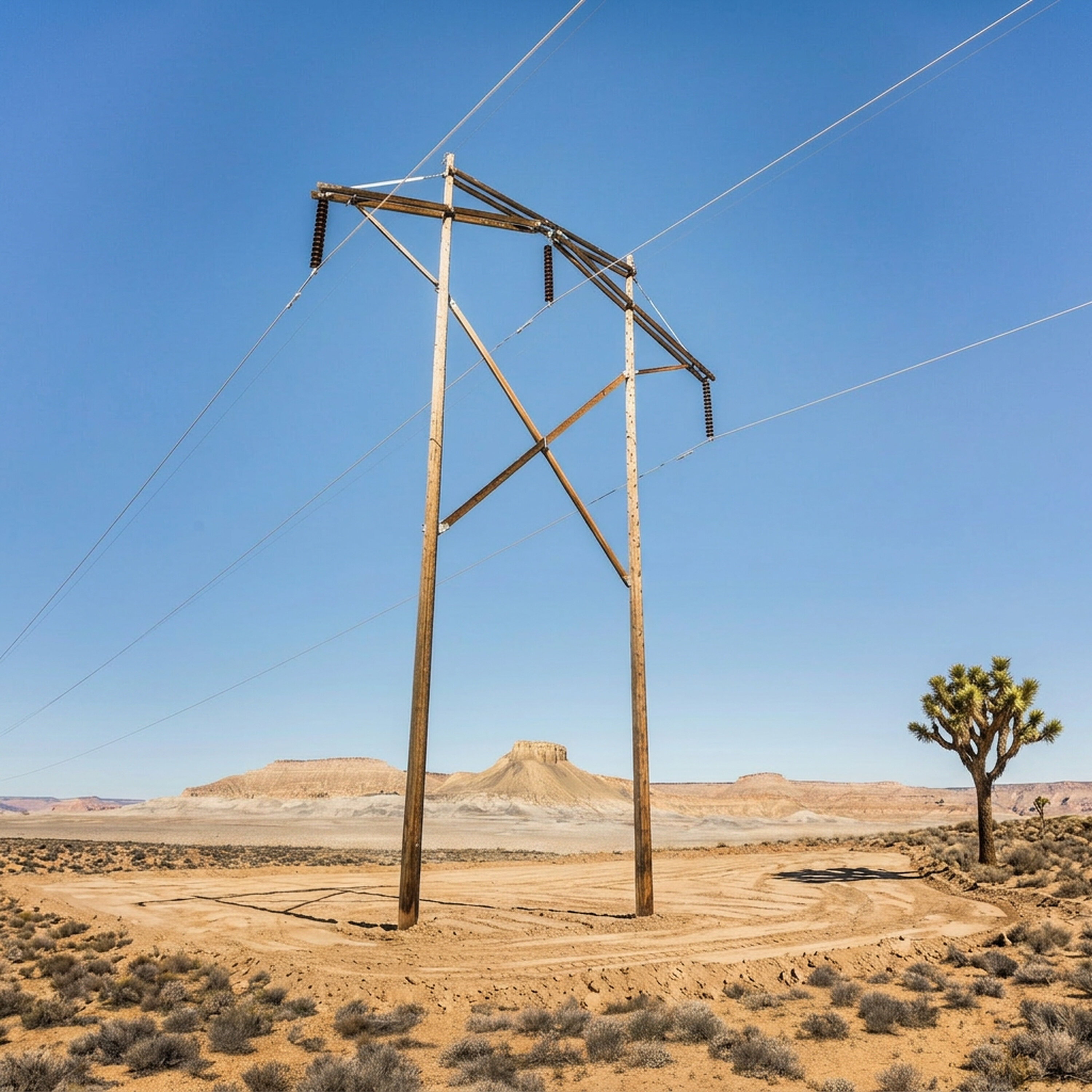
Laura Cunningham and Kevin Emmerich trace Greenlink West from the Amargosa Valley toward northern Nevada, arguing that the transmission line will accelerate utility-scale solar, gas generation and hyperscale data-center development across intact desert.
We visit the Amargosa watershed to discuss Greenlink West, a transmission project now under construction that will ship energy from Vegas-area solar facilities to data centers near Reno. This project not only threatens to enable an explosion of data centers in Northern Nevada, but also incentivizes solar developers to concentrate development in largely untouched desert in the Mojave and Great Basin.
Key Takeaways:
-
The Greenlink West transmission line is purportedly for energy distribution but appears to primarily serve data centers.
-
NV Energy's developments misalign with publicized renewable energy goals, potentially increasing the burden on natural gas resources.
-
The substation built in the Amargosa Valley indicates the impending rise of massive solar projects, with minimal benefits to local communities.
-
Sallying efforts such as the strengthening of water rights control and military navigation illustrate the complex web of interests surrounding the project.
-
The discourse reflects on broader energy infrastructure expansions, potentially at the expense of Nevada's untouched desert landscape.
Notable Quotes:
-
"It used to be the Greenlink was to fight carbon emissions and climate change. But the goal has been becoming more obvious over the years that no, it's just for hyperscale data centers that are going to suck up all of our energy and water." - Laura Cunningham
-
"What if I told you, though, that there was a pretty good chance that data centers are going to seriously damage hundreds of square miles of the wild Mojave and Great Basin deserts in the state of Nevada?" - Chris Clarke
-
"This public land needs to be put to use and it's not for people." - Laura Cunningham
-
"The primary reason that so much solar was associated with Greenlink is because it was supposed to replace fossil fuel plants... they're gonna just go with the flow with whatever market is available." - Kevin Emmerich
-
"To me, this is such an interesting area because 30 air miles that way is Area 51." - Laura Cunningham
Resources:
Become a desert defender!: https://90milesfromneedles.com/donate
See omnystudio.com/listener for privacy information.
UNCORRECTED TRANSCRIPT
0:00:00 - (Chris Clarke): 90 miles from the desert Protection Podcast is made possible by listeners just like you. If you want to help us out, you can go to 90 miles from needles.com donate or text needles to 53555.
0:00:18 - (Laura Cunningham): We've been fighting it all along. It used to be the green link was to fight carbon emissions and climate change. We'll get renewable energy and we'll reduce carbon emissions, and this will at least have that goal. But the goal has been becoming more obvious over the years that no, it's just for hyperscale data centers that are going to suck up all of our energy and water.
0:00:52 - (Joe Geoffrey): Think the deserts are barren wastelands, Think again.
0:01:01 - (Joe Geoffrey): it's time for 90 miles from Needles, the Desert Protection Podcast.
0:01:11 - (Chris Clarke): Thank you, Joe, and welcome to 90 miles from the desert Protection Podcast. I'm your host, Chris Clarke. You hear a lot these days about opposition to data centers. People are objecting to the impacts on their local communities. Next to where the data centers are being planned, they have concerns about noise pollution, air pollution, about using up scarce water resources, about the impact that these centers are having on their utility bills or are likely to have on their utility bills. And those are all really crucial concerns.
0:01:42 - (Chris Clarke): What if I told you, though, that there was a pretty good chance that data centers are going to seriously damage hundreds of square miles of the wild Mojave and Great Basin deserts in the state of Nevada? Well, last week I joined my friends Laura Cunningham and Kevin Emmerich out in the field. They have been tracking GreenLink West and similar transmission projects for a number of years. And the three of us talked a bit about just how the data center boom is threatening western Nevada and some of the most beautiful, untouched and intact desert ecosystems that North America has to offer.
0:02:17 - (Chris Clarke): And we'll get to that. First, though, I want to thank our newest donor to the Desert Advocacy Media Network, which is 90 miles from Needles nonprofit mothership, Kevin Garcia. Welcome aboard, Kevin, and thank you for the very kind note. I will be reaching out if you want to join Kevin in supporting the work we do here. You can go to 90miles from needles.com/donate and pick a size and frequency of donation that makes sense to you.
0:02:41 - (Chris Clarke): You can also help us hire up and coming desert environmental journalists by going to 90milesfromneedles.com/Fellowship that'll help us get more voices on here besides mine. We appreciate you thinking about donating to us, but for now let's head to Route 95 in western Nevada, northwest of Las Vegas and pretty close to the eastern boundary of Death Valley national park, where I Am trying to keep up with Laura and Kevin in their vehicle as we head to a good vantage point to look at the construction project GreenLink West.
0:03:41 - (Chris Clarke): So we are heading north on US 95 from Lathrop Wells which is the route I took from Las Vegas last night. And all along the route from Tule Spring Springs to here, there is a chain of footprints for each transmission tower.
0:04:18 - (Laura Cunningham): I'm Laura Cunningham, co-founder of Basin and Range Watch and California director of Western Watersheds Project. And yeah, we've lived out in the Death Valley National park region for 24 years now, so just loving this headwaters of the Amargosa River.
0:04:36 - (Kevin Emmerich): And I am Kevin Emmerich. I also am one of the co-founders of Basin and Range Watch and Laura's partner. And we have been following renewable energy essentially since 2009 and it's brought us here. We're finally seeing it show up right at our doorstep.
0:04:57 - (Chris Clarke): What are we looking at here Laura?
0:04:59 - (Laura Cunningham): This is the GreenLink west transmission project approved and now under construction. We're looking at 180-foot steel rusted colored H pole tower just like in the middle of this beautiful Amargosa desert. And they haven't gotten the heavy lift helicopter yet to string the wires. And as you can see, I mean they're still marching this construction down the valley. So this went up in the spring and you know it has this deep foundation, there's this new cement pads.
0:05:37 - (Laura Cunningham): They cleared quite a lot of desert for each pole set to get their giant cranes up. So yeah, we've been watching them construct this thing even though we've been fighting it for years.
0:05:48 - (Chris Clarke): Yeah, looks like around half an acre cleared for this one.
0:05:52 - (Laura Cunningham): Yeah, every H pole has a half-acre cleared. I don't know, just so they can drive around with their construction crews I guess.
0:06:01 - (Chris Clarke): And so this runs from northern Las Vegas to…
0:06:04 - (Laura Cunningham): actually Apex, a big center in northeastern Las Vegas actually bright by 15 which has about five natural gas plants. And then it goes along northern Las Vegas, cuts through Tule Springs National Monument on a corner which we think is a really bad precedent and then heads up 100 miles up here, bypasses Beatty and then basically it ends at the Tahoe Reno Industrial center which is east of reno and on 80.
0:06:43 - (Laura Cunningham): And that's kind of the interesting part of this whole story because that is where they're doing a bunch of huge hyperscale data centers. And so NV Energy has not been admitting the purpose of this thing. You know, they'll say it's for reliability and you know, making sure we have extra transmission for redundancy of our line. But when you look at where it begins at natural gas power plants and then where it ends at a bunch of, like the Amazon Gigafactory, there's like a lithium battery recycling plant and a bunch of data centers. Microsoft is putting up two new data centers, and there are three forked prongs of this line up there at three different substations. And two of them go right to the heart of this data center area in this industrial center called Tahoe Reno.
0:07:40 - (Laura Cunningham): So we're like, we've been asking NV Energy. So this is really for data centers, right? And they're like, no, it's for redundancy and reliability. But all the little towns along this green Link, we don't get any of this power. I mean, we're actually in the Valley Electric area. But Hawthorne doesn't get any of the power. Yarrington doesn't. There's no off taking power to small towns. It all takes up power from natural gas. And then there'll be huge solar projects built here. We'll talk about that next.
0:08:14 - (Laura Cunningham): And then it all feeds into this area that happens to have a bunch of data centers and new ones going in.
0:08:21 - (Chris Clarke): Yeah, it seems like we were talking about data centers when we first heard about GreenLink west, but data centers weren't as big or controversial of an issue six or seven years ago as they are now. So it's kind of interesting how this has sort of snuck in a little bit, and it seems like it's not getting a lot of the attention that some data center proposals are getting, you know?
0:08:43 - (Laura Cunningham): Exactly. I mean, you remember that, too, way back several years ago when they were scoping this project, I think they were mentioning data centers, and I would raise my hand at the public meetings. Go. So this is basically for data centers. And Bureau of Land Management would say, no, no, no, no. It's for resiliency and redundancy and growth and, you know, it's for everybody. But as the time progresses and we see it now approved and under construction, and then we see the end points are, I mean, they're upgrading the Comstock Meadows substation for data centers, and this is right where that ends.
0:09:22 - (Laura Cunningham): So, yeah, you have a good memory on that. And we've been fighting it all along. It used to be the green Link was to fight carbon emissions and climate change. We'll get renewable energy and we'll reduce carbon emissions, and this will at least have that goal. But the goal has been becoming more obvious over the years that, no, it's Just for hyperscale data centers that are going to suck up all of our energy and water.
0:09:51 - (Kevin Emmerich): The Senate bill that GreenLink was tied into essentially did say at one point that new electrical generation in Nevada will not be from fossil fuel. They're exempting that a little now because the governor, he's sort of an awe of the above energy guy. And they do need some of this fossil fuel to get their data center plan going. But the primary reason that so much solar was associated with Green Lake is because it was supposed to replace fossil fuel plants. And then NV Energy came in and it's really capitalizing on that. I think the line here is to sell energy to whoever and then, you know, they're gonna just go with the flow with whatever market is available.
0:10:45 - (Laura Cunningham): And that water truck that just went by, we've been watching dozens of water trucks like that a day, and we've even followed them sometimes. They're either going to the mine up here, North Bullfrog and the Arthur Exploration, or for construction of Green Lake. And we follow them and they go to alfalfa fields. And now they're just filling truck after truck with our groundwater from the Amargosa River headwaters area.
0:11:13 - (Laura Cunningham): Quite a lot of water was used for the substation, which we'll visit next for dust suppression and, you know, whatever construction needs. But the groundwater, which Kevin has the numbers in his head pumping just for construction of this thing has been gigantic.
0:11:29 - (Kevin Emmerich): It's been by now over 2,000-acre-feet. And they're actually getting it from private water owners. But Green Lake is a major endeavor, and they've been securing water rights all throughout the line from here to Reno. But for Amargosa Valley, I would say approximately 2,000, probably going on 3,000-acre-feet of water.
0:11:56 - (Chris Clarke): That's a lot. And no power for any of the communities here?
0:11:59 - (Laura Cunningham): No, no, not at all.
0:12:01 - (Chris Clarke): It strikes me as really similar to when they still were running coal slurry from Big Mountain and nobody on the reses got any of the electricity, even though they had to. Look at this slurry line going to Laughlin, Nevada.
0:12:15 - (Laura Cunningham): We call it Greed Link sometimes because it just seems like it's, you know, ratepayers usually foot the bill for these. What's this one now? 4.2 billion just for GreenLink West. And it's become so obvious now, and I'm glad the media is finally catching on that NV Energy will basically make ratepayers pay for this construction project for data centers. And that's angered people so much now that NV Energy is sort of taking a step back and saying, well, maybe we should ask Microsoft and Switch and, you know, these other big data centers to start maybe paying for this power and the infrastructure to power their data center. So we'll see how that goes. But yeah, it's just like take our water, we get nothing out of it. Maybe a couple of jobs of people with shovels.
0:13:09 - (Laura Cunningham): But that's temporary. And to me it's just like very colonial. I call this colonial project coming into our area, taking resources, leaving.
0:13:20 - (Chris Clarke): Yep.
0:13:21 - (Laura Cunningham): We are really careful not to say it's all for data centers because that's not been an explicit purpose and need in the environmental Impact Statement. But we're just piecing together evidence that we see, you know, just the map of GreenLink West where it ends, which is data center area. There's even a new categorical exclusion that came out last week from Bureau of Land Management where they're going to loop part of GreenLink to a new substation by Silver Springs, which is east of Carson City, apparently for data centers from. Microsoft has two new data centers in Silver Springs. So we're just looking at maps and articles and things like that and going, yeah, there's a lot of evidence that this is really all for AI.
0:14:14 - (Kevin Emmerich): Now, the Bureau of Land Management at a county meeting for Lyon County, Nevada did allude to the fact that they were going to need an extra power line to get to Silver Springs. And in the BLM's words, it was for a Microsoft data center.
0:14:34 - (Laura Cunningham): Okay, there you go.
0:14:35 - (Kevin Emmerich): That's the first evidence that I've ever heard. But it's on a YouTube. It's not. There's not a document writing that I'm seeing. I know that also, if Greenlink ends up using some of its capacity to transmit to data centers, that that's not necessarily going to show up in the Nevada Public Utilities Commission. But they have to talk about new generation facilities. But as to what they're actually going to, I think they want to keep a lot of that secret because data centers are not popular at all.
0:15:14 - (Kevin Emmerich): It's amazing to me, you know, the backlash just from the one near Salt Lake City alone that I'm seeing all over the media.
0:15:24 - (Chris Clarke): It's a huge thing, obviously. I mean, we have the proposal done in Imperial county that's got the entire county up in arms and Project Blue and Tucson and then there's some around El Paso and Las Cruces and people are really, really upset. And you don't generally hear about transmission in those discussions.
0:15:42 - (Kevin Emmerich): I've even heard of one proposed. And it's just people talking now about Amargosa Valley not far from the Spring Meadows Road along Ash Meadow. This is a proposal that some local people have been talking about and it is a 300 some acre parcel. So it does make you wonder how legitimate is that
0:16:09 - (Chris Clarke): the solar that's being developed along the route that wouldn't be built if it wasn't for the promise of this transmission line. I know south of Pahrump there's a whole lot. What does it look like the rest of the way north?
0:16:22 - (Laura Cunningham): Well, we should jump in the car and we'll take you to this enormous substation that's over 100 acres and it's just in the middle of nowhere, so we can go there next. I mean, picture a flat creosote bur sage Mojave desert scrub, which has a lot of cryptic biodiversity. You know, it doesn't have Joshua trees and all the sexy big Mojave desert plants, but it's actually really biodiverse and they have destroyed 100 acres of it and have completed basically a huge substation. And you look around and like there's no houses.
0:17:01 - (Laura Cunningham): There's a little brick mine over there on a cinder cone, nothing else. It's next to Big Dune which has ohv. It's in view of wilderness in Death Valley national park on the eastern edge of the park. And it's all going to be for massive solar projects.
0:17:21 - (Kevin Emmerich): And to the north of here is the Amargosa Solar Energy Zone. It's not too far. We're hearing from the BLM that their activity and movement on that and it's had its name changed to the Amargosa Energy center. And that's a name that's commonly used by NextEra Energy. And so that might indicate that that big energy giant wants to develop that 7,000-acre site. And that would feed directly into this sagebrush substation that we're gonna go to.
0:17:56 - (Laura Cunningham): Yeah, they call it the Sagebrush Substation, which makes you wonder how much they know about, you know, it's the creosote zone.
0:18:02 - (Kevin Emmerich): Yeah, it's called the Amargosa substation. And then somebody had to say sagebrush,
0:18:07 - (Laura Cunningham): you know, even though the nearest sagebrush…
0:18:09 - (Kevin Emmerich): You seen one desert, you've seen them all.
0:18:11 - (Joe Geoffrey): Right, don't go away. We'll be right back.
0:18:15 - (Chris Clarke): About this episode's contribution by Fred Bell, nature recordist Fred writes to us, oddly enough, one of the quietest places that I know is only a few miles north of Las Vegas, high up in the sheep range, within the Desert National Wildlife Refuge is a small forest with a piped spring and an old log cabin. We can thank the US Air Force for this quiet patch. Desert National Wildlife Refuge borders the Air Force's training range, so no private or commercial aviation is allowed within many miles.
0:18:44 - (Chris Clarke): Unfortunately, you will hear fighter jets, but not on the weekends or holidays. It's one of the few places where I've experienced 24 hours of continuous quiet. That sounds good to me, Fred. Let's listen.
0:20:31 - (Joe Geoffrey): You're listening to 90 miles from Needles, the desert protection podcast. Barrel cacti do not contain drinkable water.
0:20:46 - (Chris Clarke): Driving past this immense substation, among the biggest I've ever seen in my life that seems to still be under construction. There are cranes and other construction equipment in various places around on top of piles of gravel. The whole area is raised on a berm. It looks to be about 6 or 8ft high, maybe. Pulling off in a wide spot in the road.
0:22:03 - (Chris Clarke): This is a big substation.
0:22:06 - (Laura Cunningham): Yeah, it's over 100 acres. On habitat for desert tortoises. We see a lot of kit fox here, burrowing owls. And there are an endemic species of scorpion and an endemic species of tarantula, the atomic tarantula live here and only in this Amargosa Valley flat desert. And Bureau of Land Management found possibly a new species or subspecies of scorpion that's being described by science now. And invertebrates have zero protection.
0:22:41 - (Laura Cunningham): And so we are actually trying to do things like nominate part of this for an area of critical environmental concern so that at least we can save some of the scorpion habitat and not just have giant utility scale solar projects around the substation.
0:22:59 - (Chris Clarke): It will almost certainly not surprise anyone that knows me at all that I couldn't let go of the idea that there is a species of spider out in the desert called the atomic tarantula. So I looked it up and about 10 years ago there was a study by a team of arachnologists who took apart one of the genera of tarantulas, lumping a bunch of species together, but also describing 14 new species. One of them, Aphanopelma atomicum, was discovered near the Nevada test site. It is one of the smallest species of that genus of tarantulas.
0:23:36 - (Chris Clarke): Notably, that same paper also described a new species of tarantula found near Folsom Prison. It was named Aphanopelma johnnycashi. I just really like that back to the substation.
0:23:52 - (Laura Cunningham): But let me try to describe what I'm looking at now. I mean, it's just these huge towers that seem like they're over 100ft tall, like arc towers that feed into transformers and rows and rows of smaller electrical infrastructure. And you can see the rust-colored green link H poles feeding directly into this. And we're surrounded by just open desert. There's nothing here. But where we're standing, unfortunately are applications for how many solar projects now?
0:24:28 - (Kevin Emmerich): Oh, well, like I said, we have this 7,000-acre solar energy zone which is actually being planned right now. It wouldn't be unheard of within the next year or so to see an announcement for an environmental assessment. But to the south of us we have an additional, I would say 14 to 15,000 acres of solar projects that are definitely looking to move forward. And like I said, NextEra Energy owns a couple of them and they're very in cahoots with the Trump administration.
0:25:08 - (Kevin Emmerich): They donated to the ballroom. So Nextera's solar projects are getting some movement now, at least the ones on federal lands, you know, under the Interior Department. Now also there's a smaller power line you see next to the Green Lake Tower that's called the gridliance line. That's been there for years. It's a, I believe a 230kV line and that's going to probably be upgraded. The first phase of that already got the go ahead for a major upgrade and that's why some of the Pahrump solar projects have started to become active again in the Federal Register up here.
0:25:53 - (Kevin Emmerich): That's probably going to be 2027, 2028 until that is upgraded. But when that happens, that will greatly increase the capacity for solar here outside of what this substation can handle, which I believe is over 1 gigawatt. I mean, look at the size of it. It's one of the biggest ones I've seen. And it's just we don't know exactly what that's all going to be used for. But if the goal is to indeed hook energy into the substation to transmit it through the green link line, what are you going to put here besides solar?
0:26:37 - (Kevin Emmerich): Is natural gas feasible? Not really. It does need a lot of water, but it also needs a big pipeline. If that were to happen, it would be years from now. People have talked about hydrogen plants or these now these little small nuclear reactors and I think they're all in the testing process again. I mean, we're looking at years. And so this was really planned right in this location, at least for solar, as well as the one up there in Esmeralda county, which is just behind us in construction right now.
0:27:12 - (Kevin Emmerich): And so because of the Location of this and the size of the substation, that tells us that there is a solar future here, no matter what the Trump administration thinks of it.
0:27:25 - (Chris Clarke): We're getting a little bit of a breeze, but this doesn't seem like a good place for wind.
0:27:30 - (Kevin Emmerich): No, no, there's not really that many wind applications out here. There actually was one south of Beatty and the Bullfrog Hills, and that was in 2010, but that just got pooled because they just couldn't find any viable wind. It was either no wind or too windy, but it was nothing steady. That was economic. But just to the south of us, there is a major wind application associated with Green Lake. It's in Rock Valley and that maybe about 20 miles or so south of here, but it really hasn't moved.
0:28:07 - (Laura Cunningham): So I look at this substation here in the middle of a remote wild valley, and it's like to me a giant knife just stabbing the Amargosa Desert in the heart. Because now this is going to look like the Yellow Pine Solar Project or Boulder City, all the sprawling solar Chuckwalla Valley. I mean, that's the future of this area. And at least in the past, okay, it's for climate change, but now it's just for data centers. I mean, that we think that's our evidence.
0:28:37 - (Laura Cunningham): There is another piece of evidence. The cities around Lake Tahoe have apparently been for years relying on NV Energy for power to power Lake Tahoe, all the cities there. And NV Energy says, well, we're going to have to have you get your own power because we need all of this power for the data centers and Tahoe, Reno, including apparently Greenlink west that was mentioned in the article. So to me it's become not only are we shifting the goal away from climate change, but we're shifting the goal away from people.
0:29:15 - (Laura Cunningham): I mean, it's all for AI now. And I was actually just up in South Lake Tahoe area a couple of weeks ago and people there are up in arms and amazed that this is happening. And I heard talk of they may try to form their own co op utility and then try to, you know, rent existing transmission lines, maybe get it from Oregon, who knows? So they're, they have a year until NV Energy says you've got to find your own power. But that's what it's come to. Now, this substation I'm looking at benefits nobody locally.
0:29:51 - (Laura Cunningham): It seems to be a Silicon Valley tech bro project. To me, this is such an interesting area because 30 air miles that way is Area 51. And you know, The Nevada Test Site and the Air Force's Nevada Test and Training Range. Big, huge military complex. And so, yeah, like right that way beyond is Yucca Flat. So they have blown up a lot of atomic bombs in this area. So, yeah, there's quite a history here. And I'm looking right now at a new road bulldozed into these hills south of the Bear Mountains that just appeared a couple of weeks ago with construction cranes and excavators along it.
0:30:45 - (Laura Cunningham): That's where Greenlink will go towards the military and Department of Energy boundaries. And they have had problems with that, apparently. Greenlink to avoid. You know, we're at a pinch point here in the Upper Amargosa river where we have Death Valley national park on that side and military and DOE Land on that side. And then we have a big mining exploration area filling in a lot of in between. South African, Anglo, Ashanti Gold has bought up all the mining claims around and is actively searching for gold.
0:31:24 - (Laura Cunningham): So Greenlink tried to get around all of this and weave their way through without going right through people's houses and ended up getting really close to the Air Force Test Range boundary, way to the east over there. And kind of an interesting story that we've seen through a couple of FOIAs and then piecing things together, talking to Bureau of Land Management and even the military. Suddenly the military got really angry at this, saying, well, we have very low flying military flight areas here and your towers are going to be almost 200ft tall and we go close to the ground, so move it.
0:32:06 - (Laura Cunningham): This is actually in some emails we found and Bureau of Land Management and NV Energy pushed back and said, no, this is the only place we can take this. So long story short, it's still being worked out, I think, between the military and NV Energy, you know, two kind of very powerful entities. But I mean, to me it looks like they NV Energy won out and they're building it. They're heading through the narrow gap here in land management boundaries.
0:32:37 - (Laura Cunningham): And unfortunately, right where we live north of here, we'll start to see the towers go up in our distant view, which is kind of heartbreaking, but that's Nevada now. The Nevada landscape now has become one where it was just open and wild and a lot of public land to: “Well, this public land needs to be put to use and it's not for people.”
0:33:02 - (Kevin Emmerich): And if I could add, we are looking south again at the smaller gridliance network and probably, as I mentioned before, by 2028 that'll be upgraded to a 500-kilovolt line, the towers will be taller. But what's important here is that they want to upgrade or build five new substations just in this area. So that's from the south Amargosa Valley just up to Beatty. And so that along with the capacity created by the NV Energy substation is actually alarming to us because that indicates that this area is probably going to see a lot of energy development.
0:33:52 - (Kevin Emmerich): Sam.
0:34:22 - (Chris Clarke): And that, by way of full disclosure, is where the battery ran out on my recorder without me noticing. Fortunately, we're only missing a few minutes of our conversation, the most important part of which is that you can find out more on Green Lake west and it's equally evil twin Green Lake north which threatens the US 50 corridor by going to basin and rangewatch2.org basin and range watch numeral2 it's Laura and Kevin's sad conclusion that there's very little average listeners can do to get in the way of Green Lake west at this point.
0:34:55 - (Chris Clarke): That's pretty much for the lawyers and there is a lawsuit happening now, but there's still a chance to slow down or maybe even stop the Green Lake north line, which like I said, would go along the route of US 50, utterly changing the landscape around the Loneliest Road in America, which won't be all that lonely anymore. Although maybe it'll be a little bit more lonely because there won't be as many sage grouse along the way. In fact, the day after I spent time with Laura and Kevin, I was driving on US 50 from Fallon to Ely, Nevada and about six miles west of Ely I saw a bulldozed lay down area that had pieces of transmission line pole that looked very much like what was going in along the Green Link west line. Whether that pole is for Greenlink North or something else entirely, I don't know. But Nevada is getting carved up folks, and the people that care about Nevada could use your help.
0:35:47 - (Chris Clarke): Check in our show notes for links to Basin and Range Watch as well as other groups working on this issue and we will include a link to that study on the Atomic Tarantula. Again, thank you so much to Kevin Garcia for joining our contributors. 90 miles from needles.com donate I gotta say, given recent events, it was really good to get out on that Loneliest Road. Spent some time appreciating what there is to offer along the way. I stayed overnight in Ely, which I haven't done in 42 years.
0:36:18 - (Chris Clarke): Ely hasn't really changed a huge amount in the interim that I can see. It's a little bigger but it's basically the same. Also, shout out to James and Liz Woolsey, who gave me a wonderful welcome at their Bristlecone General Store in Baker, Nevada, Gateway to Great Basin national park, where I did an amazing hike up above 10,000ft. The Bristlecone General Store is a wonderful place. It's the best bookstore in Baker, Nevada, without a doubt, and probably the best bookstore for about 150-mile radius, which honestly doesn't expand the field of bookstores all that much. But it's a great place. Well worth the stop.
0:36:57 - (Chris Clarke): James and Liz, thank you so much for the welcome. I'll have more on my Route 50 trip in an upcoming episode, including a jaunt over to a trilobite quarry in Utah where I did a little bit of digging. Again, thanks to those of you who've reached out to comment on recent family events. On this end, we are hanging in there. Remember, take care of yourselves because the desert needs you.
0:37:24 - (Joe Geoffrey): And that brings us to the end of this episode of 90 Miles from Needles, the Desert Protection Podcast. You can find show notes for this episode along with links and background@90miles from needles.com we're also on social media. You can find us on Facebook, Instagram, Bluesky and Threads. Just search for 90 miles from Needles and if you'd like a more direct line, you can reach us on Signal at HEY90MFN.67.
0:37:59 - (Joe Geoffrey): If you'd like to support the show, you can make a donation of whatever size and frequency feels right to you at 90miles from needles.com donate listener support is what makes this podcast possible. Our voiceover is by Joe Jeffrey. Podcast artwork is by Martine Moncham. Nature sounds are recorded by Fred Bell. Our theme song, Moody Western is by Bright side Studio, with additional music licensed from Independent Artists.
0:38:31 - (Chris Clarke): Other music in this episode is by JP.
0:39:28 - (Joe Geoffrey): 90 miles from Needles is a production of the Desert Advocacy Media Network.
0:39:45 - (Doc Brown): 1.21 gigawatts? Great Scott!
0:39:53 - (Marty McFly): what the hell is a gigawatt?

Kevin Emmerich enjoyed a career in the National Park Service for 20 years in 7 different National Parks and Monuments, including Death Valley National Park since 1991 (now retired). He has also worked as a field biologist for research on desert species such as the Panamint alligator lizard, desert tortoise, and Mojave fringe-toed lizard. He lives in the Mojave Desert and has followed desert conservation and land-use issues for many years. He and his wife Laura Cunningham co-founded Basin and Range Watch in 2008.
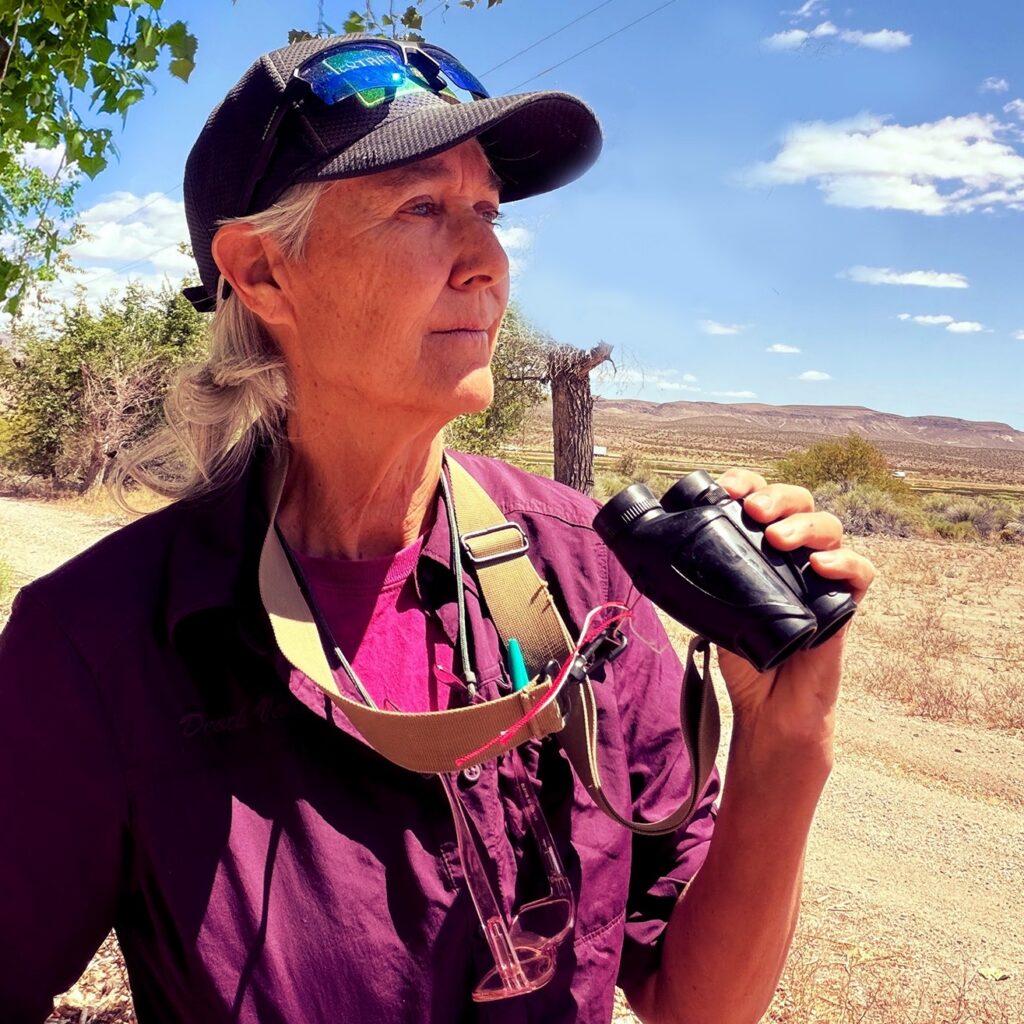
Laura Cunningham is an artist-naturalist who studied paleontology and biology at the University of California, Berkeley. She has worked field biology jobs for the California Department of Fish and Game, the United States Geological Survey, and various universities, gaining experience with such species as Owens Valley pupfish, salmon and steelhead trout, Yosemite toads, Panamint alligator lizards, and tule elk. Simultaneously, she taught herself the arts of sketching and oil painting and pursued studies of California’s historical ecology. laura currently serves as California Director for Western Watersheds Project, and co-founded Basin and Range Watch with Kevin Emmerich. An updated edition of her 2010 book, A State of Change: California's Forgotten Landscapes will be published by Heyday Books in October 2026.