
 RSS Feed
 Amazon Music
 Apple Podcasts
 Audible
 Castbox
 Deezer
 Fountain
 iHeartRadio
 Pandora
 PocketCasts
 Podcast Addict
 Spotify
 YouTube
 S5E20: Our Love for Fireworks Could Harm the Desert
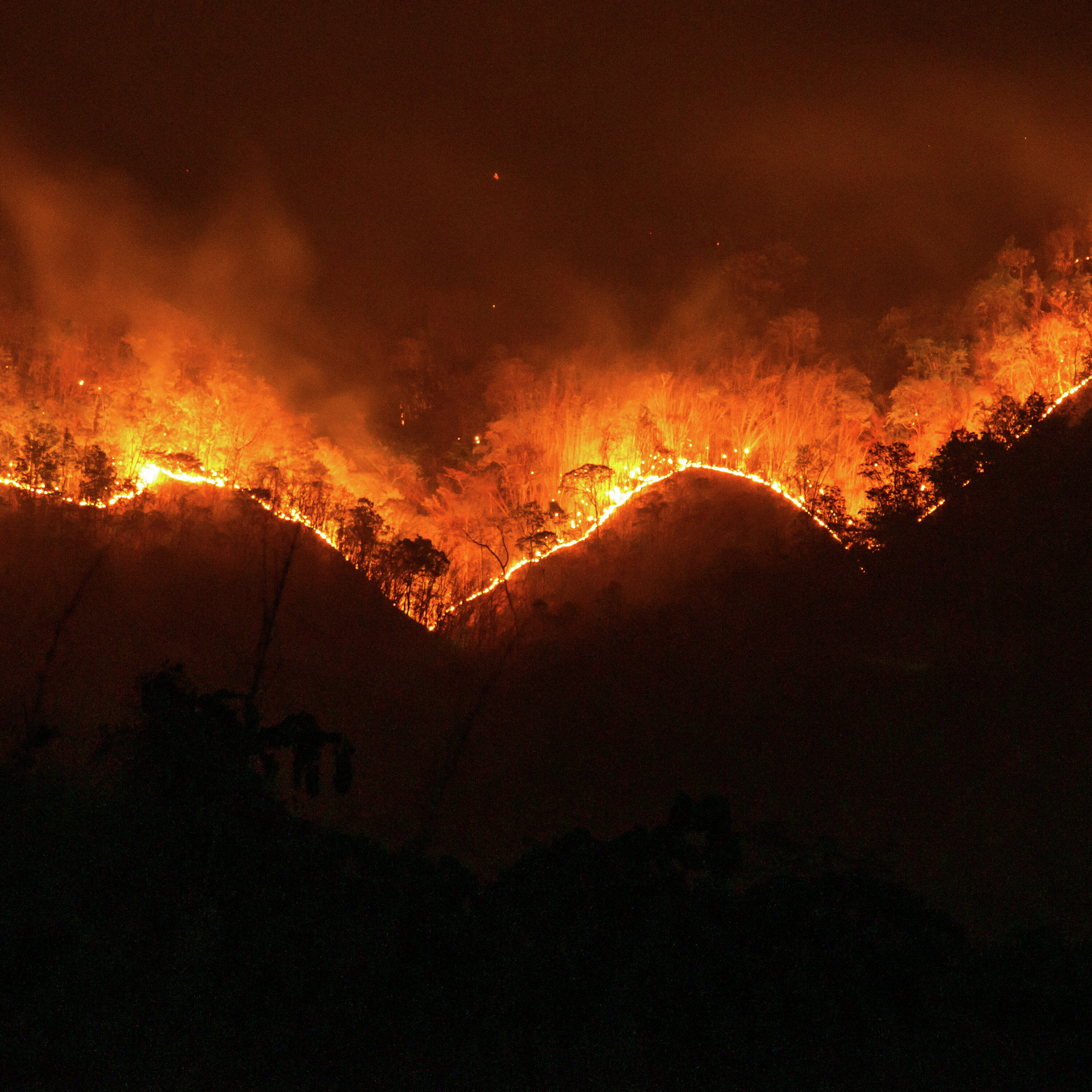
Chris examines fireworks as a recurring source of wildland ignitions, explaining how invasive grasses and depleted firefighting capacity magnify the danger while proposing safer celebrations suited to desert communities.
Against the backdrop of the current wildfire season, which has ravaged vast areas across states like Utah and Colorado, Chris draws attention to a major human activity causing these fires, particularly the use of fireworks. The discussion is timely, as it coincides with the Fourth of July celebrations, a period notorious for firework-related fire ignitions.
Listeners are taken on a journey through a detailed analysis of wildfire statistics and historical data, stressing the pervasive problem of fireworks as a leading cause of fires each year. Chris also shares insights from a significant study published in PLOS One, highlighting July 4th as a peak day for wildland fire ignitions. His narrative is woven with examples of past fire tragedies and current ongoing fires, painting a vivid picture of the dangers facing the desert ecosystems. Ultimately, Chris advocates for alternative ways to celebrate holidays without compromising the natural world, emphasizing stewardship and self-reliance cultivated by the unique desert environment.
Key Takeaways:
-
Fireworks are a major contributor to wildland fires, especially on the Fourth of July, causing around 300 wildfires annually in the U.S.
-
The introduction of invasive grasses in desert regions has increased the frequency and spread of wildfires, which were previously rare in these habitats.
-
With current federal firefighting resources strained due to staffing reductions and agency reorganizations, the Southwest faces heightened wildfire vulnerability.
-
Alternative celebrations, such as using organized drone shows in place of fireworks, offer a safer option that aligns with environmental protection goals.
-
Desert communities must balance the spirit of independence with responsible stewardship to preserve and protect their unique ecosystems.
Notable Quotes:
-
"We remember the spectacular fires. We forget the thousands of ignitions that didn't become disasters."
-
"The desert has already given us an incredible fireworks show. Thunderstorms over distant mountains, meteor showers, the Milky Way visible in the background of silhouetted Joshua trees."
Resources:
-
PLOS One Study on Wildfires: [Vachula, Nelson, and Hall, 2023]
-
App for Fire Information: Watch Duty https://app.watchduty.org/
Listeners are encouraged to tune into the full episode for a comprehensive understanding of the wildfire issues facing the desert Southwest and to gain further insights on how to engage with the natural world responsibly. Stay connected with Chris Clarke and "90 Miles from Needles" for more episodes that bring critical environmental issues to the forefront.
Become a desert defender!: https://90milesfromneedles.com/donate
See omnystudio.com/listener for privacy information.
UNCORRECTED TRANSCRIPT
0:00:00 - (Chris Clarke): 90 miles from the desert Protection Podcast is made possible by listeners just like you. If you want to help us out, you can go to 90 miles from needles.com donate or text needles to 53555
0:00:18 - (Joe Jeffrey): we've been fighting it all along. It used to be the green link was to fight carbon emissions and climate change. We'll get renewable energy and we'll reduce carbon emissions and this will at least have that goal. But the goal has been becoming more obvious over the years that no, it's just for hyperscale data centers that are going to suck up all of our energy and water.
0:00:52 - (Joe Jeffrey): Think the deserts are barren wastelands? Think again. Foreign. From needles the desert protection podcast.
0:01:12 - (Chris Clarke): Thank you Joe and welcome to 90 Miles from Needles the Desert Protection Podcast. I'm your host Chris Clark. A lot of things going on this week, so a shorter episode but as timely. I want to talk to you about how people cause wildfires because there are a lot of fires raging across the Southwest at the moment. The desert in California is not really hard hit by wildfire. That could change by the time I finish recording this.
0:01:43 - (Chris Clarke): But Utah and Colorado are having a big problem. Firefighter fatalities. Many tens of thousands of acres being burned right now. A little bit less dire, but still very similar situation in Arizona and in Nevada and New Mexico. If you want updated information, the best way to stay informed on what is on fire throughout the entire country. It's especially useful for the desert Southwest is the app Watch Duty, which you can load up on your phone or your tablet. You can also access it by way of a desktop or a laptop link in the show notes here.
0:02:25 - (Chris Clarke): But I want to talk about something that we do, especially this time of year, that makes wildfires a lot more frequent and in fact accounts for a huge number of wildfires. Something that we don't actually need to do. When I talk about this, you might be thinking about gender reveal parties because a couple of those have had regrettable effects and have been widely discussed and even derided on social media.
0:02:55 - (Chris Clarke): If you are in Southern California, you are very likely thinking of the El Dorado fire. A couple used a smoke generating pyrotechnic device during a gender reveal photo shoot in El Dorado Ranch park in Yucaipa. Not technically in the desert, but you can see it from there. It's at the base of the San Bernardino Mountains and that fire burned 22,000 acres over two months, destroyed 20 structures, cost 42 million to put out, forced thousands of evacuations and worst of all killed a superintendent of the Big Bear Interagency hotshot crew Charles Morton when flames overran firefighters constructing fireline if you're listening from Southern Arizona, you might think of the sawmill fire in 2017.
0:03:45 - (Chris Clarke): Again started during a gender reveal. A person put a target together with a bunch of colored dust. In this case it was blue. The kid is around 8 now, so we're not spoiling anything. But the person put blue dust in a box that was also full of tannerite, which is a legal explosive. It caused a fire in a grassland near the Coronado National Forest south of Tucson. Ended up burning just under 47,000 acres.
0:04:18 - (Chris Clarke): Cost 8 million to put out. In both the case of the El Dorado and Sawmill fires, the people that caused the fires cooperated with authorities and went through the court system. They honestly did not mean to start a fire. You could argue whether they should have known they would. Nonetheless, I think a lot of the discussion of both these fires focuses more on the gender reveal aspect than on the real cause of the fire.
0:04:48 - (Chris Clarke): And the cause of tens of thousands of fires, about 300 every year, namely fireworks. Legal, illegal, so called safe and sane fireworks or otherwise. In 2023, a study by Richard Vakula, Jake Nelson and Anthony hall in the journal PLOS One, they looked at the distribution of both human caused and non human caused wildland fire ignitions in the United States. The data from the federal Wildland Fire database.
0:05:24 - (Chris Clarke): They looked at almost four decades worth of stats from 1980 to 2016, and by far the single day with the most wildland fire ignitions over that period was July 4th. And July 5th is the second worst day for human caused fire ignitions. The data set recorded 600,000 fires that burned on federal lands in the U.S. between 1980 and 2016. And over that period the researchers found 11,294 wildland fire ignitions attributed to fireworks throughout the U.S.
0:06:04 - (Chris Clarke): the disastrous Palisades fire in Los Angeles last year was in one hypothesis caused by fireworks. On New Year's Eve there was a fireworks fire that had not been completely extinguished goes to sinking and that fire reignited and burned down around 6,800 structures, most of them homes. 12 fatalities. 23,448 acres burned approximately the same acreage as the El Dorado Fire, but it was more than 300 times as destructive in terms of structures lost, which is what happens when you have wildfires in a major city.
0:06:44 - (Chris Clarke): As someone who had a front row seat for the Oakland hills fire in 1991, I'm well acquainted with the potential for catastrophe in cities that isn't quite as present in wildland fires. We're coming up to the 4th of July, 2026, in a season in which the west, especially the Southwest, is already on fire. The Aspen Acres fire in Colorado has Growned by about 14,000 acres in the last day or so. 49,300 acres at last report.
0:07:20 - (Chris Clarke): It remains 0% contained, so it'll be bigger by the time you hear this. Three major fires in Utah, the Babylon fire and the Cottonwood Fire and the Wild Goose Fire. Cottonwood burned 93,918 acres. Babylon has burned 79,795 acres. And Wild Goose, 11,310 acres. In Nevada, the Grapevine Fire, now 78% contained, has burned 26,464 acres. Kane Springs Fire nearby is 17,042 acres. The Snyder Fire, where, tragically, three firefighters were killed a week ago, is at 65% containment at 30,000 acres.
0:08:09 - (Chris Clarke): Babylon Fire, just south of Canyonlands National Park. And in Bears Ears, Gold Mountain fire, northeast of Telluride at 21,000 acres. Here's the 30,000 acre Ferris fire, 10% contained. The Pocket fire north of Sedona, 23,451 acres. That's only 25% contained. The Pocket Fire in Arizona, along with the Sycamore fire and then New Mexico's Sacaton, Beehive and Macaulay Springs fires, remain active. The Sacaton Fire, the largest in New Mexico at 6,700 acres, 0% contained.
0:08:52 - (Chris Clarke): The California desert is at the moment relatively untouched. There was a small 150 acre fire in Barstow that's 25% contained. And there's a 1.5 acre fire, the Dalton Fire, in Phelan, California. So, in other words, it's a really, really bad time for those of us who either live in or visit the deserts to be having fun with fireworks in any but the absolutely most controlled conditions. For instance, the BLM has announced that they will be opening Bonneville Salt Flats to personal, private, recreational fireworks use on July 4th. No other day.
0:09:35 - (Chris Clarke): There is very little to catch on fire for much of the Salt flats. Not nothing, very little. And I think that's one of the things that drives people toward the desert as a place to set off fireworks or shoot exploding targets or whatever recreational pyrotechnics they might want to engage in because of the assumption that there is nothing out here. But fireworks don't land in empty space. They land in somebody's habitat.
0:10:04 - (Chris Clarke): Tortoise burrows and owl nests, biological soil crusts, Joshua trees, that might be 100, 50 or 200 years old creosote rings that might be older than many civilizations. And in the Mojave, at the very least, it rarely burned. Before the late 20th century, you get a lightning strike without any rain, and one Joshua tree or one smoke tree might be killed or damaged badly. But the fire wouldn't have spread because there was nothing to carry that fire from plant to plant.
0:10:39 - (Chris Clarke): There's open, bare mineral soil now. There are annual grasses that have been introduced to the desert that make fire much more of a problem. In the Great Basin, the sagebrush ecosystem burned, but there were intervals of 30 years to over a hundred years. And now with the introduction of cheatgrass, some landscapes burn every five or 15 years. That's way too frequently for sagebrush to recover. Bad for habitat. For the greater sage grouse in the Sonoran Desert, some communities burned naturally. Desert grasslands or semi desert grasslands.
0:11:18 - (Chris Clarke): But the thing people tend to think of when they talk about the Sonoran Desert, the saguaro, palo verde, creosote desert habitat generally didn't burn that often. But buffelgrass, red brome, and fountain grass have invaded along with Sahara mustard. And the saguaros are facing much the same threat that Joshua trees are in the Chihuahuan Desert. The fire story isn't as simple as in Mojave or the Great Basin.
0:11:47 - (Chris Clarke): Historically, the Chihuahuan Desert has had a mix of fire regimes. Grasslands burned relatively often, shrublands much less so. While invasive grasses have increased fire in some places, growth of woody shrubs has reduced grass fuels in other places. So it's a complicated story. Politics plays a role here, too. We do have 11,500 or more seasonal wildland firefighters hired for 2026. But given attacks on federal agencies by the Trump administration, there are fewer experienced support staff. There's less money for fuel reduction.
0:12:26 - (Chris Clarke): There is disruption from agency reorganization. There is loss of institutional knowledge that was contained in the U.S. forest Service and the BLM and other agencies with fire crews. And there is uncertainty created by reorganizing agencies during the fire season. The federal government hasn't simply cut firefighters. It has changed the institutions that support them. The administration says this will improve wildfire response.
0:12:54 - (Chris Clarke): Many experienced fire managers have expressed concern that the combination of staffing reductions, reorganizations, and reduced prevention work leaves the Southwest more vulnerable in the years to come. We have more than 400,000 acres on fire right now, more than half in Utah. Colorado comes in second before July 4th. Between 1980 and 2016, more than 11,000 wildfire ignitions from fireworks nationwide.
0:13:21 - (Chris Clarke): That's roughly 300 fireworks caused wildfires every year, two thirds of which occur on July 4th. We remember the spectacular fires. We forget the thousands of ignitions that didn't become disasters. But when they happen in habitats in the desert where fire was previously rare, they become a cumulative problem. So what's the alternative? State of Utah has banned all fireworks. Aside from that spot in the Bonneville Salt Flats where the BLM is keeping watch, the state of Colorado has banned fireworks this season.
0:13:59 - (Chris Clarke): Arizona, New Mexico, Nevada and California, not so much. I am a 12 year old boy at heart and so I understand the appeal of lighting fireworks. I'm also a dog owner. It's a shame when you have dogs and you thank the powers that be for that dog going deaf in her old age. You often hear advice along the lines of only go to municipal firework shows run by professional pyrotechnicians with the fire crews sitting right there.
0:14:31 - (Chris Clarke): And that is generally good advice. It doesn't work 100%. The Yucca Valley High School graduation ceremony in the first week of June of this year had professional fireworks operators and it still sparked a wildfire outside the campus adjacent to Joshua Tree National Park. The county fire department was able to stop forward progress on that fire at around 5 acres. There's also an increasing trend toward using drone shows instead of fireworks.
0:15:02 - (Chris Clarke): Those can be pretty impressive. The desert has already given us an incredible fireworks show. Thunderstorms over distant mountains, meteor showers, the Milky Way visible in the background of silhouetted Joshua trees. Surely we can enjoy those, even though aside from the thunderstorms, they don't make loud noises. The Fourth of July celebrates rebellion against distant authority, and that aspect of this holiday is something I kind of like.
0:15:33 - (Chris Clarke): But deserts teach another kind of independence. Accepting responsibility for your own actions because there might not be anyone around to save you from them. That self reliance is stewardship rather than rugged individualism because nobody gets anything done by themselves. Thanks for listening folks. We have one new donor to thank in this episode, Mark Nixon, who provided us with a generous donation and said, I have a podcast idea if you need one and so I'll be reaching out to you. Mark, thanks for the donation.
0:16:27 - (Chris Clarke): If you want to join mark, go to 90miles from needles.com donate if you want to give to our Fellowship for Desert Reporting to get young and emerging reporters working on desert environmental issues. A place to spread their wings and get their voices in front of your ears. You can go to 90 miles from needles.com Fellowship this has been a short episode, but you have a lot to do this weekend. Be sure and hose down anything flammable in your yard before the festivities really get underway on July 4th.
0:17:05 - (Chris Clarke): Next week, we will be talking to someone with a job I used to have, the National Parks Conservation Association's California Desert Associate Director Chance Wilcox, about a new mining proposal near Joshua Tree that has folks up in arms. Looking forward to that conversation. Been meaning to hang out with Chance for some time. In the meantime, please stay careful. Don't blow off any appendages. I have too many friends with fewer than 10 fingers as a result of childhood shenanigans.
0:17:42 - (Chris Clarke): The important thing is you want to live to shenan again. Take care of yourselves. The desert needs you.
0:17:52 - (Joe Jeffrey): And that brings us to the end of this episode of 90 Miles from Needles, the Desert Protection Podcast. You can find show notes for this episode along with links and background@90miles from needles.com we're also on social media. You can find us on Facebook, Instagram, Bluesky and Threads. Just search for 90 miles from Needles and if you'd like a more direct line, you can reach us on signal at HEY90MFN67.
0:18:27 - (Joe Jeffrey): If you'd like to support the show, you can make a donation of whatever size and frequency feels right to you at 90miles from needles.com donate listener support is what makes this podcast possible. Our voiceover is by Joe Jeffrey. Podcast artwork is by Martine Mancham. Nature sounds are recorded by Fred Bell. Our theme song, Moody Western, is by Bright side Studio, with additional music licensed from Independent Artists.
0:19:27 - (Joe Jeffrey): Sam. 90 miles from Needles is a production of the Desert Advocacy Media Network.