

 RSS Feed
 Amazon Music
 Apple Podcasts
 Audible
 Castbox
 Deezer
 Fountain
 iHeartRadio
 Pandora
 PocketCasts
 Podcast Addict
 Spotify
 YouTube
 S5E34: Chihuahuan Desert 101 with Dr. Kevin Floyd
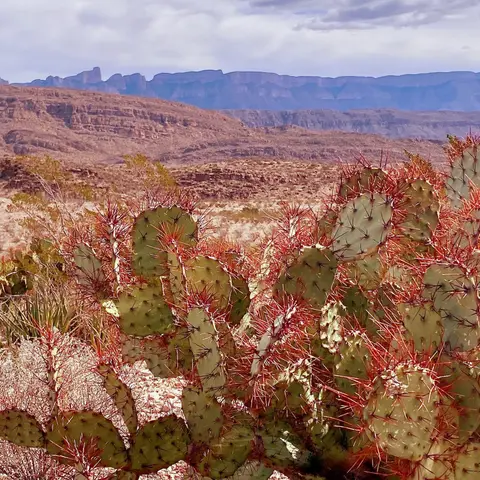
The Chihuahuan Desert rewards a closer look. UTEP botanical curator Kevin Floyd joins Chris Clarke to talk about its plants and wildlife, disputed boundaries, and the challenges of protecting biodiversity as the climate changes.
Key Takeaways
- • The Chihuahuan Desert’s small plants and less conspicuous wildlife reward close observation. • Ecological boundaries reflect overlapping influences, including climate, soils, and topography. • Conservation includes protecting movement corridors and sustaining the native plants that support food webs.
- we realized that our continent's easternmost desert, the Chihuahuan Desert, is not as well known in many ways as its sister deserts like the Mojave and Sonoran. And we had to do what we can to rectify that! So in this episode, Chris chats with Dr. Kevin Floyd, botanical curator of the Chihuahuan Desert Gardens at the University of Texas at El Paso, about what life is like in the Chihuahuan Desert. Kevin discusses:
- Elevation, winter freezes, and summer monsoon rains.
- Why no one really agrees on the precise boundaries of the Chihuahuan Desert
- The small cacti, agaves, yuccas, that thrive in the desert’s grassland landscapes
- Native bees, birds, bats, and the connections between plant diversity and animal life.
- Bighorn sheep in the Franklin Mountains, road mortality, and the case for wildlife crossings.
- How native landscaping and reduced pesticide use help support local food webs.
Our first taste of a new batch of Fred Bell’s nature recordings features coyotes around Furnace Creek Campground in Death Valley National Park. And Chris reflects on storm damage, past and future. Check on your neighbors!
Also! We've extended two deadlines. Our Fellowship for Desert Reporting is still accepting applications until October 31, and you can still be the first to submit an answer to our bird ID quiz from last week! Listen to the Fred Bell recording in S5E33; the first three emails received at chris@90milesfromneedles.com that correctly identify the birds in the audio by October 22 win a 90 Miles from Needles T-shirt.
Links and Resources:
Desert Diaries Podcast: https://www.ktep.org/podcast/desert-diaries
Chihuahuan Desert Gardens at UTEP: https://www.utep.edu/centennial-museum/chihuahuan-desert-gardens/
Kevin Floyd and Daniel Carey-Whalen staff profiles: https://www.utep.edu/centennial-museum/about/people.html
Fellowship for Desert Reporting: https://thedamn.org/fellowship
Support 90 Miles from Needles: https://www.90milesfromneedles.com/donate
Become a desert defender!: https://90milesfromneedles.com/donate
See omnystudio.com/listener for privacy information.
[00:00:00] Chris Clarke: This episode is made possible by listeners just like you, and by
[00:00:05] CMC Ad: Copper Mountain College is proud to sponsor this episode of 90 Miles from Needles, the Desert Protection podcast.
[00:00:13] Chris Clarke: How would you describe the Chihuahuan Desert to somebody that, say, lived in Tucson or in Barstow, California, or Las Vegas and was really familiar with the Mojave and the Sonoran?
[00:00:25] Kevin Floyd: We're cooler than they are. That's the both, say, in temperature and I'd say other ways as well.
[00:00:39] Joe Geoffrey: You think the deserts are barren wastelands? Think again
[00:00:48] Joe Geoffrey: It's time for 90 Miles From Needles, the desert protection podcast
[00:00:59] Chris Clarke: Thank you, Joe, and welcome to 90 Miles From Needles. I'm your host, Chris Clarke. There are four or five big deserts in North America, depending on who you ask and what your definition of desert is. For purposes of our show here, we're kind of agnostic about it, but we generally count five. We do a little poking around the edges of each one of those as well.
[00:01:21] Chris Clarke: Those five are the Mojave, where we're based. There's the Sonoran, which is probably the best known of the deserts, especially for people outside the deserts. That's the one with the saguaros. There's the Great Basin. That's a cold desert, lots of piñons, lots of junipers, cottonwoods and aspens, and sagebrush as far as the eye can see.
[00:01:42] Chris Clarke: Fourth is the Colorado Plateau, which is where the red rock is. A lot of people don't call this a desert because the precip's a little high, but it looks enough like a desert for us. That's where Moab and Shiprock and Flagstaff are. And then there's the Chihuahuan Desert, which extends northward to somewhere in New Mexico and southward well into Old Mexico, down to the state of Zacatecas.
[00:02:10] Chris Clarke: You know, you go looking for desert books, you'll find a lot on the Sonoran Desert. You find almost as many on the Mojave. There's a respectable number about the Great Basin, and the Colorado Plateau probably has the most words published per square mile of any of the North American deserts The Chihuahuan Desert isn't as well known except by, of course, the people that live there and love it and are working to protect the Chihuahuan Desert.
[00:02:39] Chris Clarke: There are some really impressive campaigns going on there. I've been consciously looking for books about the Chihuahuan Desert for the last couple of years, and I have found, I think, three that are still in print and available. But I really like the Chihuahuan Desert, and I'm heading there again, my third or fourth trip in my adult life.
[00:02:57] Chris Clarke: It's exciting. Gonna be there in El Paso at the beginning of November for the Chihuahuan Desert Conference and heading down to Big Bend after that. So I figured it was time to do a what is the Chihuahuan Desert episode. To that end, I got in touch with Dr. Kevin Floyd, who's botanical curator at the Chihuahuan Desert Gardens at the University of Texas El Paso, AKA UTEP.
[00:03:20] Chris Clarke: We had a great conversation. It was wide-ranging. It was about what is the Chihuahuan Desert, and what's it like to be there, and what's it like to live there I think you're gonna enjoy it. Got three real quick announcements before we get to that interview. No new donors since the last episode. Donations are what keep us going.
[00:03:40] Chris Clarke: If you would like to become a new donor, you can go to 90milesfromneedles.com/donate and pick a frequency and amount of donation that makes sense to you. Announcement number two, today is officially the last day that you can apply for the Fellowship for Desert Reporting, but we don't have quite as many applications as we would like to have.
[00:03:57] Chris Clarke: So I am gonna extend the deadline by two more weeks. You have till the end of this month, Halloween, Día de los Muertos, to go to T-H-E-D-A-M-N.org/fellowship to find out more. There's a link there for you to fill out the application form. I look forward to seeing your responses. Third announcement, in our last episode, we tried something a little different with our weekly recording by Fred Bell, our nature recordist friend.
[00:04:25] Chris Clarke: And that something different was me saying that if listeners can identify the birds that are in that recording and send us an accurate list, we will send the first three people with a correct answer a T-shirt in the size of their choosing. Now, we didn't get any answers to that call, so I'm gonna keep it open for one more week.
[00:04:44] Chris Clarke: If you go to the previous episode, season five, episode 33, focusing on burro overpopulation in Arizona, listen to the Fred Bell recording in midstream, jot down the names of the birds that you hear. You can send it to me at chris@90milesfromneedles.com, along with your mailing address that you like to use and your preferred T-shirt size.
[00:05:05] Chris Clarke: Or go to the 90 Miles from Needles website at 90milesfromneedles.com and click on the little tab that says, "Send us a voicemail." Either way works, and the first three people that get us the correct answer by October 22nd will get just a little bit of 90 Miles from Needles swag to enjoy. That's enough announcements for now.
[00:05:23] Chris Clarke: Let's get to my interview with Dr. Kevin Floyd of the University of Texas El Paso's Chihuahuan Desert Garden.
[00:05:50] Chris Clarke: I'm very pleased to be talking with Dr. Kevin Floyd, who is botanical curator at the Chihuahuan Desert Garden on the University of Texas El Paso campus. We met briefly in El Paso last year when I was at the zoo promoting the podcast, and we're gonna be hanging out in the same place again at the beginning of next month, early November, for the Chihuahuan Desert Conference.
[00:06:16] Chris Clarke: And since I've been talking up the conference on the podcast a little bit for the last few weeks, I realized that probably a lot of listeners could use a little bit more info on the Chihuahuan Desert. Seems like the Mojave has really good press agents, and the Sonoran has even better press agents, and iconic tree species that most people recognize these days, and-
[00:06:40] Kevin Floyd: Yeah
[00:06:40] Chris Clarke: Chihuahuan Desert is a little bit more of a black box, even to people like me who've been paying attention to deserts for decades. So who better to talk to- Yeah ... than Kevin?
[00:06:50] Kevin Floyd: Yeah, it's funny, I definitely feel that. I, I don't know what it is. I know we'll get into more details about the Chihuahuan Desert, but the vast majority of it is in Mexico.
[00:06:58] Kevin Floyd: And I feel like if you look at most maps of ranges and everything magically end at that border, and you don't see how the range extends into Mexico. It makes it a little harder for people in the US to access the desert in Mexico. And then we don't have as many population hubs. I think that's the other piece.
[00:07:15] Kevin Floyd: Mm-hmm. The El Paso, Ciudad Juárez metroplex, Las Cruces, New Mexico, we're close to probably two million people, depending on the, what, what year you look at. So it's a big metroplex, but compared to Phoenix for the Sonoran and the sort of Southern California piece for the Mojave and- Yeah ... Vegas and those places, I feel like we just don't have the number of people.
[00:07:35] Kevin Floyd: And like you said, it really is this black box for, for even the Xericophiles like us.
[00:07:41] Chris Clarke: How would you describe the Chihuahuan Desert to somebody that, say, lived in Tucson or in Barstow, California, or Las Vegas and was really familiar with the Mojave and the Sonoran?
[00:07:53] Kevin Floyd: We're cooler than they are. That's both in temperature and I'd say other ways as well.
[00:07:57] Kevin Floyd: So we're a high elevation desert, so El Paso's at about 4,000 feet. Most of the Chihuahuan Desert is somewhere between two and maybe 6,000 feet. There's debate about whether or not the sky islands that are within the, the Chihuahuan Desert, so like the Chisos Mountains- Mm-hmm ... in Big Bend, the Sierra Madres in the foothills, both the East and West Sierra Madres, whether those count or not, 'cause some of those reach up to close to 10,000 feet
[00:08:20] Kevin Floyd: Right. But we're high elevation. We're this rain shadow in between these mountain ranges, and so we're a high elevation plateau, so our winters tend to be colder. In general, we experience freezes. Of course, with climate change, there's been fewer of those the last decade. So we're higher elevation, we're cooler, and then most of our rainfall is monsoon dependent.
[00:08:38] Kevin Floyd: It's mostly summer, so we get r- generally half to two-thirds of our rain is those summer monsoon storms, with the remainders scattered out with some winter storms and things like that. Because of that, we tend to have more grasses. The Chihuahuan Desert was typically more of a, a desert grassland or in a lot of areas.
[00:08:56] Kevin Floyd: Of course, a lot of that has been lost to agriculture- Mm-hmm ... and development and drought and things like that. But we don't have the giant cactus partly because of the freezes. Chihuahuan Desert aficionados are always jealous of the saguaros in the Sonoran, and the Joshua trees in the Mojave. There's those really signature vegetation that we don't really have here.
[00:09:18] Kevin Floyd: Here we have a lot of agaves, yuccas-
[00:09:21] Chris Clarke: Mm-hmm …
[00:09:21] Kevin Floyd: grasses, shrubs, cacti. We actually have more cactus in the Chihuahuan Desert than the other deserts, more species of cactus, but a lot of them tend to be smaller. Right. So they're the mammillaria and things like that. So the ones that you have to really get out of the car and look around, look under the rocks, look under the shrubs, and then be amazed at the, the beautiful cactus that we have.
[00:09:42] Chris Clarke: Yeah, there's an endemic cactus around the Big Bend area that I fell in love with when I was there a couple of years ago, and a friend of mine not too far away says he's got them in his nursery, and I haven't managed to ask him how much it would cost to pick one up. Mm. But it was a prickly pear, Opuntia spinosobacca, which is..
[00:10:03] Chris Clarke: It's just got this wonderful sort of halo of red spines around it.
[00:10:09] Kevin Floyd: Oh, cool.
[00:10:09] Chris Clarke: And I don't know how far into Coahuila or Chihuahua it grows, but in Texas it's right around Big Bend, the Terlingua Boquillas area. In fact, I have somewhere on my social media, I have a photo of a really nice clump of that with Boquillas in the background.
[00:10:28] Chris Clarke: Oh,
[00:10:28] Kevin Floyd: nice
[00:10:28] Chris Clarke: But it's just, yeah, there's some amazing things growing in the Chihuahuan Desert. The false agave in the bromeliad family is just
[00:10:36] Kevin Floyd: Mm-hmm ...
[00:10:36] Chris Clarke: really wonderful. And I brought you on as the botanist to talk about the Chihuahuan Desert. Mm-hmm. So I'm horning in on your territory a little bit, but-
[00:10:43] Kevin Floyd: It's such a, a huge diversity that, like, that prickly pear is not one that I've heard of before, so it's one I'm gonna have to look up and check it out and see if it's something that we can get into the gardens here, here at UTEP.
[00:10:54] Kevin Floyd: The, the garden, just as a, a quick mention of it- Mm-hmm ... so it's the Chihuahuan Desert Gardens, and the gardens were founded roughly 1999. There was some stuff before and some after, but that's the date we use. So we're at 26 years, 27 years now, and focusing almost entirely on plants of the Northern Chihuahuan Desert.
[00:11:13] Kevin Floyd: And we really try to spread that, that message that the Chihuahuan Desert has lots of really beautiful plants. I think especially around the cities, people just think about mesquite and creosote- Mm-hmm ... and trash bags that get caught in the mesquite and the creosote. Yeah. And there's a lot more to it.
[00:11:29] Kevin Floyd: It's, there's a lot of really beautiful things. And so we have some sections that are really focused on the flora of Big Bend, some stuff that was collected in Mexico by the founder of the garden, Wynn Anderson, and just some really interesting stuff. So being able to highlight that diversity, especially in areas that not many people get to.
[00:11:47] Kevin Floyd: I mean, we're a close city to Big Bend National Park, and it's still a good five or six hours from El Paso to get-
[00:11:52] Chris Clarke: Yeah ...
[00:11:52] Kevin Floyd: down into the heart of the park.
[00:11:54] Chris Clarke: At least that gives you an opportunity to try and see the Marfa Lights for an overnight.
[00:12:00] Kevin Floyd: Exactly, yeah. I've stopped at the viewing station. Can't say I've seen the lights, but always willing to try.
[00:12:05] Chris Clarke: Yeah. So you mentioned the Northern Chihuahuan Desert, and I've got a question about how far north it will get to. What are the differences between your section of the Chihuahuan and the parts that are further south on the other side of the line?
[00:12:20] Kevin Floyd: And the north is a tough question. So there's, as, as with most things, it depends on whose definition you use.
[00:12:26] Kevin Floyd: The one that is used probably the most common is by a, a geologist whose name is Schmidt, and that's the one that we have on our museum website, and that's a common one. And he was doing it pretty much based off of climatic data
[00:12:38] Chris Clarke: Mm-hmm
[00:12:39] Kevin Floyd: And so looking at temperature and rainfall together to create sort of the, the boundaries of it.
[00:12:44] Kevin Floyd: And as you move further south, you tend to not get the same freezes. You're getting closer to the equator, and so it's a little bit warmer, at least in the winter months. And so that's where you find some of the, the interesting cactus, like the, the astrophytum. There's the bishop's cap and Turk's cap and things like that.
[00:13:01] Kevin Floyd: The golden barrel cactus that has become really popular in landscaping- Mm ... is in that region. And those are plants that he- we have here in the garden. And if we get a cold snap that takes us down into the mid-20s, we'll actually protect them and cover them. They can probably make it, but we want them to look good and be pampered in our botanical garden.
[00:13:19] Kevin Floyd: So it's really temperature, and then again, as you start getting into some of the other areas, like if you move up the foothills of the Sierra Madres, you also get cooler and more rainfall. The big one is really the, just the, the, doesn't freeze quite as much the further south you go.
[00:13:33] Chris Clarke: Mm-hmm. Yeah, that makes sense.
[00:13:36] Chris Clarke: On the northern boundary issue, I was really surprised to see, and this might just be my Californian privilege because the deserts out here are nice enough to give us pretty distinct boundaries to assign them to. But I've seen discussions of the Chihuahuan Desert as reaching as far as just north of Albuquerque, reaching as far west as, say, Benson, Arizona.
[00:14:02] Chris Clarke: There's a whole transition zone area that I think people like to argue about whether it's in the Chihuahuan Desert or not over beer.
[00:14:09] Kevin Floyd: Yes.
[00:14:09] Chris Clarke: And-
[00:14:10] Kevin Floyd: All the best arguments ...
[00:14:11] Chris Clarke: is there anything approaching a rough consensus or is it still fodder for barroom brawls?
[00:14:20] Kevin Floyd: I think it's largely still fodder as far as I know.
[00:14:22] Kevin Floyd: It really depends again on what you're using as your distinctions, and I know in some of that Arizona, New Mexico transition zone, it can also just be what side of the mountain you're facing. A south-facing slope is gonna have the warmer temperatures- Mm-hmm ... be a little more arid, so you're gonna find more of the Chihuahuan Desert species.
[00:14:40] Kevin Floyd: Maybe it's more of a, a limestone soil type, and so you're gonna again get more of the Chihuahuan species than you will the Sonoran species or what- whatever the soil type is. And so I think there's quite a bit of just intermingling and the plants are doing what they're doing. They're dispersing out, and if there's a good location, they'll grow there.
[00:15:00] Kevin Floyd: Further north, same thing. You can definitely see if you're driving from El Paso up to Albuquerque, it does go through the shift. The creosote gets replaced by sagebrush. Mm-hmm. You don't see some of the other cacti and things like that. And I think it's largely that it's colder and a little bit wetter and...
[00:15:16] Kevin Floyd: But yeah, as far as exactly, there's obviously no exact boundary of any of these things as far as the plants are concerned. And then of course, the other fun is with climate change, everything's moving around as well- Right ... and we're gonna be redrawing some of these boundaries on a, I don't know, annual basis, a decadal basis, something like that, as things shift around.
[00:15:35] Chris Clarke: Maybe we'll both live to see the Chihuahuan reach up to Pueblo, Colorado.
[00:15:39] Kevin Floyd: It's interesting. So I'm part of this working group in New Mexico that's trying to look for climate-friendly trees. It was a program that started maybe a decade ago out of Albuquerque with The Nature Conservancy, and they're, they're revisiting.
[00:15:51] Kevin Floyd: And so they're really looking in down south, so the Albuquerque region's looking for what's surviving in El Paso because that's what their climate's gonna be like in the next 50 years. So it's been really, it's been a really interesting conversation to think about. If you're planting a tree, you're hoping that thing's gonna live for 50 to 100 years.
[00:16:08] Kevin Floyd: How do you plant something in the climate of today being ready for the climate of the future? And there are some people have, in these, these discussions have said, "We tried planting species X already, and it died in the cold snap the first winter." Mm-hmm. And it's like, okay, it's not quite to that point yet.
[00:16:25] Kevin Floyd: How do we balance these, these changes that are happening so quickly?
[00:16:30] Chris Clarke: Yeah, that's fascinating. And it's something I think people have been talking about in the Mojave at least with regard to Joshua trees, which are very well adapted to a desert ecosystem that no longer exists. Right. And do we do assisted migration up into the Great Basin where they're already kinda knocking on the door anyway?
[00:16:50] Chris Clarke: Mm-hmm. And of course, that gets complicated because you can't move just the yuccas without moving the moths.
[00:16:56] Kevin Floyd: And what about the soil types, and what about ... There, there's just so many factors that fit into this that temperature and climate, climate's one, one aspect, but not the only aspect. So it's, assisted migration as a whole, I don't know if you've done any podcasts on them, but we definitely, those are other good bar room discussions, the pros and cons, and all the complexities and so forth.
[00:17:18] Kevin Floyd: I'm certainly not an expert, but I've heard bits and pieces and I'm glad I don't have to make those decisions myself. That's for sure. Yeah.
[00:17:25] Chris Clarke: Yeah, one person's assisted migrant is another person's invasive exotic.
[00:17:29] Kevin Floyd: Exactly, yeah.
[00:17:30] Chris Clarke: Uh, maybe invasive's the wrong word with regard to Joshua trees, but-
[00:17:34] Kevin Floyd: Right ...
[00:17:35] Chris Clarke: and on, on the yucca topic, I will confess to some rank envy a couple years ago when I was in Big Bend and trying to key out the different yucca species there 'cause we think we're so hot here in the Mojave 'cause we have three and sometimes four yucca species.
[00:17:51] Chris Clarke: And, yeah, Big Bend's got us beat by a bit.
[00:17:55] Kevin Floyd: Yeah, especially the, the faxon yuccas. Those are, I think, Spanish dagger. Common names in plants are always fun. I think there's three or four species called Spanish dagger. Yeah. Just anything with big leaves. But the, the Yucca faxoniana is, it's amazing. They get to be huge.
[00:18:10] Kevin Floyd: I really, I haven't been there when they've been flowering, but I've seen pictures and it's just, it's spectacular. It's definitely something that I wanna check out. And we have a couple of them here in the garden, and they're big and impressive, and so multiply that by a, a thousand. It's mind-blowing.
[00:18:26] Chris Clarke: Yeah.
[00:18:27] Chris Clarke: So geology and botany are the bases of the sum total of biological diversity, and the Chihuahuan Desert is especially biodiverse on the plant scale. How does that reflect in, let's say, upper trophic levels, the insects and birds and such? Is that biological diversity reflected in the animal side?
[00:18:48] Kevin Floyd: Yeah, I would say so.
[00:18:49] Kevin Floyd: I... In terms of deserts, we don't think about them as being particularly diverse for most animal life because it's hot and dry and difficult, but there's a lot of individual niches for things to live into. Because there's so many different types of plants, there's specialists on the plants, so there's a wide diversity of bees.
[00:19:05] Kevin Floyd: I think El Paso, we don't really know what the, the diversity of bees are, but you're looking at hundreds of species in the region. In the Chihuahuan Desert, it's probably 500 plus. Sonoran Desert has a huge diversity. There's a g- lot of interesting butterflies. There, there really is just about everything, and then the things that eat those insects.
[00:19:23] Kevin Floyd: And so we've got over 400 species of birds have been documented in the El Paso region itself. And then of course in New Mexico it's even greater diversity. Most of our mammals are the little critters that run around at night. We do have some desert bighorn. That was an exciting thing that happened in El Paso recently- Mm-hmm
[00:19:40] Kevin Floyd: maybe two years ago, I wanna say now. Texas Parks and Wildlife captured 80 to 100 desert bighorn sheep from down in the Big Bend region and transported them here into the Franklin Mountains, and they've been doing great. I've only seen them at the release, but we were driving through the mountain this weekend and my wife saw one.
[00:19:57] Kevin Floyd: Nice. So I was trying not to crash the car as I was very jealous and trying to get a look at them. But they've been doing well and there's mountain lions and bobcats and foxes and all sorts of cool stuff here as well. So there's a lot of diversity. You just have to either be out at night or have a hand lens and look up close and personal with a lot of our insects.
[00:20:17] Kevin Floyd: Road mortality was a concern because there's a big road called Transmountain that goes right through the middle of the, the Franklins. And they're, the sheep have the whole mountain range to hang out in, and they like to hang out near the roads. We're not entirely sure why, but people have seen big numbers of them just from some of the pullouts on Transmountain.
[00:20:38] Chris Clarke: Mm-hmm
[00:20:38] Kevin Floyd: Texas Parks and Wildlife or TxDOT or both need to be putting in fencing and wildlife crossings and more than what they've currently done. I think right now there's just a couple animal crossing signs that you see, which probably existed when- Before the sheep were released- Right ... because there's mule deer in the area.
[00:20:56] Kevin Floyd: It's like, it's all right. And they, they put so much effort into this. Like, all of their animals they release have had radio collars or GPS collars, I'm not sure which. They do surveys. Their desert bighorn or a bighorn group came and put in watering tanks for them. They did so much that it would just be such a shame to have anything happen because of road mortality.
[00:21:18] Chris Clarke: Yeah. Yeah, and I can't imagine what that would do to somebody's Miata.
[00:21:23] Kevin Floyd: Oh, yeah.
[00:21:24] Chris Clarke: Sounds like it would be fatalities in both directions most likely.
[00:21:28] Kevin Floyd: Yeah. Yeah, not good at all. So hopefully, as far as I know, we haven't had any. Knock on wood, hopefully that, that continues.
[00:21:37] Chris Clarke: It seems like there's a lot of momentum for wildlife crossings throughout the Southwest these days.
[00:21:42] Chris Clarke: We're definitely looking at some for bighorn and other large animals. Well, actually, we're not gonna keep the small animals from using the crossings either- ... to connect them between Joshua Tree and some of the taller mountains in the transverse ranges out here. But-
[00:21:57] Kevin Floyd: Nice ...
[00:21:57] Chris Clarke: yeah, that's, that's a, I think a practice that we're gonna see a lot more of throughout the Southwest, and not just in the Southwest, obviously.
[00:22:07] Kevin Floyd: Yeah. I sure hope so. I know there's areas... So my PhD research was on roads and lizards, so I definitely got into the road ecology-
[00:22:15] Chris Clarke: Mm-hmm ...
[00:22:15] Kevin Floyd: literature quite a bit, and I know there's some, some crossings. And like you said, there's more and more efforts to put them in just because we see the issues. And a lot of it's driven by exactly what you said, the human mortality.
[00:22:25] Kevin Floyd: We definitely care about the animals as well, but when, when your car hits a, a deer, your car is in bad shape. Yeah. So the, the crossings actually help save money in the long run with their lack of accidents, loss of life, all that.
[00:22:40] Joe Geoffrey: Don't go away. We'll be right back.
[00:22:43] CMC Ad: Copper Mountain College is a proud sponsor of 90 Miles From Needles, the Desert Protection podcast.
[00:22:48] CMC Ad: Located in Joshua Tree in the Mojave Desert, Copper Mountain College serves the communities of the high desert with a broad range of programs, from desert studies and the popular Wildland Fire Academy to nursing, EMT, water technology, and many more programs. Copper Mountain College provides direct transfer programs to CSU and UC universities, as well as career technical education.
[00:23:10] CMC Ad: Learn more at www.cmccd.edu. Go Fighting Cacti.
[00:23:17] Chris Clarke: Great news, everyone. We have a whole new batch of recordings from Fred Bell, our friend the nature sounds recordist based in Las Vegas. And for the first one we're gonna use out of this batch, we have coyotes in Death Valley. Fred writes, "This is a recording of coyotes around and perhaps inside Furnace Creek Campground at Death Valley National Park.
[00:23:38] Chris Clarke: Usually, the bird song and animal sounds that I record are never loud enough, making them a challenge to record. Not this time. No doubt many visitors to the park may recognize their nightly serenade. I like to think that the coyotes are reminding us that they were here first."
[00:24:48] Joe Geoffrey: You're listening to 90 Miles From Needles, the Desert Protection podcast. The desert rewards attention
[00:24:57] Chris Clarke: But we've talked about the bighorn. We've had Rick LoBello on a couple of times, and some other folks talking about attempts to e- envision reintroducing Mexican wolves to West Texas
[00:25:08] Kevin Floyd: Mm-hmm
[00:25:09] Chris Clarke: It's nowhere near the implementation phase at this point, obviously, 'cause people have to be talked into it being a good idea.
[00:25:16] Chris Clarke: Yeah. And we also talked about black bears on their own- Mm ... coming across the river and repopulating the Chisos in, in Big Bend. And I can't help but wonder if we are missing some other kind of interesting megafauna or r- or at least mesofauna in that sort of counting. What other kinds of interesting medium to large-sized critters are you likely to run into?
[00:25:42] Kevin Floyd: Yeah. I'd be curious, though, when you said that, my first thought went to jaguars, which I know are in the Southeast Arizona area- Mm-hmm ... going up into those mountains. I think there was a sighting not that long ago south of Tucson in that area. And they're, I think, sticking along those mountain ranges, but we've got mountain ranges that lead right up to Big Bend as well.
[00:26:00] Kevin Floyd: Mm-hmm. So I don't think anybody's documented jaguar, but I- we're part of the historic range. I know that. And it's ... Again, it's such an area that is understudied. It's so remote. I think people just don't have a good sense. You say it's remote, "Oh yeah, I understand remote." And then it's like, "No, it's remote."
[00:26:18] Kevin Floyd: You're 100 miles from a gas station. If you grow up in, in most metropolitan areas, you don't think about just how far away everything is. So I wouldn't be surprised if there's jaguar not too far from the Big Bend region. Like you said, Mexican wolves probably not. We have a pretty good sense of where those are located.
[00:26:37] Kevin Floyd: Reintroductions would be interesting. I know they've ... They seem to be doing better in the Gila. I know their numbers seem to have been stabilizing a bit, and I'm sure there's still people who are unhappy with it, but I think in general it seems to be going reasonably well. This stuff definitely takes time, so- Yeah
[00:26:52] Kevin Floyd: it would be interesting to see. But I think the more common meso, medium-sized animals, we have badgers out here, which always blows people's mind. I was surprised when I saw them the first time.
[00:27:02] Chris Clarke: Mm-hmm.
[00:27:02] Kevin Floyd: So they're in the region. We've got raccoons, which again was a surprise, but we see them here in town.
[00:27:07] Kevin Floyd: And lots of foxes, gray foxes. I saw one this morning here on campus. They've really well acclimated to urban life. I see them, you know, eating the trash out of the garbage cans, and they love a, a good tailgate party because then they can go clean up afterwards. And ring-tailed cats. What a cute little critter that I think I've only seen once or twice in my life, 'cause they're another one of those nocturnal species that you just have to get lucky to spot,
[00:27:33] Kevin Floyd: But, um, yeah, really nice interesting diversity. I'm not sure how many, if we have any other foxes than the gray fox. But definitely enough to keep a, a mammalogist happy.
[00:27:43] Chris Clarke: Mm-hmm.
[00:27:43] Kevin Floyd: And bats. I didn't even mention bats. We have a new bat biologist coming to UTEP in the r- next year, and there's- Lots of interesting bats.
[00:27:50] Kevin Floyd: We don't think we have the nectar-feeding bats, although that's another interesting project. I don't know if you've talked to anyone from Bat Conservation International. They've
[00:27:57] Chris Clarke: been on my list for a long time, for sure.
[00:27:59] Kevin Floyd: Yeah. They're great. One of their field managers, I forget her title, lives in Las Cruces, and is- we've met a couple times, and they're doing some interesting work trying to plant agaves for the nectar-feeding bats,
[00:28:11] Kevin Floyd: There's Mexican long-nosed or long-tongued and lesser long-nosed or tongued, I forget the names. And there's one population that makes it into Big Bend, and so it's a Texas-listed species. And then the other one makes it into Arizona and New Mexico. Again, they're migrating up the mountain ranges following where flowers are,
[00:28:30] Kevin Floyd: And so Bat Conservation International is trying to plant agaves. They're trying to grow out and plant agaves into public and private land so that there's food for the bats when they come. And of course, agaves, they flower once and die. So you have to really plant a lot of them to create that long-term nectar source for them.
[00:28:49] Kevin Floyd: But they're... We're not sure. We don't think that any of the nectar-feeding bats are in El Paso, or if they are, they're just flying over.
[00:28:54] Chris Clarke: Mm-hmm.
[00:28:55] Kevin Floyd: But they're not entirely sure. They could be following the river valley up, then heading into their known roosting spots in the Gila, New Mexico. That way, and trying to do what we can to help to protect open space and provide food for them.
[00:29:08] Kevin Floyd: And then most of the bats we have are insect feeders. So Carlsbad Caverns, of course, is the famous spot with all the Mexican free-tailed. Mm-hmm. But we've got several roosts here in El Paso that are known under bridges and things like that. And I always tell people y- they'll need the insects, so if you aren't planting native plants and you're out there spraying mos- you're letting the Mosquito Club come and spray all your stuff, there's not gonna be food for the bats.
[00:29:31] Kevin Floyd: There won't be food for the birds, the warblers, the flycatchers, anything. So really trying to promote that, that vision of having native plants, minimal pesticide use to build up that, that biodiversity or support that biodiversity that we're talking about.
[00:29:48] Chris Clarke: And one of the efforts that you've been taking part in to get people to think more and to know more about what lives in the Chihuahuan Desert is a, a podcast, the Desert Diaries podcast.
[00:30:01] Chris Clarke: And would you consider yourself a co-host or a perma-guest or-
[00:30:06] Kevin Floyd: It was weird. So we've done one season that's released, and I was basically the perma-guest for those. But I think going forward I'm the co-host.
[00:30:14] Chris Clarke: Mm-hmm.
[00:30:14] Kevin Floyd: Or we haven't really figured that out exactly. But the first season, so as part of the 25th anniversary of the gardens here at UTEP, we had a museum exhibit, and so we were basically talking to people related to the museum and Chihuahuan Desert biology more than anything and…
[00:30:30] Kevin Floyd: Or just, I guess, talking to me about it. And then this second season we did one episode, or we recorded one, and then the building that we were recording in, they were under construction, so there was someone hammering outside the studio. Yeah. And so we're like, "Let's just wait until all that's done." But we're gonna try to talk to some of the UTEP people who are working on stuff in the Chihuahuan Desert.
[00:30:51] Kevin Floyd: So the, the one that we've already recorded was with a geologist. We have some social scientists lined up, a guy that studies nocturnal pollinators and the effect that light pollution has on them. Some really interesting stuff. We're, there's just, there's so much interesting information happening around campus and around the region that the more we can share it out, the better.
[00:31:11] Kevin Floyd: Not to try to crowd in on your podcasting space, of course.
[00:31:14] Chris Clarke: Hey, we're all about teamwork and collegiality and everybody lifting each other up. I was just really pleased to find the podcast and I'm having a lot of fun. I haven't made it all the way through the last season yet, but it's been fun.
[00:31:27] Kevin Floyd: Yeah. I hope we get them…
[00:31:28] Kevin Floyd: With everything that's been going on with construction and- ... everywhere on campus, we're behind on our second season. But we definitely wanna get that recorded and out in the next few months.
[00:31:38] Chris Clarke: Yep. Worst case scenario, you're welcome to make the trek out to 29 and use my studio here- ... if it comes to that.
[00:31:45] Kevin Floyd: It sounds like a good excuse to go visit.
[00:31:47] Chris Clarke: Yeah. Couple other questions. I noticed last week that there seemed to be a pretty good pulse of water heading down the river from around Taos, Santa Fe, Albuquerque, towards your way. And I did see some evidence that somewhere around El Paso, the, the border wall took a beating there. Mm. I was just wondering what the flood passing was like for those of you in El Paso.
[00:32:15] Kevin Floyd: It was bizarre because it, like you're saying, it was mostly the water flowing downstream. And so we had... It was the remnant hurricane, I forget the which one, that was coming up through Baja and then- Mm-hmm ... mostly tracked a little north of us. So we had good rain. We had a really wet September, like third wettest on record, and the, the hills are green.
[00:32:34] Kevin Floyd: It's beautiful. But the flood alerts were the next day, and it was kinda like, "Wait, I thought we had all the rain. What's going on with that?" And then again, to dig in, it's just all that water that came down above us working its way down the river. And I know into, it flooded into Juárez more as the river overflowed the banks.
[00:32:51] Kevin Floyd: I know it, it really messed with traffic and things like that. I'm not sure what the, the impacts on the infrastructure there were. I think here in El Paso, of course the river is totally channelized. It's been channelized for about 100 years. Right And then levees. And then when I first got to town about 20 years ago, we had a big rain event where the river came close to the levees.
[00:33:11] Kevin Floyd: And so they, they've been doing a lot of work to reinforce those. I don't think there was any real risk of flooding in the El Paso region. But yeah, those pulses of water that come down, there are... So that whole historical hydrology where that used to be what would happen is you'd have pulses of water that'd flood the region.
[00:33:28] Kevin Floyd: El Paso was known as this really lush agricultural res- region in the 1700s because we had this fertile floodplain where- Mm-hmm ... this area where the river would overflow its banks, deposit all the nutrients, and then people would grow vineyards and peaches and all sorts of agriculture. And then, but when the river floods your house, that's not so great.
[00:33:50] Kevin Floyd: Right And so it was channelized and controlled, and so we've lost a lot of that agricultural infrastructure that goes along with it. And then they're trying to build, or they have built walls right on, right along the levees. They're, I'm not, like I say, I'm not sure what happened as far as where things actually were located.
[00:34:06] Kevin Floyd: But I know that's a big concern is putting that sort of physical barrier across areas that are still subject to nature. There's still flooding. There's windstorms. I saw a picture circulating recently of an area near, near El Paso that it looks like the wind just blew sand up and had come close to burying some of the, the older vehicle barrier type fencing.
[00:34:28] Chris Clarke: Mm-hmm.
[00:34:29] Kevin Floyd: And that's what happens out here. The wind blows, and the sand piles up, and yeah, things change. It's not a static landscape.
[00:34:36] Chris Clarke: It's the land of provisional infrastructure.
[00:34:38] Kevin Floyd: Yeah.
[00:34:39] Chris Clarke: So a wrap-up question here. If you had to sum up the Chihuahuan Desert in a sentence or two to somebody that was asking what it's like there, what would you say?
[00:34:52] Kevin Floyd: Oh, man. I thought you said no gotcha questions. Um, so I think, so to me it's, there's, it's two extremes. So there's wide open vistas where you're seeing all the way to the next mountain range, and in between there's grasses and yuccas and maybe pronghorn, which we haven't talked about. And so you have these beautiful wide open vistas.
[00:35:15] Kevin Floyd: And then the other half of it is there's so many little things, like the cactus are small or the wildflowers are small. Like, it's getting down and getting into the arroyo or into the shrubs, under the shrubs or that, that mountain crevice that has really cool plants in that microhabitat. So it's balancing the macro and the wide angle with getting in on the micro and really enjoying the cactus that's only the size of a quarter that has a little red fruit on it because it got pollinated by a tiny little bee this, this spring.
[00:35:47] Chris Clarke: Mm-hmm. I like that answer. Dr. Kevin Floyd, thank you so much for joining us, and I'm looking forward to grabbing a cup of coffee with you in a couple of weeks.
[00:35:58] Kevin Floyd: Yeah. That's so exciting. That's great that I'm looking forward to the conference and seeing everybody and getting to just nerd out about the Chihuahuan Desert with a bunch of like-minded people for a couple days.
[00:36:07] Kevin Floyd: It's gonna be great.
[00:36:07] Chris Clarke: Yep.
[00:36:08] Kevin Floyd: Thanks for inviting me on.
[00:36:09] Chris Clarke: You bet.
[00:36:40] Chris Clarke: Thanks again to Dr. Kevin Floyd for talking to us about his desert, the Chihuahuan Desert. I am really looking forward to getting there in a couple of weeks and seeing those different yuccas and different agaves, and just generally getting reacquainted with the landscape. Once a year is not really enough, but I will take it.
[00:36:57] Chris Clarke: If you'd like to try out the podcast that Kevin does with his colleague Daniel Carey Whalen, the director of the Centennial Museum and Chihuahuan Desert Gardens, you can check that out at ktep.org/podcast/desert-diaries. Check our show notes if you don't wanna remember that. We will have a link. Again, if you would like to help us keep going, you can go to 90milesfromneedles.com/donate and figure out whether or not you wanna make a one-time donation or a recurring donation, and then figure out whether you wanted to make it on a monthly or annual basis.
[00:37:32] Chris Clarke: And if you want us to give you money, think about applying for the Fellowship for Desert Reporting and go to thedamn.org/fellowship. That is on the website of the Desert Advocacy Media Network, our nonprofit mothership. I don't know how you've been since we talked last, but I slept through a hurricane on Sunday morning.
[00:37:53] Chris Clarke: Hurricane Rachel came through the Morongo Basin north of Joshua Tree National Park at about 3:00 or 3:30 in the morning. I woke up just enough to hear the barrage of raindrops and not be sure whether my white noise generator was responsible for it, remembering briefly that there was a hurricane right overhead, and then falling back asleep.
[00:38:11] Chris Clarke: I missed out on all the fun. And to be quite precise and keep the fact-checkers off my back, by the time it reached us, it was not a hurricane anymore. I don't even know what it was, a tropical storm, a tropical depression, or something even weaker than that. But for not being a hurricane when it hit the Morongo Basin, it still did a bunch of damage here and to our north and east.
[00:38:32] Chris Clarke: We have roads in Joshua Tree National Park that are still closed almost a week later, roads in Mojave National Preserve that are closed. A huge pulse of water hit the Rio Grande, as Kevin and I talked about, and there's just lots and lots of damage throughout the desert. Now, up until recording this, I was wishfully thinking that the storm hadn't killed anybody, but in fact, at least eight people in Baja have died, including four children.
[00:38:58] Chris Clarke: All those eight were in Ensenada. There are four more people missing, and our thoughts go out to those families. It was big, and there are a couple more hurricanes coming before we're done with the season. So just remember, if you're in one of those places that is vulnerable, whether it's because of landslides, or it's in a floodplain, or the road is paralleling a wash that flash floods- Check on your neighbors.
[00:39:26] Chris Clarke: Make sure they're okay. They may return the favor at some point. The only way we're all gonna get through all of this, all of this, is together. In the meantime, I'm gonna be pruning trees for the rest of my life, I think, 'cause that burst of rain, it was about two inches here. We don't have a rain gauge because it blew away.
[00:39:47] Chris Clarke: That's life in the Mojave for you. But I think we got two inches based on what was filling up the plant pots and things like that sitting outside, and all of the plants in the yard, especially including the trees that have become established since I planted them a few years ago, responded with a burst of growth.
[00:40:05] Chris Clarke: I am pretty sure the palo verdes in the yard put on a foot of height between Thursday and Monday. And it's also a little humid here after Rachel passed through. It is much cooler, which is a saving grace. I really appreciate you listening. Think about telling friends that love the desert about our podcast.
[00:40:23] Chris Clarke: We could really use all the listeners we can get so that we feel like we're doing something that makes a difference. We do see our listenership ticking up slowly, slowly, relying on word of mouth. And in fact, spreading the word about the fact that we are doing what we do is as important as sending us donations.
[00:40:39] Chris Clarke: If you can do both, that's even better. But if you ask me to pick which one was more helpful, I would have a hard time deciding. If it is cooler where you are than it used to be, enjoy that, and I will see you at the next Watering Hole
[00:40:58] Joe Geoffrey: And that brings us to the end of this episode of 90 Miles From Needles, the desert protection podcast. You can find show notes for this episode along with links and background at ninetymilesfromneedles.com. We're also on social media. You can find us on Facebook, Instagram, Bluesky, and Threads. Just search for 90 Miles From Needles.
[00:41:23] Joe Geoffrey: And if you'd like a more direct line, you can reach us on Signal at Hey90MFN.67. If you'd like to support the show, you can make a donation of whatever size and frequency feels right to you at 90milesfromneedles.com/donate. Listener support is what makes this podcast possible. Our voiceover is by Joe Geoffrey.
[00:41:50] Joe Geoffrey: Podcast artwork is by Martín Mancha. Nature sounds are recorded by Fred Bell. Our theme song, Moody Western, is by Bright Side Studio, with additional music licensed from independent artists.
[00:42:07] Chris Clarke: Other music in this episode is by Sun Channel Music and PremiumBeat.
[00:43:03] Joe Geoffrey: 90 Miles from Needles is a production of the Desert Advocacy Media Network.