

 RSS Feed

 Amazon Music

 Apple Podcasts

 Audible

 Castbox

 Deezer

 Fountain

 iHeartRadio

 Pandora

 PocketCasts

 Podcast Addict

 Spotify

 YouTube
S5E35: Blackbrush and the Desert's Long Memory
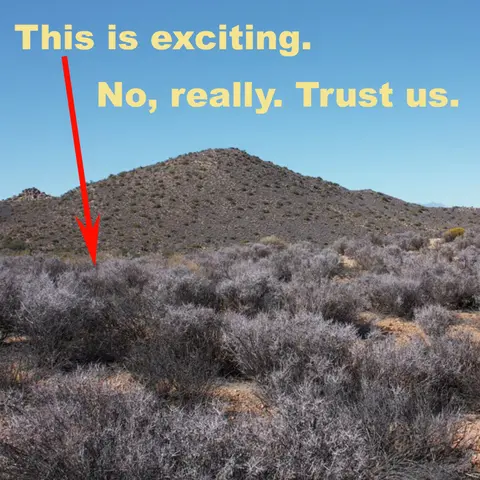
Fire can erase blackbrush stands quickly, while invasive annual grasses can make subsequent fires more likely.
Blackbrush, Coleogyne ramosissima, is easy to overlook. It’s tiny, dark leaves and gray stems can make a stretch of landscape look at best boring, at worst funereal. But this rose family plant’s low, dense canopy helps shape desert plant communities, and gives desert animals an important food source. Nurse plants shelter vulnerable seedlings from heat, drying winds, and hungry animals. Blackbrush may well be the most important nurse plant for Joshua trees.
Long-lived adults, episodic seed production, rodent seed caches, and suppressed young plants help blackbrush stands persist. But blackbrush isn’t well adapted to what North America’s hot deserts have become. Research in the Panamint Mountains shows why rebuilding a mature desert shrub community can take far longer than replacing its individual plants.
Protecting existing blackbrush matters as warming and disturbance make natural recovery harder.
Also, you still have a few days left to apply for our Fellowship for Desert Reporting, viewable at https://thedamn.org/fellowship.
Sources cited, plus extras:
- Webb, R. H., Steiger, J. W., & Turner, R. M. (1987). Dynamics of Mojave Desert Shrub Assemblages in the Panamint Mountains, California. Ecology, 68(3), 478–490. The exceptionally slow recovery of blackbrush communities after disturbance, including the climatic and geomorphic stability quotation. Free PDF. pubs.usgs.gov
- Hunter, K. L., & McAuliffe, J. R. (1994). Elevational Shifts of Coleogyne ramossissima in the Mojave Desert during the Little Ice Age. Quaternary Research, 42(2), 216–221. Packrat midden evidence for blackbrush expansion at the southern Nevada study site during the Little Ice Age. The extra “s” in ramossissima appears in the published title. Cambridge Core
- Meyer, S. E. (2023). Factors Regulating Population Stand Structure in Blackbrush (Coleogyne ramosissima: Rosaceae), a Masting North American Desert Shrub. Diversity, 15(5), 619. Stand structure, episodic seed crops, rodent dispersal, and banks of suppressed young plants within adult crowns. mdpi.com
- Pendleton, B. K., & Meyer, S. E. (2004). Habitat-correlated variation in blackbrush (Coleogyne ramosissima: Rosaceae) seed germination response. Journal of Arid Environments, 59(2), 229–243. Differences among populations in seed chilling requirements and germination responses. . ScienceDirect
- Jones, L. C., Schwinning, S., & Esque, T. C. (2014). Seedling ecology and restoration of blackbrush (Coleogyne ramosissima) in the Mojave Desert, United States. Restoration Ecology, 22(5), 692–700. Seedling establishment, herbivory, and how nurse-plant effects change with elevation and environmental stress.
Become a desert defender!: https://90milesfromneedles.com/donate
See omnystudio.com/listener for privacy information.
[00:00:00] Chris Clarke: This episode is made possible by listeners just like you, and by
[00:00:05] CMC AD: Copper Mountain College is proud to sponsor this episode of 90 Miles From Needles, the Desert Protection podcast.
[00:00:13] Chris Clarke: Find the oldest coast redwood forest on Earth with trees 300 feet tall, 30 feet thick at the base, some of them 2,000 years old.
[00:00:22] Chris Clarke: Then measure out a few square miles of the White Mountains bristlecone pine groves, home of the Methuselah tree and its ancient cohort. Then pick a random piece of blackbrush cover in the Mojave a couple miles in each direction. Chainsaw all three places. Bulldoze it all flat. Leave only stumps flush with the ground, then let them all grow back at their own pace.
[00:00:48] Chris Clarke: When the new redwoods and bristlecones are considerably older than the ancient ones we have now, the blackbrush may still not be more than about halfway recovered. It's a blackbrush old-growth forest out there.
[00:01:10] Joe Geoffrey: You think the deserts are barren wastelands? Think again
[00:01:19] Joe Geoffrey: It's time for 90 Miles From Needles, the desert protection podcast
[00:01:31] Chris Clarke: Thank you, Joe, and welcome to 90 Miles From Needles. I am your host, Chris Clarke. For this episode, I wanted to talk about one of my favorite plants in the desert. It grows in the Mojave, and in the Great Basin, and in the Colorado Plateau. It's not something you would necessarily notice if you were driving by, even at 35 miles an hour, let alone 80 miles an hour.
[00:01:53] Chris Clarke: It's unprepossessing. But as inconspicuous as it may be, it's crucial for the survival of other desert plants, and it is extremely vulnerable to habitat change that is caused by us. So sort of an MVP of the desert that is also one of the more existentially threatened species in the desert, at least in the Mojave Desert.
[00:02:19] Chris Clarke: And we'll get to talking about that really quick. First, though, we don't have any new donors. We had the same message last week. If you wanna break that cycle, you can go to 90milesfromneedles.com/donate and make a donation of the size and frequency that seems right to you. We also are still accepting applications for the next week or so for our fellowship for desert reporting.
[00:02:49] Chris Clarke: If you wanna find out more about that, you can go to thedamn.org/fellowship. We're basically looking for people with a story to tell about the deserts and their environment, and we have a little bit of money to offer fellows. So again, thedamn.org/fellowship. And with that, let's get to our discussion of blackbrush, also known as Coleogyne ramosissima.
[00:03:19] Chris Clarke: Blackbrush is much easier to say
[00:04:03] Chris Clarke: I'm thankful for the way I first noticed blackbrush because it was also the way I first noticed how blackbrush intermingles with other plants at the edges of its limits of environmental tolerance. When it gets too hot for blackbrush as you walk down slope in the Mojave, generally, it's creosote bush that takes up the slack and starts filling those desert spaces that the blackbrush would've filled if the Mojave was a little cooler place When I first came to the desert to live permanently, I was a couple miles from what is now Avi Kwa Ame National Monument in Southern Nevada.
[00:04:38] Chris Clarke: I was newly divorced, newly moved, had no local friends. I had no job. What I did have was time to hike, and I went usually to a little part of Avi Kwa Ame National Monument called Wee Thump Joshua Tree Wilderness. Regular listeners will be familiar with the place 'cause we've mentioned it a couple of times.
[00:05:01] Chris Clarke: Wee Thump is Paiute for ancient ones, and the trees there are pretty old. Some people maintain that some of them there are 700 years old or more, and that's probably not true. Joshua trees generally don't get that old by about half, but we're not talking about Joshua trees. We're talking about blackbrush.
[00:05:23] Chris Clarke: On one of my visits to Wee Thump, I drove from my little house across the state line and over a small rise and into the middle of Avi Kwa Ame National Monument, which wouldn't be called that for another 16 years. I parked the car on the side of a dirt road. I got out. I grabbed my backpack, and I started walking uphill I was in an area that was a thick Joshua tree forest.
[00:05:48] Chris Clarke: There were lots of barrel cacti, lots of chollas, lots of prickly pears, red brome grass, and a little bit of cheatgrass, occasional snakes. Not nearly enough snakes for my liking. But the most visually dominant living things in the area were a forest of Joshua trees, some of them reaching 25 feet high, and an understory of creosote bush, Larrea tridentata, that ubiquitous green plant of lower elevations in the Mojave.
[00:06:18] Chris Clarke: In that section of the Mojave, creosote tends to peter out at around 3,500 to 4,000 feet. Not too far uphill, the landscape changed From where I stood, it looked like a hard line drawn through the desert. On the side of the line nearest me was the deep green of creosote, and on the other side of the line, everything turned gray.
[00:06:39] Chris Clarke: There's a point at higher elevation above which no creosote grows, and from a distance, the boundary between those places may look sharp, as it did to me on that day in Wee Thump, as if someone had carved it with a knife. And I walked uphill, expecting to find a spot at which the creosote stopped and that gray shrub took over.
[00:07:03] Chris Clarke: But as it happened, I walked through the boundary without even noticing it. Or I should say the boundary was so gradual that at first I didn't notice it. And the thing that caused me to remember and start paying attention was that the creosote had been buzzing with bees. There was a point on my hike where I noticed that I didn't hear buzzing anymore.
[00:07:23] Chris Clarke: I looked around. I was lost in thought, as many newly divorced people are. But the sudden relative silence grabbed my attention, and I looked. There was no creosote anywhere nearby. I was surrounded by blackbrush, Coleogyne. The boundary between the creosote and the Coleogyne was maybe half a mile wide. It was so gradual that I didn't notice it until I was all the way into the Coleogyne, at which point I turned and looked down slope, and that boundary seemed like a sharp line again.
[00:07:55] Chris Clarke: It was a very cool lesson in how natural boundaries might seem pretty sharp until you look closely. And I held that memory in mind five years later on a hike in Joshua Tree National Park. At high enough elevation that blackbrush was the dominant understory plant, and I came to a place on my hike where the blackbrush just stopped in as abrupt a boundary as I was expecting on that hike in Wee Thump.
[00:08:23] Chris Clarke: There was no gradual petering out, no gradual infiltration by another understory plant. It was as if somebody had taken a bulldozer and just removed the blackbrush, and the boundary was so sharp that I could put one foot in blackbrush and another foot in absolutely not blackbrush, a sharp boundary.
[00:08:42] Chris Clarke: Now there are a few things that can cause that kind of sharp boundary in blackbrush, and most of them have to do with us humans walking around on the desert floor, either with actual bulldozers or with fire, which was the case in the Joshua Tree hike. The fire had removed all the blackbrush in an area, and you could tell where the fire was several years later by where the blackbrush wasn't.
[00:09:10] Chris Clarke: Now blackbrush is in that very, very large family of plants called Rosaceae, the rose family. And because the rose family is so large, botanists have split it up into subfamilies, which honestly doesn't help us narrow down the actual closest relatives of blackbrush all that much. There are a few members of the rose family that are fairly closely related to Coleogyne, which means they had a pretty recent common ancestor, or at least relatively compared to the rest of the family.
[00:09:39] Chris Clarke: Kerria, Japanese rose, is pretty closely related, as is Neviusia. Snow wreath is the common name. It's native to the US. And Rhodotypos, which is an Asian plant that is far too successful in Eastern North America for environmentalists' liking. And if you haven't heard of any of those plants before, you're not alone.
[00:10:01] Chris Clarke: But if you zoom out a little bit, you find a whole lot of really familiar plants that are in the same subfamily as blackbrush. They include chamise, probably the most common woody plant in California chaparral areas, Catalina ironwood, serviceberry, also called juneberry or Saskatoon, apples, crabapples, quinces, peaches, almonds, nectarines, apricots, plums, cherries, pears, mountain ash, loquats, and we've really only scratched the surface there.
[00:10:37] Chris Clarke: Unlike most of those relatives that I've named, blackbrush doesn't offer us any particularly tasty food to eat. It doesn't provide us with shade. It's not economically important. It's not pretty enough that people plant rows of it in their garden like its cousins Rhaphiolepis or Spiraea. But in the desert, it is the keystone that supports an entire ecosystem To understand the important role that blackbrush plays in the ecosystem of the deserts, I wanna guide you through a little exercise in imagination Imagine that you're a seed of a desert plant, snug and secure in your seed coat, maybe buried under a centimeter or two of desert soil, and a wet winter happens, and the temperature is very much to your liking, maybe 40 degrees Fahrenheit, maybe a little warmer.
[00:11:33] Chris Clarke: Rain seeps into the ground, very slowly penetrates your seed coat, and causes the rest of you inside that coat to swell a little bit, and an ancient, primordial stirring happens in you. You send a tendril deeper into the earth, your first root. Thus secured to the ground, you send a tendril in the other direction.
[00:11:56] Chris Clarke: Depending on who you are, you may have one or two seed leaves on that tendril. Those seed leaves are called cotyledons. They're not true leaves, but they act like leaves. They're pieces of the seed that nonetheless photosynthesize and help feed the plant until it can grow true leaves. If you're a plant in that big group called dicotyledons, or dicots for short, you have two seed leaves.
[00:12:20] Chris Clarke: If you are a monocotyledonous plant, or a monocot, you have one, which will generally look pretty much like a blade of grass. Regardless of whether you have two seed leaves or one, everything is fine until summer approaches. That's when the desert warms up and dries out. Now, if you're fully exposed to the sun, growing in a place without a sheltering plant or a rock overhang or something like that, there are two possible things that could happen that you will not like.
[00:12:52] Chris Clarke: One is simply that you will sunburn and dry out and die of dehydration. The other possible thing, which is probably a little bit better way to go, is that one of the animals in the desert that is constantly looking for food and for green plant material that might offer a little bit of water will just come up and eat you.
[00:13:12] Chris Clarke: This is the life of most germinated seeds in the desert. Unless there are a couple of strokes of luck in which the summer stays cool and wet and the jackrabbits and packrats and pocket mice don't find you, your life is pretty short, and you don't get to grow up and flower and make more seeds. But if you're lucky enough to germinate under a plant that offers you a little bit of shade in the heat of the summer, a little bit of a windbreak so that desert breezes don't dry the soil out quite as quickly, and also, importantly, hides you from those vegetarian desert critters, you have a much better chance of surviving to adulthood, flowering, and making your own seeds, and the painted ponies go up and down.
[00:13:58] Chris Clarke: This is known to ecologists as the nurse plant relationship, where an established desert plant with its own defenses in fine form, whether they're spines or scratchy branches or unpalatable leaves, cause the rabbits and the rats to look elsewhere for food to eat. Or even it just provides a physical barrier between you and the sun and the sharp teeth of those vegetarians.
[00:14:21] Chris Clarke: With a nurse plant, you stand a much better chance of surviving that first difficult year and becoming an adult plant. Now, as it turns out, Coleogyne is an excellent nurse plant. I mentioned Joshua trees before and said that the topics were related, and Joshua trees are the plant that we know for sure relies most on Coleogyne, and the reason we know that for sure is because we've looked.
[00:14:45] Chris Clarke: Other plants haven't been studied as closely in their relationships to nurse plants, and Coleogyne's not the only nurse plant available. There are things like bursage, which is often an important nurse plant for creosote. And then when the creosote grows up, it can be a nurse plant for lots of other plants.
[00:15:02] Chris Clarke: Other things that serve as nurse plants are patches of cholla or prickly pear, especially the prickly pears with the really stout spines. But Coleogyne, except where someone has bulldozed it, can form immense solid stands in which it is the main component of the canopy of that two-foot-tall forest stretching across the desert I've seen some sources that say Coleogyne can get as tall as six feet, and I do not disbelieve that, but I have really only seen Coleogyne get maybe two or two and a half feet tall.
[00:15:35] Chris Clarke: Your mileage may vary. Anyway, if Joshua trees or other yuccas or cacti or mariposa lilies or whatever, if they're to survive, they have to use the Coleogyne as a nurse plant. Some of the reason that blackbrush is as important a nurse plant for Joshua trees as it is, is that they kinda like the same conditions.
[00:15:55] Chris Clarke: A little bit of altitude, a mild preference for north-facing slopes as opposed to south-facing slopes. Shallow root systems on both plants mean they both like soil that is a couple of feet deep. And in places where the two of them grow together, Coleogyne are crucial in making sure that a new generation of Joshua trees grows up and replaces its parents and its grandparents.
[00:16:19] Chris Clarke: Take away the Coleogyne, and you pretty much take away the future of the Joshua trees. But Chris, you may well be asking quietly in your head at this point, Joshua trees can live for decades, sometimes centuries, and they flower from adulthood up until they die. Doesn't that give the Coleogyne a chance to come back from the fire or the misguided parking lot project or the landslide or whatever it might be that took the Coleogyne away in the first place?
[00:16:47] Chris Clarke: And I understand why you would wonder that. blackbrush is generally small, and our experience with small plants is that they don't take long to grow. But blackbrush is slow-growing, and when it gets to a certain height, it stops and then can live for several more centuries. And you might not even see the plants that are only 70 years old anyway, unless you really are careful to look.
[00:17:13] Chris Clarke: Each Coleogyne grows in really close proximity to the next one. It's hard to tell where one plant stops and the other starts, but it takes each individual plant a while to get there To become a full-fledged member of that canopy. Individual Coleogyne plants can live for 400 years or so. They flower. The flowers generally aren't really conspicuous, but sometimes they put on a bit of a show, little yellow four petaled things which might make you question their membership in the usually five petaled rose family, except that those petals aren't actually petals, they're sepals.
[00:17:49] Chris Clarke: blackbrush flowers do not grow petals. But they tend to flower and set seed in years where there's a nice wet winter. You'll often read that they need a cold winter to flower. In fact, I've said that in the past. But recent studies have established that they don't really need a freezing temperature.
[00:18:07] Chris Clarke: They just like cool. They can do fine with cool to medium warm temperatures. And how fine they are with those temperatures kinda depends on where they grow. Now, if you look at a range map of Coleogyne, you'll see two rough clusters of populations where this plant grows. And they do intersect a bit, but think of it as two bulges or a really, really badly drawn dumbbell.
[00:18:32] Chris Clarke: One bulges around the Mojave in upper elevations, and the other is on the Colorado Plateau. So Four Corners, Arches, Canyonlands, Grand Junction. And it probably will not surprise you to hear that the plants in the Mojave are a little more tolerant of warm winters for setting seed. Regardless of where it grows, Coleogyne does need water in order to take that gamble and put some energy into flowering and setting seed.
[00:18:59] Chris Clarke: Having those seeds mature and fall off of the plant or be taken off of the plant, where most of them will be eaten by those self-same packrats and kangaroo rats and pocket mice. And while they eat a lot of them, they will also cache a lot of them, saving them for later. And if they forget where they put them, or a coyote eats the rat before it can get back there, those seeds will germinate.
[00:19:24] Chris Clarke: They don't require a whole lot of convincing to germinate. They do so pretty readily. But you do need a cool summer afterward and wet winters to get them through the first few years and allow them to grow and mature and become reproductively functioning adults. Most of those seeds end up in the vicinity of the original blackbrush plant, the parent plant.
[00:19:45] Chris Clarke: And what this means in practice is that a mature stand of blackbrush with its centuries-old plants shoulder to shoulder will often have plants that are mere decades old eking out a living underneath that canopy, competing with their parents and aunts and uncles and grandparents for sunlight and for water, soil moisture.
[00:20:04] Chris Clarke: When one of those elder plants gets to be 400 or 500 years old and dies after a long and productive life, the younger plants that are right there are freed from being suppressed by their elders, and they can grow into that solid stand and become shoulder to shoulder with their nearby elders. In other words, Coleogyne is usually its own nurse plant.
[00:20:26] Chris Clarke: In fact, it relies on itself to be its own nurse plant.
[00:20:31] Joe Geoffrey: Don't go away. We'll be right back.
[00:20:34] CMC AD: Copper Mountain College is a proud sponsor of 90 Miles From Needles, the Desert Protection podcast. Located in Joshua Tree in the Mojave Desert, Copper Mountain College serves the communities of the high desert with a broad range of programs, from desert studies and the popular Wildland Fire Academy to nursing, EMT, water technology, and many more programs.
[00:20:54] CMC AD: Copper Mountain College provides direct transfer programs to CSU and UC universities, as well as career technical education. Learn more at www.cmccd.edu. Go Fighting Cacti.
[00:21:09] Chris Clarke: Here's what our friend, nature recordist Fred Bell, says about this week's offering. The echo of a woodpecker drumming against a hollow tree defines an ancient forest for me.
[00:21:20] Chris Clarke: A northern flicker calls for a mate at Great Basin National Park.
[00:22:59] Joe Geoffrey: You're listening to 90 Miles From Needles, the desert protection podcast Don't step on the cryptobiotic soil crusts
[00:23:08] Chris Clarke: When I took that hike in Joshua Tree National Park, in which I saw that sharp boundary between the blackbrush and the not blackbrush, the fire whose footprint I walked through where there was no blackbrush remaining had happened four years earlier in 2009.
[00:23:25] Chris Clarke: There were a lot of plants that had come back in the burned area. Mojave yucca four years after the fire was well on its way to recovery. Clumps of Nolina were putting out new leaves from the ground. Lupines were blooming abundantly. There were quite a few things that were coming back after the fire, but there was no blackbrush to be found.
[00:23:47] Chris Clarke: The first time I really explored a desert fire area was in 1997. I traveled to what's called the Woodbury Desert Natural Area southwest of St. George. In that little corner of the Mojave Desert that's in the southwest corner of the state of Utah. This was in October 1997. Charred husks of Joshua trees were standing upright offering a stark charcoal and bone white forest standing against a blue desert sky, and the ground between them was essentially vacant.
[00:24:15] Chris Clarke: There was some grass growing, and more on that grass in a minute. Outside the fire perimeter, there was blackbrush. That fire occurred in July 1993. It was the Welcome Springs Fire which burned 2,200 acres across what's called the Beaver Dam Slope. And that Welcome Springs Fire was one of the earliest modern alarms for desert biologists and desert ecologists who were suddenly confronted with a new idea that those of us in the desert have all become pretty familiar with in the intervening 33 years.
[00:24:47] Chris Clarke: The fire happens and the footprint the next year is filled with introduced grasses, cheatgrass and red brome. There've been quite a few fires in that area since, including one two years after I visited. I need to get back there and look again. As far as spots that are easier to get back to, that spot out in Joshua Tree where I had hiked in 2013, I've been to quite a number of times since, including last year.
[00:25:12] Chris Clarke: Seventeen years after the 2009 fire, there's still no blackbrush growing. Some of this is because the weather in the desert is getting warmer and drier rather than the cooler and wetter that Coleogyne likes best. And having that series of relatively cool moist years in a row just basically hasn't happened in the Mojave for a while.
[00:25:33] Chris Clarke: Probably the rest of the reason is the lack of nurse plants, the lack of local surviving Coleogyne to generate seed and to shade the young ones. Instead, that area's growing the two introduced grasses I mentioned before along with, especially in Joshua Tree National Park, Mediterranean splitgrass. Now that area and many other places in Joshua Tree and elsewhere in the desert have entered into what's generally called the grass fire cycle A fire happens, introduced grasses can grow very quickly with the first rain.
[00:26:07] Chris Clarke: They do that, summer happens, they die back, and their dead leaves provide fuel for the next fire. Desert organisms that aren't adapted to fire don't come back as quickly or at all. I mean, conditions are different in the Colorado Plateau. The blackbrush there is under less of an existential threat. But in the Mojave, a fire essentially means goodbye to the blackbrush cover.
[00:26:31] Chris Clarke: Even sensitive Joshua trees can survive a low to medium intensity fire. With high intensity fires, they can often come back from ground level, and they're about as sensitive a plant to fire damage as you can imagine except that blackbrush is even more sensitive. Now, even without fire, even if we had no introduced grasses in the desert and fires were no more common in the desert than they were 300 years ago, blackbrush would still be having some trouble potentially just because of that change in the overall climate in the desert.
[00:27:03] Chris Clarke: A 1994 study by Kimberly Hunter and Joseph McAuliffe, again, link in the show notes, suggests that a lot of the blackbrush cover in the Mojave may have arisen because of the Little Ice Age. The Little Ice Age was a period of generally cooler conditions, especially around the North Atlantic and including much of the Northern Hemisphere.
[00:27:24] Chris Clarke: The Little Ice Age lasted roughly around 1300 AD to 1850. Hunter and McAuliffe suggest that increased precipitation during the Little Ice Age created conditions in which blackbrush could have become established fairly readily. Their Southern Nevada study site, which was also in what would become Avi Kwa Ame National Monument, offered them evidence that there was no blackbrush there before the Little Ice Age and lots of blackbrush during and after.
[00:27:52] Chris Clarke: How did they know? Well, the answer involves pack rats and their houses. Well, we probably need to do an entire episode on this. Basically, pack rats gather what's within around 50 feet of their houses, and they bring that back to their house, and they preserve it by carrying out a rodent's everyday bodily functions In other words, they entomb the plant material in solidified rat urine with lots of rat feces mixed in.
[00:28:19] Chris Clarke: And packrats will often occupy the same midden for generations, hundreds of generations, thousands of generations. So this gives researchers a handy tool to determine what grew in a place at a particular time. You dig into the floor of a packrat midden and separate things out. You can use carbon-14 dating to age some of it.
[00:28:39] Chris Clarke: You get a picture from doing this of what grew in that 50-foot radius at different times over the course of prehistory. So packrat middens in the study area in what's now Avi Kwa Ame didn't contain any evidence of blackbrush older than the Little Ice Age. And packrat middens let us date stuff back around 20,000 years.
[00:29:03] Chris Clarke: Now, cold snaps are not impossible in a warming world, even in the desert. Warming puts a lot more energy into the system, and that can change wind patterns, and it is technically possible that that could manifest in localized cold spots even in the Mojave Desert. But the safe bet is on this part of North America getting hotter and mostly drier, and that is not good for the prospects of survival of blackbrush.
[00:29:33] Chris Clarke: In 1987, a study came out that was authored by Robert Webb, John Steiger, and Raymond Turner, published in Ecology. It was entitled Dynamics of Mojave Desert Shrub Assemblages in the Panamint Mountains, California. In the study, Webb, Steiger, and Turner looked at areas that had been disturbed at known dates, including nineteenth century mining attempts, landslides that were several hundred years old, a few landslides that happened in the Pleistocene, as long as the age could be determined.
[00:30:03] Chris Clarke: And they found that when a solid stand of blackbrush is displaced, removed by fire or bulldozer or landslide or nuclear weapons testing or whatever it might be, it would take a very long time for that solid cover of blackbrush to come back. And there's a line in the study that has stuck with me since I read it in 2010 or so.
[00:30:24] Chris Clarke: That line is at the end of the abstract of the study, and it is, "The time span for recovery may be longer than past periods of climatic and geomorphic stability." They're talking the time since the Pleistocene there. We're talking thousands of years. And that's assuming that something happens that creates conditions favorable to blackbrush germinating.
[00:30:47] Chris Clarke: So I take two things away from what I've learned about blackbrush over the years. One is that we need to be careful to save as much of it as we can in the Mojave, and that's not gonna be easy. We can't control where lightning hits necessarily. There's always gonna be an accidental fire here and there caused by somebody's hot tailpipe or a spark arrestor that blew off of somebody's chimney.
[00:31:09] Chris Clarke: And once we lose it, it's gonna take either a miracle or a significant advance in wildland botany science for us to get them back. The other thing I take away just basically underscores the importance and the beauty of this unprepossessing desert shrub. And I can't find a better way of expressing that than something I wrote on my blog back in the 2010s.
[00:31:35] Chris Clarke: Quote, "blackbrush is the base of a very specific ecosystem that may have taken longer to develop than the whole span of human history. And this may be hard to grasp for those of us raised on nineteenth century ecological notions such as succession and climax forests and such. So let me put it this way.
[00:31:55] Chris Clarke: Find the oldest coast redwood forest on Earth, with trees three hundred feet tall, thirty feet thick at the base, some of them two thousand years old. Then measure out a few square miles of the White Mountains bristlecone pine groves, home of the Methuselah tree and its ancient cohort." Then pick a random piece of blackbrush cover in the Mojave a couple miles in each direction.
[00:32:21] Chris Clarke: Chainsaw all three places. Bulldoze it all flat. Leave only stumps flush with the ground, then let them all grow back at their own pace. When the new redwoods and bristlecones are considerably older than the ancient ones we have now, the blackbrush may still not be more than about halfway recovered.
[00:32:41] Chris Clarke: It's a blackbrush old growth forest out there, and it grows inconsequential, short-lived Joshua trees out of it here and there. Ephemeral companions. Barnacles on the whale. The individual blackbrush plants in a stand may not be particularly old, but a solid stand of blackbrush is an astonishingly ancient community.
[00:33:30] Chris Clarke: Thanks for sticking with this episode. I know nondescript desert plants are not everyone's cup of tea, so you have my special appreciation for making it this far. Now, I just learned something about this podcast, which is that it's getting comments on Spotify. I didn't know you could comment on things on Spotify.
[00:33:47] Chris Clarke: I don't use Spotify much, and I had not seen the comments before. I just finally got myself signed up with a Spotify creator's account after publishing to Spotify for the last five years, and there are comments there that are very friendly and warm, and I haven't responded to any of them, and I'm sorry, 'cause I didn't see them.
[00:34:08] Chris Clarke: But I'm gonna start responding, so if you're one of those people that left a comment for me on Spotify as far back as season three, I apologize. I really appreciate the dose of well-wishing that these comments offered. And again, 90milesfromneedles.com/donate. Help us out. Make us feel wanted. Make us feel like we're doing something that's worthwhile to you.
[00:34:30] Chris Clarke: And again, thedamn.org/fellowship if you wanna learn more about the Fellowship for Desert Reporting. We're gonna stop taking new applications in nine days, so if you're interested, get it together. There's some really attractive weather out right now, and I'm gonna drop this and take Jack, the giant German shepherd, around the block.
[00:34:51] Chris Clarke: He has been so patient today. So that's it for this time, and I will see you at the next Watering Hole.
[00:35:01] Joe Geoffrey: And that brings us to the end of this episode of 90 Miles From Needles, the Desert Protection Podcast. You can find show notes for this episode, along with links and background, at 90milesfromneedles.com. We're also on social media. You can find us on Facebook, Instagram, BlueSky, and Threads. Just search for 90 Miles From Needles.
[00:35:27] Joe Geoffrey: And if you'd like a more direct line, you can reach us on Signal at A90MFN.67. If you'd like to support the show, you can make a donation of whatever size and frequency feels right to you at 90milesfromneedles.com/donate. Listener support is what makes this podcast possible. Our voiceover is by Joe Geoffrey.
[00:35:53] Joe Geoffrey: Podcast artwork is by Martín Mancha. Nature sounds are recorded by Fred Bell. Our theme song, Moody Western, is by Bright Side Studio with additional music licensed from independent artists.
[00:36:10] Chris Clarke: Other music in this episode is by Premium Beat, Music Dog, and Purple Planet.
[00:37:06] Joe Geoffrey: 90 Miles From Needles is a production of the Desert Advocacy Media Network