
 Amazon Music
 Apple Podcasts
 Audible
 Castbox
 Deezer
 Fountain
 iHeartRadio
 Pandora
 PocketCasts
 Podcast Addict
 Spotify
 YouTube
  RSS Feed
 S5E8: We Don't Need Heroes. We Need Activists.
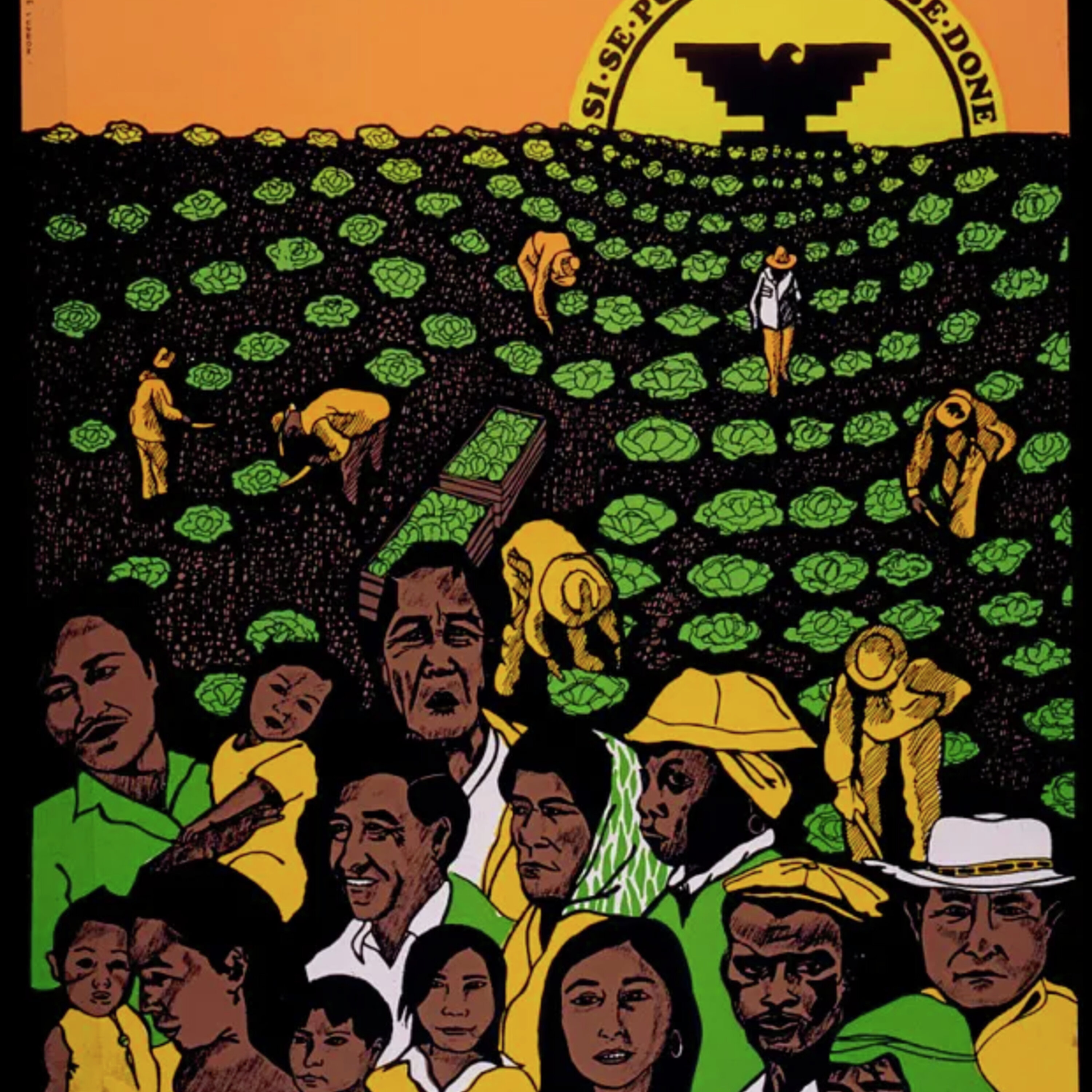
Responding to sexual-assault allegations against César Chávez, Chris examines the damage caused by hero worship and argues for accountable, distributed movements that value collective work above charismatic leaders.
Episode Summary:
This episode tackles the troubling legacy of Cesar Chavez amidst recent allegations of sexual assault and misconduct, which have shaken the progressive and environmental spheres. Host Chris, who shares a personal history influenced by Chavez, critically examines these revelations, comparing past admiration with the need to hold figures accountable for their actions. The episode also navigates the broader implications on movements Chavez impacted, emphasizing the importance of acknowledging both the achievements and failings of public figures.
In a candid exploration, Chris discusses the complexities surrounding hero worship in social justice movements, particularly when such icons are involved in controversy. With references to other figures such as Ed Abbey and David Brower, the episode unravels the persistent issue of separating an individual's contributions from their personal failings. The episode spotlights how such revelations impact the perception of someone like Chavez, who played a significant role in farm labor rights but whose personal actions warrant serious condemnation. Chris concludes with a call for reflection on leadership dynamics within advocacy movements and how they must evolve to prevent future transgressions.
Key Takeaways:
- The episode explores the lasting impact of recent allegations against Cesar Chavez, which profoundly affect his legacy within activist movements.
- Chris discusses the challenges in separating Chavez's contributions to labor rights from his personal misconduct and abuse.
- Examination of leadership within progressive movements highlights the dangers of a centralized cult of personality.
- The discussion offers insights into how allegations of misconduct by leaders affect the morale and trajectory of advocacy efforts.
- The host emphasizes the need for inclusive and responsible leadership that prioritizes the community's cause over individual recognition.
Notable Quotes:
- "Heroes are really problematic. I keep learning this over and over again."
- "The decline of the UFW is a testament to the failings of leadership that centered ego and image over collective goals."
- "When leaders put their self-interests first, they sabotage the very movements they claim to champion."
- "Ask yourself how much more good Chavez might have been responsible for if he had not been a rapist."
Resources:
- For more on the Cesar Chavez revelations, see This article by David Morales at Three Sonorans.
- Three Sonorans also addresses criticism of Dolores Huerta's role in all this.
- Here's the UFW Foundation's comment on the revelations.
- Need help? Visit IASP for crisis support or call 800-656-HOPE.
- Suggestions from the host include exploring the resources available at RAINN.
Listen to the full episode for a more in-depth discussion on Cesar Chavez's complex legacy and stay tuned for upcoming episodes filled with insightful conversations about environmental justice and activism.
Become a desert defender!: https://90milesfromneedles.com/donate
See omnystudio.com/listener for privacy information.
UNCORRECTED TRANSCRIPT
0:00:00 - (Chris): 90 miles from the desert Protection Podcast is made possible by listeners just like you. If you want to help us out, you can go to 90 miles from needles.com, donate or text needles to 53555. There's a quick content note on this episode. This episode contains discussions of issues of sexual assault and suicidal thoughts. If you are considering suicide or otherwise need help, you can check into the Suicidal Crisis support webpage@iasp.info
0:00:36 - (Chris): suicidal thoughts. Regardless of where you are in the world, you can find someone who can help you at that website. If you or someone you love has been sexually assaulted or abused, you can contact rainn.org or call 800-656-HOPE. You can also text HOPE to 64673. Everyone involved with this podcast wants you to stick around and to get the help you need.
0:01:10 - (Joe Geoffrey): Think the deserts are barren wastelands? Think again. It's time for 90 miles from Needles, the Desert Protection Podcast.
0:01:31 - (Chris): Hey y'. All, welcome to 90 Miles from Needles the Desert Protection Podcast. I'm your host, Chris, and it's been chaotic here and this episode is going to be a lot shorter than usual. The sound quality is not likely to be quite as good as usual. Regular listeners will know that we had a bit of a house fire about a month ago and this morning we had crews moving everything that we own out of the house, which created some ruckus and some confusion in our household and in the studio in the back of the garage where I usually record this, that was going to be interesting enough to contend with, especially with a pit bull barking every time one of the workers came out with a box of stuff on a hand cart. But the power was out just to make things even more fun. So I'm recording this somewhere else and I'm not going to be able to do my usual several takes to get things smooth and easier to listen to.
0:02:20 - (Chris): Plus, the room I'm in is not sound treated to limit reverb, so I'm going to have to ask you to bear with me. I also don't have access to reliable Internet here, so we're going to have to wait until next week on our Fred Bell Recordings, those nature recordings that Fred provides us. Fred Bell fans, I apologize. We'll have his work back next week. Also, if you're used to hearing me thank people right about now who donated in the past few days or weeks, I don't have access to that list right now because of the power outage, so I will catch you all up next week.
0:02:59 - (Chris): I apologize to those of you who've given to the podcast and to the Desert Advocacy Media Network in the last 14 or 15 days. 90 miles from needles.com donate if you want to become one of those people, there's no way through this, but through it. And I am preoccupied right now with the news about Cesar Chavez that broke this week. Now, I'm going to cop to the fact that he played a huge role in my early activism as a teen. In fact, actually, literally exactly 50 years ago, I found myself on a couple of weekends picketing outside a supermarket in Buffalo, New York, which is where I lived at the time, if you can call it that, which I did.
0:03:46 - (Chris): I was picketing with the Aztec eagle, symbol of the United Farm Workers, on my sign, encouraging shoppers to refrain from buying nonunion lettuce during a lettuce boycott of the 1970s. And most of us learned this past week, some of us knew already, but most of us learned this past week that during that period, during that precise period, Cesar Chavez was molesting kids who were my age. Now, I'm not trying to make this thing about me. I'm just saying that that struck a nerve in me.
0:04:22 - (Chris): The age commonality makes it easier for me to identify with the victims. Not that it's that hard. So unsurprisingly, there are a lot of people out on the Internet that have had excellent and very sensitive and well-informed takes on what this means for the legacy of Cesar Chavez and what it means for the internal dynamics of the environmental justice and farm labor and other labor movements. I'm going to link to some of the commentary that I appreciated most in the show notes for this episode. And I gotta say that ordinarily I would tap someone who is much better informed and much better able to speak on this than me because, you know, I'm a product of my upbringing and my demographics.
0:05:06 - (Chris): And for those of you new to the podcast, I am an older white guy, straight cis, et cetera, and it's sometimes fraught for me to wade into discussions of, to be frank, sex crimes committed or allegedly committed by men of color. As a white guy, there are a lot of mistakes I can make in discussing this. One of the people I'm going to link to is three sonorans on substack. Friend of the podcast, David makes some very, very good points. He states up front that he 100% believes and supports the survivors.
0:05:38 - (Chris): But he also points out that what we're seeing happen to Chavez's legacy may well have been very different if Chavez had been an Anglo. This society not only treats actual, credible violations of law and morality by people of color much more stringently than it does for white people and white men in particular. But allegations of sexual assault have also been used as trumped up excuses fairly often to punish men of color for being men of color. You can Google Emmett Till if you want the canonical example. I highly recommend David's writing and I'll link to some others.
0:06:11 - (Chris): At the same time, a lot of times when people who remain silent and just for the sake of being authoritative and well informed, my tendency is to reach out to a potential interviewee about a topic that they are closer to hesitant. I remain hesitant to bloviate on topics that, due to who I am, my take might be flawed. That said, when people remain silent despite having some privilege and authority, it does help create conditions in which further assaults can continue, in which impunity can continue.
0:06:50 - (Chris): And I don't want to contribute to that either. So here's some thoughts about parts of this that I do have some knowledge and some experience and some credibility. Or at least I'd like to think I have some credibility. Heroes are really problematic. I keep learning this over and over again. By the time I was a little bit older than 16, you know, in my early 20s, I heard some pretty disturbing criticism of Chavez and of the United Farm Workers, especially after I left Buffalo and moved to California.
0:07:21 - (Chris): A lot of that criticism had to do with Chavez's admiration for cult leaders like Charles Diederich of Synanon and and Chavez institution, deliberate institution of a cult of personality style organizational structure at the ufw. It didn't take long before I heard about Chavez's attacks on migrants. Of course, the whole idea that undocumented migrants are here to compete with us for jobs is, well, not gonna mince words. It's pretty fucking offensive and counterfactual. In a weird inversion of the dynamics that David talks about at three Sonorans. You have someone like Dennis Kearney in 19th century California who pressed for the Chinese Exclusion act, and he has been roundly criticized through the past several decades as a horrible racist. Though of course San Francisco hasn't bothered to change the name of Kearney Street. It's a little bit harder for somebody like me to charge Chavez with racism, but he certainly advocated violation of the rights of migrants. And that's bad no matter what the color of your skin is.
0:08:24 - (Chris): So what I'm saying is my understanding of Chavez as a person got kind of nuanced over the decades. But when he died in 1993 and I was already doing Roughly the job I'm doing right now, different employer, different medium, essentially the same job. There was a lot of outpouring of raw emotion among the progressive element in Berkeley and not a whole lot of discussion of the man's flaws that we knew at the time.
0:08:51 - (Chris): People that had studied the history of the movement, which was not me at that time, also knew about Chavez as essentially co-opting the union and the movement from the Filipino agricultural laborers who had really kicked the whole farm worker unionizing thing in California and the Imperial Valley and the Central Valley. And so Chavez's reputation certainly had been tarnished. And nonetheless, I and a lot of other people sort of kept him in the category of flawed human beings that I nonetheless admired by way of parents parallel.
0:09:24 - (Chris): You may recall that Zak Podmore and I talked a few weeks ago on this podcast about David Brower. In the course of our discussion discussing Glen Canyon. And Dave, during a period in the 1990s, allowed himself to be persuaded that the Sierra Club needed to oppose immigration into the US period. He spoke rather prominently about the topic. The Sierra Club was contending with what I will deliberately, ironically call an invasion of anti immigration nativist types.
0:09:54 - (Chris): Many of them, though not all of them, but many of them allied with the far right. And Dave was taken in by their arguments. And he later rejected those arguments to his credit, and tried to make amends, reached out to some folks doing migrant justice stuff. And just as with his much more well publicized mistake on deciding not to fight about, not to fight the Glen Canyon Dam's construction, Dave did what he could to make amends for that mistake. And that's all we can ask, really.
0:10:24 - (Chris): There's no one perfect. That's the main problem with hero worship culture. Even in the absence of revealed crimes against children, as in the case of Chavez, there is no one perfect. Everyone has flaws. Sometimes we indulge our flaws, sometimes they're drilled into us through trauma or upbringing or some weird mixture of the two. And so for a time I could overlook or I could grant the flaws that I knew about Chavez and still generally respect him as someone who did good in the world. That has changed. And it's not just because of the odious nature of the crimes that he is now accused credibly of committing. And these accusations are not something you can explain away or hand wave. These accusations describe odious assaults on women and children.
0:11:18 - (Chris): And these are the ones that we know about. I can forgive having the wrong opinion on a point of politics, even if people are suffering as a result of that opinion, to A certain degree, people are abstracted and divorced from the consequences of their actions and especially from the consequences of their opinions. But just as with someone else who I have greatly admired in the past, Noam Chomsky, who, it was recently revealed, counseled Jeffrey Epstein on how to PR his way out of the mounting allegations that he was a serial child rapist, there is no way that I can write this off or overlook it when it comes to Chavez's assaults on women and children. The biggest reason, obviously, is that deliberately causing harm for your own pleasure to someone who did not consider consent to that action is not the mark of someone that is to be admired or tolerated or even allowed to roam free.
0:12:14 - (Chris): In a just world, Cesar Chavez would have been imprisoned for his assaults on women and children. In a just world, he would not have been allowed to live within a mile of a school. One of the women who survived his abuse while she was a child spoke to the New York Times about spending time wanting to end her life. That's not just an error in judgment on Chavez's part. That is a deliberately evil act on his part. So that's the big, obvious reason that anyone with an ounce of decency or empathy will understand why we need to stop honoring this man, despite the set of good works he unarguably took part in, which is more abstract.
0:12:52 - (Chris): But the other reason, which is more abstract, is not being overlooked per se. But I think not a lot of people are talking about it. And that reason is that through these actions and similar actions, some of which rose to the level of crimes and some didn't, but all of them centered Chavez as the only important person in the United Farm Workers. Chavez sabotaged the United Farm Workers and betrayed the people that the United Farm Workers was instituted to help. I certainly don't want to imply that it's anywhere near as important as the fact that he hurt people, including people that could not defend themselves against him. And he's not the only progressive activist man who has done shit like this. And this needs to be called out, and it needs to be stopped.
0:13:39 - (Chris): The impunity needs to stop. But the pragmatic argument, I think, is important nonetheless, if only because it's a direct rebuttal to people that say, have been saying, and will continue to say, oh, Chavez was flawed, but he did so much good in the world. He did so much good for farm workers and people in frontline communities. And I just have to wonder how much good work could have been done if instead of victimizing these kids and victimizing his essentially his business partner, Dolores Huerta, instead of seeing them as resources to be exploited, as second class human beings to be manipulated and assaulted and controlled, what if he saw them as his inheritors? What if he saw them as people who, with his help, could surpass his accomplishments and become even better known than he is?
0:14:30 - (Chris): What if he was a leader instead of a predator, A teacher instead of a narcissist? What could these women have done if they weren't subject to his predatory behavior and his sapping of their self confidence and their self esteem and just their energy? I mean, no doubt Dolores Huerta has accomplished a hell of a lot in her life. I'm not saying otherwise. There are people that are criticizing her whole role in this, and I'll link to some of those just for your own information.
0:14:55 - (Chris): But she hadn't had to deal with the sexual assaults and the results of them. What more might she have accomplished? I've worked with a lot of people considerably younger than me, and there's just more and more people that are considerably younger than me all the time. And there is nothing more exciting in the world than seeing someone that you have mentored, that you've worked with, that you shared your knowledge with, surpass your achievements.
0:15:22 - (Chris): Now, two of the women who were abused by Chavez's children have shared their names with the New York Times. You can go read that to find out what their names are. I feel icky about sharing their names without their consent, so go read the New York Times article if you want to know. But what if he, instead of victimizing them, has helped set them on a path so that we would know who the hell they are?
0:15:46 - (Chris): That we would say, yeah, she's like the Chief justice of the California Supreme Court. Wait, wasn't she the leader of the AFL CIO in the 1990s? Isn't she a senator? Isn't she a writer who has broken hearts and changed minds? The decline of the UFW as an organization and a movement, the restructuring of the UFW to become the Cesar Chavez cult of personality, and Chavez's assaults on women and children, I suspect, come from the same root. They come from the activist putting his own image and his own feelings of worth above the cause of saying that his own image and his own feelings of worth in some cases are the cause. And this is not an uncommon phenomenon.
0:16:31 - (Chris): It doesn't always result in kids being assaulted, but it does usually mean the person is sabotaging the work he claims to be wanting to do. And I wish Chavez was the only case I knew about in the progressive movement, even in the desert protection movement, where a putative leader exploited, belittled or even sexually assaulted women working in the movement. For those of you who might be inclined to saying, yeah, I despise what he did, but you can't erase the good that he did, or you want to argue it was a different time, we can't hold them accountable to 2025 standards for stuff that he did in 1973, which is a lousy argument by the way. I mean, I remember 1973 really clearly and I was a 13 year old boy and I knew that rape was wrong 1973.
0:17:23 - (Chris): The world knew that child sexual abuse was wrong in 1973. But if you're inclined to making that kind of argument that we shouldn't cancel Chavez because he did manage to do some good in this world and it was arguably considerable good, to be clear. Ask yourselves, and I will continue to ask myself, how much more good might he have been responsible for, directly or indirectly, if he had not been a rapist, if he had not assaulted children, if he had not repeatedly assaulted his closest co worker? How much more good could Chavez and the UFW had done if he hadn't had his predatory urges and his ego get in the way? Now, the last time this podcast took on a controversial man and his legacy, our first season, our episode on the Good and the Not Good, about Ed Abbey's work in the desert protection world. I heard it from some folks and I lost a couple of friends.
0:18:25 - (Chris): And, you know, I'm not losing any sleep over that. But I expect people will have feelings about this episode. And if you want to let me know what you think, whether ripping me a new one or or not, and go to our website at 90miles from needles.com to leave a note. Fire away. And just so you know, this is possibly the least upbeat episode we've ever put together. Upcoming episodes will be more joyous.
0:18:49 - (Chris): One thing I learned, I learned a lot of things in AJO last week at the Tri National Sonoran Desert Symposium. It's a fantastic event at the throughline for me was that joy is a much greater motivator than rage or anger or resentment, all of which are necessary from time to time. All of them are good motivators in some ways, but joy is the one with the greatest miles per gallon return on investment.
0:19:15 - (Chris): Now, next week we're going to return with Fred Bell's Wonderful Nature Recordings from the American Southwest and expressions of sincere gratitude for those of you who have donated in the last couple of weeks. And those of you who donate in the next week, we are going to be talking to Caroline Tracy, who has a book out on the 17th. Just a couple of days ago it dropped called Salt Lakes, which I'm partway into.
0:19:37 - (Chris): It's a really wonderful read. Also scheduling an interview with a writer, Paul Loeb, whose book Soul of a Citizen changed my life. I expect we will be talking about a bunch of different things, but one of them will be that activists and even activist leaders are not saints or supernatural or better than you or me. Some of them are worse than you and me on bad days. The question is, how do we approach those flaws?
0:20:01 - (Chris): How do we manage those flaws? And how do we encourage more people to take part in the movement so that our flaws matter less? One last thing, we broke triple digits this past week in 29 palms, and winter is not over yet as I record this. So we're going to be talking a lot about drought and extreme temperatures and super El Ninos and things like that in the weeks to come, I expect. But in the meantime, please be careful if you live in the desert Southwest or hell, if you live in San Francisco, you're going to have some extremely unseasonably warm temperatures coming up if you work outside or if you live outside.
0:20:41 - (Chris): And congratulations on being able to listen to a podcast if you live outside. But regardless, please be careful. Hydrate, get inside when you can. When I say it's going to be a hell of a year, really hope I don't mean that literally. Anyway, thanks for listening to this most downbeat of episodes. Love all of you for tuning in and for supporting what we're doing here. Keep your chins up and we'll see you next week.
0:21:10 - (Joe Geoffrey): And that brings us to the end of this episode of 90 Miles from the Needles, the Desert Protection Podcast. You can find show notes for this episode along with links and background@90miles from needles.com we're also on social media. You can find us on Facebook, Instagram, Bluesky and Threads. Just search for 90 miles from Needles. And if you'd like a more direct line, you can reach us on signal at HEY90MFN67.
0:21:45 - (Joe Geoffrey): If you'd like to support the show, you can make a donation of whatever size and frequency feels right to you at 90miles from needles.com donate listener support is what makes this podcast possible. Our voiceover is by Joe Jeffrey. Podcast artwork is by Martine Moncham. Nature sounds are recorded by Fred Bell. Our theme song, Moody Western, is by Brightside Studio, with additional music licensed from Independent Artists.
0:23:14 - (Joe Geoffrey): 90 miles from Needles is a production of the Desert Advocacy Media Network.