




 RSS Feed
 Amazon Music
 Apple Podcasts
 Audible
 Castbox
 Deezer
 Fountain
 iHeartRadio
 Pandora
 PocketCasts
 Podcast Addict
 Spotify
 YouTube
Desert biologist Tim Shields joins 90 Miles from Needles to discuss efforts to protect the Mojave Desert's tortoise population. Shields updates on using non-lethal lasers to deter ravens, major tortoise predators, and shares insights into the challenges posed by the invasive schismus grass. He reveals plans to restore native ecosystems using cutting-edge technologies, aiming to revive the desert's biodiversity. The conversation highlights innovative conservation strategies and Shields' dedication to preserving the desert environment for future generations.





Podcast episode image: ©Jim Boone, BirdAndHike.com
This episode, we welcome back Tim Shields, a dedicated desert tortoise biologist whose half-century-long career has been devoted to unwavering efforts in conservation. As we explore abandoned terrains once frequented by old Hollywood, Tim shares his innovative methods combatting raven predation and invasive plant species threatening tortoise habitats.
In this captivating episode, Tim Shields explores how the invasive grass Schismus has transformed once vibrant, diverse desert landscapes into monotonous expanses, diminishing essential food sources and shelter for the desert tortoise. Chris and Tim engage in a panoramic conversation covering technological advances in ecosystem management, the ecological consequences of invasive species, and the ways technology can help mitigate human impact on wildlife. Through innovative tools and perseverance, Tim aims to hand over a toolkit to future generations for the restoration of these precious ecosystems.
Key Takeaways:
- Raven Management: Tim has pioneered non-lethal methods to deter ravens, such as innovative lasers that make the birds uneasy without physical harm, significantly reducing raven presence in key habitats.
- Invasive Species Impact: Schismus grass represents a major threat to desert ecosystems, highlighting the need for innovative solutions to restore native plant diversity.
- Ecological Vibrancy: Creating a sound-based ecological index could help measure the health and diversity of the desert ecosystems, showing the vibrancy and biodiversity of an environment through acoustics.
- Future of Conservation: Tim emphasizes the importance of preparing future generations with the tools and knowledge to continue ecological restoration and avoid repeating past mistakes.
- Hope Through Innovation: Despite challenges, Tim remains optimistic about technologies and methods paving the way for ecological recovery in the desert.
Notable Quotes:
- "Ravens are good students. We are talking to them in bird."
- "If you have an environment that can support tortoises, it supports the whole crew."
- "The Schismus remains invisible to most; they don't notice it, but we see the ecological damage."
- "It’s about putting our hands on the ecological levers; otherwise, protected lands will become irrelevant."
- "This is a beloved landscape, and it is in dire trouble."
Resources:
- Tim Shields & Ornilogic: Discover more about Tim Shields' ongoing efforts and projects in desert conservation here.
- Chris’ 2015 article on raven deterrence: read it at pbssocal.org
- 90 Miles from Needles Podcast: For more information and additional episodes, visit our website.
- Cornell Lab of Ornithology: Explore extensive bird call collections referenced by Tim in the episode here.
Join us in this insightful conversation to uncover how persistence and innovative thinking can foster change in conservation. Engage with how desert ecosystems can be protected and invite yourself to imagine sustainable futures for these wild terrains. Don’t miss tuning into the full episode for an enriching experience, and stay connected for more compelling discussions on the "90 Miles from Needles" podcast.
Become a desert defender!: https://90milesfromneedles.com/donate
See omnystudio.com/listener for privacy information.
Like this episode? Leave a review!
Check out our desert bookstore, buy some podcast merch, or check out our nonprofit mothership, the Desert Advocacy Media Network!
UNCORRECTED TRANSCRIPT
0:00:00 - (Chris Clarke): 90 miles from the desert Protection Podcast is made possible by listeners just like you. If you want to help us out, you can go to 90 miles from needles.com donate or text needles to 53555.
0:00:25 - (Joe Geoffrey): Think the Deserts are Barren Wastelands? Think again. It'S time for 90 miles from Neil's the Desert Protection Podcast.
0:00:00 - (Chris Clarke): 90 miles from the Desert Protection Podcast is made possible by listeners just like you. If you want to help us out, you can go to 90 miles from needles.com donate or text needles to 53555.
0:00:25 - (Joe Geoffrey): Think the deserts are barren wastelands. Think again. Foreign. From Needles, the Desert Protection Podcast.
0:00:46 - (Chris Clarke): Thank you, Joe, and welcome to 90 Miles from Needles, the Desert Protection Podcast. I'm your host, Chris Clark, and I think you're going to like this episode. Today we welcome back our friend Tim Shields, a longtime tortoise biologist who's been watching tortoises sadly decline over the course of his half a century of working in the field. And rather than just sitting around and waiting for the bad news to come in, Tim has been trying a bunch of different things for as long as I've known him to try and make things a little bit less dire for desert tortoises in the Mojave Desert and by extension in other places as well.
0:01:20 - (Chris Clarke): We talked to him about not only a new venture, making sure tortoises have the right kinds of things to eat as they're wandering around in the desert, but also an update on one of the main threats to individual tortoises, which is raven predation. Now, ravens are a wonderful species that are native to the deserts of the Southwest. And at the same time, we have been subsidizing them through our garbage. Our piped in water, leaky faucets, fountains and such, water sources and food sources for them have allowed them to increase their numbers many orders of magnitude beyond where they were. Even in my own memory, I remember a Mojave Desert in the late 80s and mid-90s where if you saw more than one raven at a time, it was probably just two.
0:02:02 - (Chris Clarke): And they were mated and they were headed somewhere else. And now you see crowds of dozens of ravens just hanging out, waiting for the wind to blow a dumpster lid open. And ravens are the main predator on baby tortoises. They are very, very efficient. We have spoken with Tim in the past on this exact topic. So he provides a really interesting update on some of the tech advances that he has encountered in his quest to nonviolently persuade ravens that they really want to do something different.
0:02:30 - (Chris Clarke): But in addition, there is an annual plant that is slowly taking over the Mojave and other deserts as well. And when it outcompetes native plants, it deprives tortoises of the kind of food they need to prosper. So we're going to be talking to Tim at some length. We left my studio here, walked a little ways to A place called Campbell Hill in Twentynine Palms, which right now has a pretty good diversity of native plants, including some desert lilies that are are getting ready to bloom and a couple of introduced plants we started recording right outside of an abandoned house. That fun fact used to belong to the movie star Jimmy Cagney, who used to come out from Los Angeles from Hollywood and decompress by painting the desert.
0:03:17 - (Chris Clarke): He had a couple of artist friends he spent time with. That house is now abandoned and it's a target for graffiti and other kinds of vandalism. In fact, there's some racist graffiti on the inside I need to wander back with a can of spray paint and just obliterate. But at any rate, that aside, Tim and I had a great conversation outside of Jimmy Cagney's house. It's always good to have Tim on the podcast, and I think you're going to like what he has to say.
0:03:42 - (Chris Clarke): Before we get to my chat with Tim, though, I wanted to thank a couple of people for their donations. Big thanks to Dawn Martin for her first ever donation. Relatively generous donation, and as people often do when they make a generous donation, they say, I'm sorry I can't afford to donate more. But Don, we are incredibly grateful and we are glad you're on board and thanks for the kind words. Also, my friend Eva Soltes made yet another donation to our Fellowship for Desert Reporting. Eva is a longtime supporter of the podcast and former landlord of mine. In fact, you can join Eva and Dawn by going to 90 miles from needles.com
0:04:20 - (Chris Clarke): donate if you want to donate specifically to our Fellowship for Desert Reporting, you can go to 90 miles from needles.com Fellowship that will go to help us raise matching funds to pay emerging desert environmental journalists to work with us. We have a goal of 10k and we are slowly approaching our first k, so check that out. I'm very excited about diversifying the voices you hear here on this podcast or in the Desert Advocacy Media Network's other ventures.
0:04:50 - (Chris Clarke): You'll notice that in our conversation, Tim talks a lot about the legacy he wants to leave. He is aware that he's got limited time left, although hopefully he's got more than he thinks he does. He wants to provide the upcoming generation with tools to work after he can no longer do so to make the world a better place for desert tortoises. And if he'd swap out a couple of nouns, that's pretty much why I want to do the Fellowship for Desert Reporting. Tim's only a little bit older than I am and we have the same motivation.
0:05:22 - (Chris Clarke): It's all about secession plans. So 90 miles from needles.com Fellowship if you want to help that work continue. So for now, let's go to Campbell Hill out in front of Jimmy Cagney's former house to talk with tortoise biologist Tim Shield. So, Tim Shields, thank you for joining me here in front of Jimmy Cagney's house.
0:06:12 - (Tim Shields): Jimmy Cagney's house. It's a pleasure. Here overlooking Wonder Valley. Beautiful February afternoon. It's really nice.
0:06:19 - (Chris Clarke): So we're looking out over, we're maybe 75ft above Amboy Road and looking eastward toward the Sheephole Mountains and it's a really nice day. A little bit of cloud in the sky from a recent rain front that came in and skipped over us and
0:06:34 - (Tim Shields): another one on the way.
0:06:36 - (Chris Clarke): Oh good.
0:06:36 - (Tim Shields): Yeah.
0:06:38 - (Chris Clarke): Monday, Tuesday, lots of, lots of really healthy looking creosote popcorn flower. It's not a super bloom so far, but.
0:06:49 - (Tim Shields): So far. But, but if we get another set of storms in here, it could, it could really take off.
0:06:55 - (Chris Clarke): It's always nice to see, you know, the stuff that's been in the, in the seed bank. Just decide, okay, this is the year I'm going to come up and try
0:07:02 - (Tim Shields): and bloom, take my shot. I mean, for an annual plant, that's it. It's like they commit, they're, they're going and they gotta, gotta produce some seeds.
0:07:10 - (Chris Clarke): And there are some plants we like to see better than others.
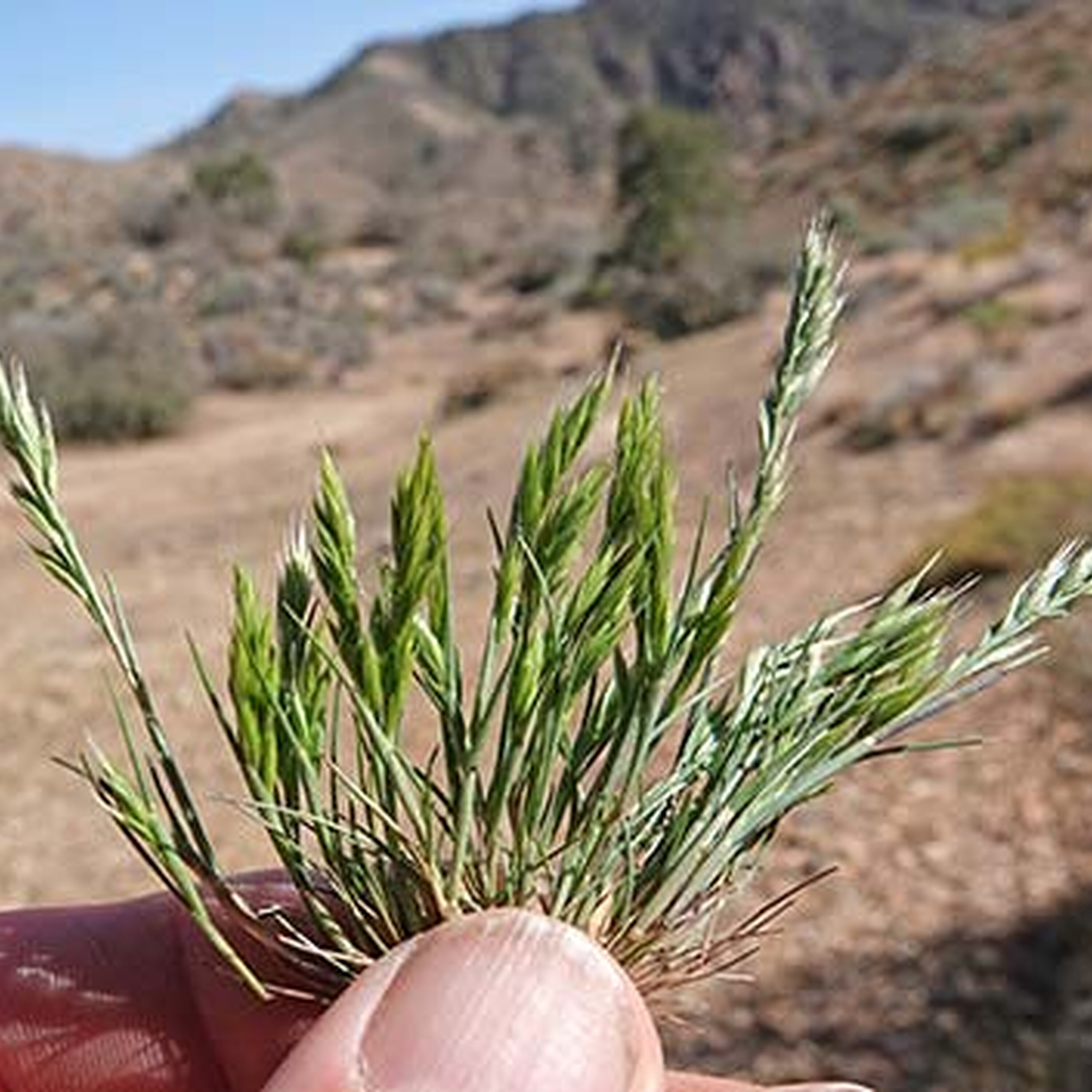
0:07:13 - (Tim Shields): Yes. And some we don't like to see at all. Like this thing in front of us, which is Schismus, called split grass. This is probably Schismus arabicus, but I'm not good at grassid, so I just call it Schismus. They're two species. But I think the interesting thing about sort of vegetative crises in the desert and we're in the middle of a crisis as far as the vegetation goes, is that it's largely invisible to most humans.
0:07:42 - (Tim Shields): They don't notice it and they can look up at the hills and go, oh my God, the hills are so green. And I go up as desert ecologist, I go up into the hills and I go, oh my God, this place is so green. Because Schismas, this one particular plant and this place we're in, is, is a, is a pretty hardy community, diverse community of annuals. But there is Schismus here. However, there are, particularly further west in the Mojave, there are square miles of Schismus being about the only annual plant that exists and not all that much further west.
0:08:16 - (Chris Clarke): I Mean, no. Last place I lived in Joshua Tree, which is maybe 10 miles west, had nothing except for Schismus that would come up.
0:08:23 - (Tim Shields): Yeah. And indeed in our yard in Joshua Tree, it's the same way. And my wife and I have been remarking on the change in the last five years since we got there. I've been doing vegetation transects for a half century. I'm not a very good botanist, but I'm what was available to go out on desert tortoise research plots. So I have done numerous vegetation transects to determine sort of the species mix and the dominance of each.
0:08:53 - (Tim Shields): Schismus has been a part of the desert biome since I've been out here and probably for several hundred years. The supposition is that it got here on the wool of imported sheep because it is a Mediterranean genus of grasses. And it's, this is a very familiar tale of you bring something into an ecosystem from elsewhere and there's just, it has a combination of characteristics that allows it to escape the normal ecological bounds. And like that's familiar to rabbits in Australia and lionfish in the Caribbean and on and on.
0:09:31 - (Tim Shields): Schismus is doing the same thing, which is it's an invader that has a proper suite of characteristics that have allowed it to sort of escape ecological bounds. The really interesting thing with Schismus has been it has exploded in the last like 20, 25 years and it was nowhere near this dominant. When I, when I was a boy, you didn't have entire hillsides turned gold because Schismus dried. Schismus is covering the entire ground.
0:10:01 - (Tim Shields): And now it's very pretty. I mean, you know, in the off season, in the spring season it's green and beautiful and in the fall it's gold and beautiful. But to me it's horribly ugly because it is, in its full expression, it's the death of the desert ecosystem, or at least that portion associated with native annual plants, which is your entire pollinator community. I was listening to your, your episode on bees.
0:10:31 - (Tim Shields): Well, in a Schismus only ecosystem there's, there's no work for bees because these guys are wind pollinated. They, they produce their seeds, pollen blows around, fertilizes the seeds. The seeds are wind carried as well. They don't need pollinators. And so in an ecosystem, and they, they do no good for pollinators at all. And, and so we're actually starting. I guess I'll back up.
0:10:55 - (Chris Clarke): Let's back up a little bit more probably than you were gonna, which is
0:10:58 - (Tim Shields): to, I mean, you're the boss here. So you, you decide.
0:11:01 - (Chris Clarke): In my own half assed manner of introducing you didn't really explain who you are and why we're here.
0:11:07 - (Tim Shields): That's true. We just kind of dived in.
0:11:08 - (Chris Clarke): So for those people who have not memorized every single episode because you've been on before, who the hell are you?
0:11:14 - (Tim Shields): Tim, I'm a, I'm a desert biologist, I would say. I'm a desert ecologist and a behavioral biologist. And by avocation I'm not a botanist, however, I'm, I'm principally focused on trying to keep desert tortoises on the planet. So I look at the desert through the lens of is this thing good for tortoises neutral or bad? And the bad things, that's where I have to focus my attention. And for the last decade I've largely been focused on ravens, which are, there's some interesting parallels between my relationship with ravens and my relationship with schismas.
0:11:53 - (Tim Shields): And they are two very different organisms, but there is, there are similarities. So, you know, I've been doing this a long time and I've got a little more juice in me, probably another decade, 15 years maybe. I want to get done as much to set the next generation up with tools to restore and maintain habitat that's habitable and, and fostering of tortoises. Because if you have that, if you have an environment, a desert environment that can support tortoises, it supports the whole crew. And tortoises are really important.
0:12:32 - (Tim Shields): And I noticed this, this was knowledge by witnessing subtraction. When I started as a tortoise biologist, there were, in the places I was studying, there were hundreds per square mile and the entire ground surface was like Swiss cheese. There were so many tortoise burrows. And tortoise digging did a bunch of things. Now it made comfortable escapes available to a wide variety of organisms. It also functioned, the digging of tortoises function to take soil from beneath the surface and put it on the surface.
0:13:06 - (Tim Shields): And so there was a fertilization aspect of their excavations and they're churning the soil and just the watching that go away and watching those burrows go away, I mean it was architecture in the desert that suddenly disappeared with the demise of the tortoises over large stretches. Nobody was there to maintain the holes in the ground and the holes went away and with them went significant desert ecosystem maintenance function that was performed by the tortoises.
0:13:39 - (Tim Shields): I've even thought of what if we just went around and excavated holes, we could simulate the presence at least for all the other critters. We could simulate some of the benefits, but I'd rather just have tortoises do it. So the goal is to make the desert amenable to tortoises as much as possible. And the frustration of being a tortoise biologist right now is an old tortoise biologist, is that I am not going to live to see the turnaround.
0:14:07 - (Tim Shields): However, like I said, I want to create a toolkit for desert ecosystem maintenance that succeeding generations can apply to tortoise conservation and desert conservation in general.
0:14:21 - (Chris Clarke): People that have memorized all of the episodes we've ever put out will remember that you did some really interesting work with ravens, which eat baby tortoises and
0:14:33 - (Tim Shields): they're there for a problem.
0:14:34 - (Chris Clarke): And we'll link in the show notes to that episode, but also to an article I wrote when I was at KCET that features you and some laser
0:14:41 - (Tim Shields): rifles and that I would like to give a little update on that because the news is extremely positive on the raven front.
0:14:48 - (Chris Clarke): Yeah, let's do it.
0:14:49 - (Tim Shields): So developing cutting edge technology on close to a zero budget is a time-consuming endeavor. And it basically took us about four or five years and lots of miss starts and lots of blind alleys to come up with a really beautifully functional Internet connected laser that allows physical separation between the operator and the unit itself. And right now we've got 12 of these Internet. We've got a network of Internet connected lasers. And I.
0:15:21 - (Tim Shields): Well, today I skipped from Boulder City. We have two in Boulder City and then we've got a bunch all over the West Mojave at raven subsidy sites. And it allows me, sitting in Joshua Tree to operate these lasers all over the desert and look through the camera, zoom pan, tilt and fire the laser. And we have like, on a regional basis, we've kicked a ton of ravens out of this area, this core area we're working in. And it's thrilling.
0:15:53 - (Chris Clarke): And just for people that aren't inclined to check the show notes, these, these laser rifles do not harm the ravens. I am, I have personal experience with being shot with one of these. You can't even tell.
0:16:06 - (Tim Shields): Bad boy.
0:16:08 - (Chris Clarke): I'm just going to butt in here and provide some context for people that are disinclined to check the show notes. Wanted to read a little bit of that KCET article that I wrote back 11 years ago. Really wanted to make sure that I wasn't covering something that was actually going to cause harm to wonderful animals such as ravens. Really, they're just trying to get along in the world the same as the rest of us. And they're doing it in a way that we find less ecologically sounds than we would like. But whose fault is that?
0:16:37 - (Chris Clarke): So I really wanted to make sure that I wasn't covering something that was actually going to cause suffering to these wonderful animals. And so in the middle of the article that I wrote, which was fairly extensive, I covered how I found out whether or not this was going to actually hurt the ravens. And here's what I wrote back in 2015. Firing the TR3 the laser rifle is an anticlimactic event for someone who grew up watching Star Trek.
0:17:02 - (Chris Clarke): Aside from the whirring of the onboard fan to cool the electronics and the slight click as the trigger is depressed, there really isn't immediate tactile feedback. There's no recoil, no phaser sound effects or pew, pew, pew. But watch the TR3 fired at dusk, as I did outside my house in Joshua Tree when Shields had offered a demonstration of the gun itself a few weeks earlier. And the laser is nonetheless impressive.
0:17:24 - (Chris Clarke): It creates a startlingly bright beam of collimated green light stretching at least a half a mile, like a lightsaber that a Jedi might wield if he had personal inadequacy issues. The power of the laser is impressive, and this is something that people intend to aim at living things with neurons that can sense pain. Will Ravens feel pain or even discomfort when shot with this thing? The math says probably not. The TR3's manufacturer, Extreme Alternative Defense Systems, rates the weapon as safe to use without causing human beings vision damage at 200ft, five times closer than the ravens we've been laser tagging here. Eyes are far more sensitive to damage from strong light than is skin.
0:18:01 - (Chris Clarke): Sitting in full sun for 20 minutes might give you a mild sunburn while staring at the sun for a 20th that time could permanently blind you if the manufacturer says shining a TR3 in the faces of oncoming pirates won't hurt them at 200ft, the weapon almost certainly won't harm birds, whose skin is protected by a thick layer of feathers at the much longer distances SHIELD's project would involve. But that's at best informed speculation. I thought during that earlier visit what I needed to write this piece with any confidence. I wasn't inadvertently plugging a technology that would burn birds was first firsthand empirical data on that earlier meeting in the dusk in Joshua Tree. I broached the idea to Shields, explaining my concerns. I suggested to him that my journalistic ethics required that we find a careful yet experimentally rigorous setting in which he would shoot me with a laser. The experience would allow me to report firsthand on whether the laser might cause physical discomfort to its intended targets. Shields inner 12-year-old, was thrilled with the idea, and he beamed almost as bright as the TR3, but it only took three or four seconds for his inner grownup to regain control.
0:19:04 - (Chris Clarke): While allowing that it would be helpful to have a firsthand report on what the laser felt like, he couldn't bring himself to approve of the idea. Nor when I broached the topic to my editor at kcet, could he see his way clear to approve it. Given the obvious potential liability issues, should my math be way off. in the foxhole up above the composting facility, Shields assistant Al demartini and I are discussing Raven behavior, the capabilities of the TR3, and various other topics, some of them related as Shields is away for 20 minutes making a phone call, the wind has picked up and we're eating grit again. I try not to think about the fact that the grit is blowing from the direction of the composting facility. I mentioned my conversation with Shields about shooting me with a laser in order to ground truth its relative harm to living things. Demartini asks, did Tim clear it? Thinking quickly, I lie through my grit covered teeth. Five minutes later I'm 150 yards south, crouched behind a large concrete pillar, holding my right arm out so that demartini, still in the foxhole, can have a clear shot at the unprotected back of my hand. I stare at my hand and do my best not to blink so as not to miss anything.
0:20:08 - (Chris Clarke): Within 20 seconds, half my hand is bathed in a green glow. Wobbling there for most of a second, I feel nothing. If I hadn't been watching, I wouldn't have known I'd been hit. Shields, when he returns to the foxhole, takes only a split second to regain his equanimity when I inform him of our unauthorized experiment. That was kind of cowboy, he says. A second passes and then he starts to chuckle. If my unscathed skin is any indication, the TR3's effect on Raven should be painless. Pure annoyance.
0:20:36 - (Chris Clarke): At least at the range at which Shields and demartini have been working. Back to the interview.
0:20:40 - (Tim Shields): That's. That's a worthy story. The KCET story was very amusing, and in retrospect, I'm. I'm. I was. I'm glad you did it. And it was amusing. At the time, they wouldn't say I was pissed off, but it was just like that bad boy. He said he wouldn't.
0:20:55 - (Chris Clarke): I just knew that people were going to get upset and in Fact, we did have one person commenting who apparently didn't read the whole article and saying, you just like to torture the ravens. Why don't you do operant conditioning and train them not to eat the tortoises? And, well, I thought, well, kind of what Tim is doing.
0:21:10 - (Tim Shields): Exactly. And, and let me, Let me just. I'll. I could enthuse about this at length, but these birds are incredibly trainable. They're very good students. And we are at the point at many of these sites where if we just show them the laser, we don't have to shoot the ravens. They learn very quickly, oh, I don't like that thing. And then you show it to them and they leave. And it's. It seems remarkable because now we can basically wave it in the air. We don't have to even hit very close to them. If they see the thing coming, they split.
0:21:42 - (Tim Shields): And numbers at these subsidy sites are down about 85%. And that's a single operator can run all 12 of these lasers and kind of skip around. And it's enough. It's enough. It's basically at this point we're reminding them of the presence of the laser and we're even going to take that. I'll describe this because I love this idea. This is like maybe my favorite idea that has dropped into my brain. We're going to take a foreign bird song. I've actually gone on the Cornell website, Cornell bird Laboratory of Ornithology website. They've got a vast array of recordings of bird calls.
0:22:20 - (Tim Shields): I'm going to choose one that's melodic, memorable, different enough from all the native birds that it stands out, but not obnoxious. There are a lot of obnoxious bird calls. I'm going to pick one that's, that's pleasant, such that it won't offend human beings. And this bird song is going to precede all of the negative experiences that ravens have and that other birds we apply this to. So we're basically going to have a secret language with ravens saying something unpleasant is about to happen. Even though this song is pleasant, it means something bad is coming.
0:22:58 - (Tim Shields): I'm 100% confident in the, the efficacy of this approach because they're just such good learners, they're really smart, and we're going to be talking to them in bird. And so what I expect the relationship of all interested parties will be humans. By and large, other than a few confused birders hearing some African swallow or something will not even notice it. So it'll be a zero for them. Other birds who aren't the target of the aversive conditioning will probably be curious, but won't be concerning. And ravens, because it will be associated with bad experiences, will flee that noise. They'll hear this pleasant little bird song and it will be, oh, something bad is going to happen.
0:23:39 - (Tim Shields): And so it's this very targeted communication with one element of an ecosystem without offending or damaging anybody else. And that is at that point, when they're trained well enough, will barely need the lasers. My relationship with ravens is not an antagonistic relationship. I don't dislike or hate ravens. I find them a little obnoxious to be around. They're kind of noisy and they're. And they yak all the time, but they're beautiful and they're interesting and all that.
0:24:09 - (Tim Shields): So I don't have anything against the concept of a raven. I dislike how humans have provided such rich opportunities for them, that they are so numerous that they're an existential threat. Not just to tortoises. Like the tortoise predation thing gets the most attention because it's an easy one. And the remains of the tortoise are dramatic evidence of an attack. But lizards get nailed, snakes get nailed, baby birds get nailed, mammals get nailed. I saw two of them chasing a bat one time.
0:24:43 - (Tim Shields): So they're just sort of general purpose problems in the ecosystem when they are occurring at such high numbers. There's ravens everywhere because they're so dang smart and we are so dang sloppy that they figured out how to hitchhike on our civilization. Well now if we don't take active measures, and I call it, you know, putting our hands on the ecological levers, you can, you know, preserve all this wonderful habitat and fence it off and, and you know, keep it, keep it insulated from obvious human damage, like off road vehicles running around, whatever else. If you don't address the raven problem and if you don't address Schismus and other invasive plants, it's irrelevant. It's ultimately going to be irrelevant.
0:25:29 - (Tim Shields): So we're in this situation where we just have to put our hands on the ecological levers. Kind of a pain in the butt. It's much nicer to have a fully functional ecosystem that just generates the goodies for you. We're, we're well past that in the Mojave. We've got a kind of a variously broken ecosystem. But, you know, it's going to give us something to do when AI takes over all the jobs. Come on out and be a desert conservationist because there's plenty of work to do, man.
0:25:57 - (Chris Clarke): Anyway, there's a selling point.
0:25:59 - (Tim Shields): I don't want a rabbit hole. That's too bad.
0:26:01 - (Chris Clarke): So just one thought that came to mind is that probably in 150 years Chachalacas will make it up this way.
0:26:07 - (Tim Shields): Yeah.
0:26:08 - (Chris Clarke): And so if you got the ravens to associate chakalakas or chachalacas with bad things happening, then maybe that would be a way of having a legacy.
0:26:19 - (Tim Shields): Maybe the great, great, great grandkids will be dealing with that.
0:26:23 - (Chris Clarke): Or maybe the ravens will just pile on the chachalacas.
0:26:25 - (Tim Shields): Right. I'm very confident now that we, we can reduce like I'm sure we can reduce raven numbers on a landscape scale. Now we have the tools, we've done it and we're doing it. So we used to do it on a per site basis and we got 95% reductions or more using these lasers. Now we're doing it on a regional basis because we're taking a whole arc of subsidy sites along the Mojave river between north end of Victorville over to Newberry Springs, that arc of the Mojave river. And we basically denied them every major subsidy site, which is about six or seven.
0:27:04 - (Tim Shields): And they're moving like roosts that were within the treatment area. We were also disrupting roosts. It was sort of a, it's kind of a broad spectrum attack on some of their vulnerability points. All of a sudden we had roosts, new roosts showing up outside the treatment area. An existing roost ballooning, like birds are moving out of the area we're operating in. And a really common comment is, well, aren't they just going to go somewhere else? And at this stage of the game, yes, but let's boot them out of really good tortoise habitat into other places. But we're also demonstrating that you can apply these tools anywhere and have the same beneficial effect. We're about to do a project called out on the coast because ravens are wiping out snowy plovers. Same technology.
0:27:54 - (Tim Shields): In fact, it'll be part of the same network. We'll just put a new module out there to protect this beach. So I'm like thrilled by that. And then another just exciting thing on the raven front is that we've also been doing remote egg oiling for now, eight, eight or nine years. The decline in raven numbers in the areas where we've been doing it consistently and at, you know, with relative intensity, they've plummeted.
0:28:22 - (Tim Shields): 33% is the smallest decline in the, in the desert Tortoise conservation, what are they called? Critical habitat units. The maximum we've seen is 86% decline and the average is around 65%. So we've, by just doing the egg oiling, we've driven the numbers down that far. And then we'll add in the subsidy denial portion because in the winter the ravens move to these subsidy sites. That's what gets them through the winter, which is the tough time in the Mojave.
0:28:53 - (Joe Geoffrey): Don't go away. We'll be right back.
0:28:56 - (Chris Clarke): And here is our offering this week from our field recordist friend Fred Bell, who brings us a quiet morning in the Desert National Wildlife Refuge just north of Las Vegas, Nevada. Enjoy. We'll get back to our conversation with Tim Shields in just a minute, but I wanted to share with you something. Now. We're not selling ads on this podcast just yet. We don't really have the bandwidth to go around asking people to advertise with us.
0:30:39 - (Chris Clarke): So we don't really have the ad campaign infrastructure set up for the podcast. We've talked about doing this for the last five seasons and just haven't haven't gotten around to it. So this is not a paid ad. This is just that we have a business that is doing its best to promote our podcast and has been doing so for more than a year. That business is 29 loaves based in the Joshua Tree area. And it's about time that we thank them for their support.
0:31:05 - (Chris Clarke): This is about building community. Building community is what we are doing. And 29 loaves has jumped into supporting our podcast and getting people that just want to have a bagel to think about protecting the desert that they're visiting. There are very few small businesses more supportive of what we're doing here at the Desert Advocacy media network than 29 loaves. And why am I bringing this up right now if they're not paying me to put an ad together? Well, because one of the ways they are helping to promote the podcast is by including a free sticker with purchases of their bagels from their bagel portal in downtown Joshua Tree at 618-77-29 Palms Highway. There are not too many better ways to get some calories in for that desert hike. It's a 24. 7 self-serve bagel portal that keeps the bagels fresh in the desert, ready and waiting before sunrise hikes or after a long day in the field.
0:32:01 - (Chris Clarke): You don't have to worry about delivery windows or anything like that. Just desert fuel, desert carbs when you need them. And like I said, every bag has a free 90 miles from needles sticker in it. I want to thank Richard for helping us get the word out about the podcast and for making some of the best bagels I have had since I was last in New York City, which was most of you were not alive at that point. So check them out. 618-772, 29 Palms highway in downtown Joshua Tree on the east side of downtown corner of El Reposo. I especially like the salt bagels. Don't tell my doctor.
0:32:37 - (Joe Geoffrey): you're listening to 90 miles from Needles, the desert protection podcast. Sunscreen is your friend.
0:32:44 - (Chris Clarke): So what is the what's the deal with schismus with regard to tortoises? I mean I assume fire, yeah, that's bad.
0:32:51 - (Tim Shields): But that's down the line and that's after it takes over. Here's how I stumbled across it. I mean I started to see schismus everywhere, but I didn't really think about it except for I was doing tortoise sign searches on a wide variety of parcels around a mountain called Fremont Peak, which is sort of west northwest of Barstow near the Four Corners area junction. It's a little bit northeast of Cramer junction, east of 395.
0:33:20 - (Chris Clarke): The other four corners?
0:33:21 - (Tim Shields): Correct, the other four corners on the way to like halfway between there Cramer Junction and and Ridgecrest roughly. So it's, it's over in there. So I was doing a wide variety of of I was doing transects on a wide variety of parcels, some in the hills, some on the flats round around. And I started to see when I went to a place that was really packed with schismus, I would find ancient carcasses like 25, 30 year old carcasses almost just like degraded, not to dust but just crumbly.
0:33:55 - (Tim Shields): A really old tortoise carcass gets to the point where you can't pick up any of the elements. It just kind of falls apart in your hands and Sidebar this is why tortoise conservation is There are certain advantages like the persistence of tortoise remains is a really powerful analytical tool because they bear evidence of the fate of the animal. Sometimes you can't tell, but in many cases you can. In these cases I couldn't tell what had killed these tortoises, but what I noticed was in the places that were packed with schismus it was all old dead tortoise remains and no sign of living tortoises.
0:34:35 - (Tim Shields): That tells me they were there at one point they're not here anymore and they haven't been here for a long time. And those were the places that were packed with schismus. And then I looked at the literature a bit and there have been a couple of studies of tortoises being allowed nothing to eat, nothing but schismus. And in all cases, all tortoises lost weight. They can't maintain them. If you just ate potato chips and nothing else, like a potato chip occasionally is fine, but if there was nothing else, you'd die.
0:35:09 - (Tim Shields): And I think that's what's happened is that schismus just can't sustain them. A tortoise needs a really varied diet and they actually have two kind of completely different approaches to nutrition. In the spring they're acquiring protein and there are certain challenges associated with taking protein in. And in the fall it's carbohydrates. So their, their varied diet is seasonally varied because in the spring they've got on a good spring like this, they have wet food to eat. And that's when the proteinaceous plants are available.
0:35:43 - (Tim Shields): In the fall it's dried grass, but dried grass is good for them as well. Or dried, dried plant material. Not necessarily, not really grass, but dried annuals, they come out and they eat hay in the fall. And so they really depend on a varied, a varied menu of plants to eat. And if you only have one species of plant, Schismus is not a good one to have as your, your sole sustenance.
0:36:06 - (Chris Clarke): It looks like the schismus in this spot is around the road.
0:36:09 - (Tim Shields): Well, and that's typical of an invasive plant is disturbed soil. They, they spread largely in disturbed soil and disturbed soil really encourages their growth and spread. And that's one of the problems with surface disturbing activities like off road vehicles and military maneuvers is that it just churns the soil up. Now here's a grass that we all love because here's a perennial grass that tortoises love this stuff.
0:36:39 - (Tim Shields): And there are places in the East Mojave where certain times of year the tortoise turds are just, just packed with, it's just fibers of, of Gaeta grass and it, and because it's a perennial grass and in certain areas it'. Plentiful, they can, they can kind of base their diet on this stuff. And this is where they've got beautiful source of carbohydrates in the fall. Because this is a persistent grass that lasts and lasts and lasts. And meanwhile, you know, over here is a camissonia and so tortoise can eat that in the spring there's popcorn flower, they like that too.
0:37:13 - (Tim Shields): There's actually a lot of different tortoise food here, but there's our friend Schismus moving in. And this was sort of like when I was a boy, a young biologist. This was kind of like most places, like you'd see Schismus, there's a bit of it here, but it was not, it wasn't, it never dominated and it wasn't, it wasn't scary and it's in the degree of dominance, but now it is in many places. And the, it's really interesting because you go into those landscapes, the color is dull, there's nothing a lot of sound and there aren't a lot of burrows and the whole, the whole ecosystem seems boring and dull because it is. We're doing a really cool thing now. We're working on putting acoustic monitors that basically, using a, pattern recognition software, can identify individual species of noisemakers and an overall index of sonic richness and on the assumption that the sonic richness is going to reflect the ecological richness. And we're really looking forward to going into some of these areas, some of the very diverse areas that we found, but also some of the really schismus dominated ones, and putting these acoustic monitors there and just seeing what the sound tells us, because it's possible, we think it's possible that we can just stick these recorders out and have a really good index of ecological vitality completely passively.
0:38:41 - (Tim Shields): Once you record the noises, run them through these, these analytical programs, we may be able to come up with an index of ecological vitality that's sound based. And then you get to the point where you start to restore the habitat and, you know, does the sound, you start getting the music back. So this is like, I'm. Right now I'm lucky because I work with a bunch of really smart people who have like the sonic thing that was brought to us by one of, one of our colleagues.
0:39:11 - (Tim Shields): And I wouldn't have had a clue. I don't have much of a clue other than I can kind of see problems and I, I can kind of look at the challenge presented by any of these problematic species and really I apply the same filter to schismus as I do to ravens, even though they're so different. It's, you know, I looked at the ravens and I thought a lot. First of all, I also had friends that were really familiar with ravens and we kind of talked about it.
0:39:42 - (Tim Shields): But the, the framework is, what are the vulnerability points of this organism and how can I exploit, exploit those vulnerabilities? In the case of a raven, they build a nest and they're going to be in that nest for six weeks, two months, something like that. They're tied to a location. That's an advantage. That's a vulnerability point on their part. Their nests are very visible. That's a vulnerability point.
0:40:07 - (Tim Shields): Their dependence on subsidies is a vulnerability point. So you take all of those and you start thinking, can I. How can I use. How can I exploit those vulnerabilities? Schismus has an interesting one, and that is a potential vulnerability, and that is it will respond to rainfalls any time of year. Schismus is really just like, give me water, I'm going to make seeds there. There are times where Schismus is the only annual plant that's above ground.
0:40:37 - (Tim Shields): The native annuals are inactive. And so all the plants you see are schismas. Are there. Are there treatments we can do to the Schismus that will affect it during that time? Because nobody else is going to be bothered by those treatments. We have some comfort in this way. Yeah, we do. So what are we going to do about this?
0:40:57 - (Chris Clarke): We are going to let them go, right?
0:41:00 - (Tim Shields): It's going to kill the. Kill the recording for the time being,
0:41:03 - (Chris Clarke): or it'll add to it.
0:41:05 - (Tim Shields): Well, there's that too. It's all a recording.
0:41:08 - (Chris Clarke): This is a very popular spot for people to come do hill climbs.
0:41:12 - (Tim Shields): Okay, Yeah, I guess that makes sense.
0:41:14 - (Chris Clarke): So, yeah, I have had some experience with Schismus in the last couple of places I've lived. And it doesn't look like much, but if you have one of them, it's real easy to deal with. You just grab the hoopoe or hula ho or whatever you call it in your region and hit it. It comes up and you're done. And if you have, like, what we're looking at here, you can still do that, but you're going to be damaging some other plants you want to, and
0:41:38 - (Tim Shields): you'll be disturbing the soil.
0:41:40 - (Chris Clarke): And if you get a solid cover of it, then you have to be a lot more persistent than I ever am to make a dent in it.
0:41:50 - (Tim Shields): And you need a scalable. You need a scalable treatment. You can't be out here with a hula hoe. Hula hos bust up the soil anyway. And you can't pull them all out. There's too many of them. There aren't enough humans to pull all the Schismus out.
0:42:04 - (Chris Clarke): So.
0:42:04 - (Tim Shields): And that's drudge work. So we're working right now on an approach to treating Schismus. I'm going to have to be somewhat coy because this is like, very Very, very new. Like this is the last two months. We've suddenly a bunch of stuff has come together, but it is a light based treatment. And that's another, that's a vulnerability of all plants, is that they're interacting with the atmosphere and with the incident light. And they live on light, they need light, but they also need certain wavelengths of light.
0:42:39 - (Tim Shields): And this particular approach basically ods them on certain wavelengths of light to over, to basically blow apart their physiology. And the exciting part of that is in areas that are completely dominated by schismus, we can just like zap them. But it is scalable, we think and it's early in the development of the technology. So we don't even know at this point. We know we can treat individual plants and they'll die.
0:43:09 - (Tim Shields): Then the question is how do you get it to millions of plants and thousands of acres or tens of thousands of acres? And that's where it gets trickier and more challenging. But we're working on the delivery system and we're working, we, we're working with engineering firms that are involved in the, the refinement of this herbicidal like treatment. And it has me feeling, I'm so excited about this because I work for 10 years on Ravens and we start to turn the corner on ravens and some stuff's looking really good and then, then I look down at the ground and it's covered with schismus. And I think, oh my God, another giant problem.
0:43:51 - (Tim Shields): So we're working on it. I used to be a Luddite. I would go out in the desert. I love this phase of my life. I'd live on a square mile of desert. I'd hang out with the tortoises. There were hundreds of them. It was really entertaining, really cool, really, you know, kind of Buddhist purity thing. And now I'm in this mess with these invasive plants and grubbing around and trying to keep raisins out of sewage treatment plants and going into these God awful Schismus hell holes that are just like chock a block of carpet of schismas. And I just, I've come to the point, it's just like I'm at peace with it because this is the thing I should be working on right now.
0:44:32 - (Tim Shields): I can work on it.
0:44:34 - (Joe Geoffrey): I.
0:44:34 - (Tim Shields): We've built a network of contacts and it's, it's actually very exciting work and I'm really optimistic about it too. Which is rare for an ecologist these days to feel optimistic about something, but it is, these are, this is byproducts of technological Advance. And I've just sort of turned a corner and I think, okay, we're going to have a bunch of gizmos. How can we use them to reach scale on critically needed habitat, sustenance and restoration activities, and with them, the whole ecosystem. And there's a bunch we can use, which is really cool.
0:45:11 - (Chris Clarke): So with the light thing. And I understand if you need to be coy about.
0:45:15 - (Tim Shields): I do.
0:45:16 - (Chris Clarke): What happens when you expose the Schismus to this particular flavor of light? You have to come back in three weeks and see it dead.
0:45:23 - (Tim Shields): It looks really kind of instantaneous. Like we're not even really entirely sure how it's working, but like there's. There's indications. But what it does, it dies from the. From the root crown out. And so you have this vibrant green plant and you hit it. And where the roots and the. And the shoots stick out, it just goes blonde there and it dies from the core out and it turns to straw color. And I just did. I treated a patch with this device and I came back three, four days later. And it's like you're getting blonde there in the middle. It's almost like the opposite of bleach blonde hair where it gets black at the roots and comes in black.
0:46:06 - (Tim Shields): This is like it starts turning a straw color, kind of a blonde color right at the core, and then it just dies. It's really exciting. I don't know if it's. Well, I know it's going to work in some. To some degree, at some scale. My hope is that we can go in, like the plan forward. Let's just. We'll leave the technology aside because it's somewhat irrelevant, but let's pretend it works and we can scale it.
0:46:34 - (Tim Shields): The things that occur to me, and this is where I come in. I'm not a technologist, but I sort of guide the development of technologies or I work on finding the ones that are adaptable to various purposes. But it's like find the leading edge of the invasion or the place where it's getting serious. Halt that. So you maintain the quality. So set up defense. You know, kind of a. Almost like a fire, defensive perimeter kind of a thing.
0:47:05 - (Tim Shields): So keep it from taking over the stuff that's good. Then you have to assess. You got a bunch that's bad. To varying degrees. Do you go in and this is real. Like I'm getting into island biogeography and all these kind of concepts. But do you establish a bunch of patches of schismus free ground? Can you inoculate the soil with the Proper mix of soil microorganisms that will foster growth of native annuals, seeding with pelletized native annual seeds, supplementing water to a degree.
0:47:39 - (Tim Shields): There are various manipulations you can do to increase the supply of water for the plants in certain areas. But what I'm envisioning is gardens. It's actually a return to the ecosystem that preceded this mess. But patches, so what size patch should you make, will tortoises and other wildlife? I think the pollinators and all that, they'll, they'll, they're blowing around in the wind, they'll find it. And so I'm envisioning and I think I will probably live to, to this stage anyway, where we can take a platismous hellhole, restore a patch of native desert.
0:48:16 - (Tim Shields): It'll be clunky and clumsy because we're young at this, at this thing of building ecosystems, but we'll learn, can we establish the correct soil community to foster the growth of the right plants to bring back the pollinators and the diversity of desert wildlife? Because other than some small mammals, the Schismus hellhole seemed to be empty. You go in there and you don't hear birdsong and you don't see birds flying around. You don't see snakes, you see very few lizards, you see a few bugs. But we did some pit trapping for insects. And the Schismus hellholes, like, I pulled the cups out and I was used to like a certain number of bugs associated with the places with diverse growth.
0:49:01 - (Tim Shields): And I pulled these cups out and they're about empty and they're boring. And it makes sense. You got a boring landscape vegetatively, you're not going to have some wildly diverse insect community because only the insects that can handle that kind of homogeneity are going to be able to persist there. So the indicators are, you know, like the bugs are the, there's a paucity of insects and we're analyzing the sonic monitoring thing and I'll bet it's really boring in the Schismus hell holes. Then. The idea, the exciting thing is can you, can you bring it back on some scale? Can you make it colorful again?
0:49:40 - (Tim Shields): Because another thing is Schismus landscapes are dull colored, you know, so patches of flowers and, you know, another challenge we're facing that I'm really excited about and a bunch of stuff is breaking on that is how can we use aerial imagery either from satellites or drones to map it. I think it's going to be as simple as is it dull colored or is it bright and there's that magical window of late February to mid April where the desert can explode in color.
0:50:12 - (Tim Shields): Can we use that? Can we look down from satellites and just go, that's all bright yellow. That looks okay over there. That's all dull green. That's Schismus trying to figure out how we can map Schismus, track its progression using, again, using freaking satellites up in space. But they're tools that are there. And we're actually starting to work with a NASA JPL person who has expertise in analyzing aerial imagery.
0:50:42 - (Tim Shields): So all of this is weaving together in really interesting ways. It's early in the weaving process, but we at least have pulled out some. Some really positive threads. And I can't wait. I mean, I'm on fire. This is so fun and so exciting. And like I said it, I don't, you know, we're all just little brief sparks in this thing. And I'm. I feel really good that, you know, I'm on the far end of my life cycle. I'm at least going to get to play around with this stuff and see the potential for the recovery of the desert that I just have always loved and will always love.
0:51:19 - (Tim Shields): This is a beloved landscape and it is in dire trouble. And I have the wonderful opportunity to do something about it. It's great.
0:51:28 - (Chris Clarke): Can't think of a better place to close than that.
0:51:30 - (Tim Shields): We've talked enough now. Let's walk in silence, shall we?
0:51:34 - (Chris Clarke): Sounds good.
0:51:35 - (Tim Shields): Okay.
0:51:56 - (Chris Clarke): Thanks to Tim Shields for talking with us. It's a great conversation and I learned a lot, and I bet you did, too. Also want to thank Don Martin and Eva Soltis for their contributions to keeping us going here. If you want to join them 90 miles from needles.com donate we're getting a little bit of. I won't say unseasonably because it is still February, but unusually cool weather here in the Mojave Desert in California.
0:52:26 - (Chris Clarke): It's actually kind of nice. The dogs are enjoying it a great deal. And I have to think it's a little easier on the older dog and dealing with the heat following the news. And it seems about equally full of really horrible news and potentially redemptive news or news about things that could help us deal with the. Well, the shitstorm that continues to come out of the Trump administration. I'm very grateful for everyone who has been out in the streets challenging ice, blowing whistles, holding signs by the sides of the road. And as you continue to do that, don't forget to take some time and recharge. We went on a Wonderful hike into the Cleghorn Lakes Wilderness just a few days ago. As I record this, the flowers were in fine form. There were a whole lot of things I didn't recognize that were blooming. Looking for a mine that we couldn't find, which is probably just as well. Good company, good photos, a good hike. And we came back having hiked just under seven miles. A little bit achy, a little bit sore, but really recharged and we need to recharge. So I encourage you to do likewise. Get out there, watch the stars arc overhead at night. If you're in a place where it's likely to rain, stand out in the rain a little bit and don't expose yourself to lightning strikes or anything like that. But one of the things about living in the desert is you start to get really grateful for rain and you have a tendency to, or at least I have a tendency to want to stand out in a and experience it. Who knows how long it's going to be until the next time water falls out of the sky for free. Upcoming Episodes we have Going to be talking to the Grand Staircase Escalante partners about the management plan for that wonderful national monument. Going to be looking into the prevalence of flock surveillance cameras in desert cities.
0:54:14 - (Chris Clarke): There's been a lot of controversy in this town about the handful of cameras that are there to spy on us, report our neighbors to ICE without us having to lift a finger. Is a little startled to see that while people are really upset in Twentynine Palms, Tucson has a startling number of flock cameras, especially around the university campus. There's so many fronts we gotta fight on. Anyway, I just put in a Public Records act request for 29 palms, which I can do under California law to try and get copies of any public records relating to the decision to install flock cameras. We'll see how that goes. Very much looking forward to getting to AJO for the Trinational Sonoran Desert Conference. It's in the second week of March. If you're going, please tap me on the shoulder and say hello. I'll be the man with the long hair and the beard. I'm sure that narrows it down somewhat. Thanks for listening and take care of yourselves. The desert needs you.
0:55:13 - (Joe Geoffrey): And that brings us to the end of this episode of 90 Miles from Needles, the desert protection podcast. You can find show notes for this episode along with links and background@90miles from needles.com. we're also on social media. You can find us on Facebook, Instagram, Bluesky and Threads. Just search for 90 miles from Needles and if you'd like a more direct line, you can reach us on signal at HEY90MFN67.
0:55:47 - (Joe Geoffrey): If you'd like to support the show, you can make a donation of whatever size and frequency feels right to you at 90miles from needles.com donate listener support is what makes this podcast possible. Our voiceover is by Joe Jeffrey. Podcast artwork is by Martine Moncham. Nature sounds are recorded by Fred Bell. Our theme song, Moody Western is by Brightside Studio with additional music licensed from Independent Artists.
0:56:20 - (Chris Clarke): Additional music in this episode is by Triple Seven Music.
0:56:33 - (Joe Geoffrey): 90 miles from Needles is a production of the Desert Advocacy Media Network Sat.

As the head of a conservation technology company I am applying decades of experience as a field biologist to the task of adapting emerging capacity to ecological management. Many of the most valuable things I've learned about Earth and biology have come by walking thousands of desert miles as a biologist - searching for tortoises. I think "Outside the Box" because I have spent so much time outside boxes discovering the astounding complexity and beauty of the wild world. I have learned that collaborating with engineers is much more valuable than commiserating with wildlife biologists. The can-do spirit of engineering must be massively applied to the ecological and conservation challenges we face.
Having witnessed the steep decline of the desert tortoise, the primary subject of my work over 35 years as a field biologist, I am dedicated to keeping the species on the planet, but in the process to learn how the techniques we apply can be used elsewhere and for the benefit of other species. I am working to weave together the three main strands of my professional life - conservation technologies, biological research, and teaching - to pass on what I have learned to as many people as I can. Knowledge only becomes wisdom when it is shared.
With my company, Hardshell Labs, I've begun exciting work with inventors, educators, technologists, entrepreneurs and funders of cutting edge conservation innovations, distilling what I have learned in a lifetime in the field into forms that will engage a wide audience in exploring and preserving their home …Read More