

 RSS Feed
 Amazon Music
 Apple Podcasts
 Audible
 Castbox
 Deezer
 Fountain
 iHeartRadio
 Pandora
 PocketCasts
 Podcast Addict
 Spotify
 YouTube
Mary O'Brien from Project 1100 joins us to discuss the often-overlooked impact of honeybee apiaries on public lands, highlighting the threat they pose to native bee species and their critical role in desert ecosystems. The episode explores the unique biodiversity of deserts, emphasizing the irreplaceable role of native bees in pollination. Listeners will gain insights into how industrial beekeeping practices disrupt this balance and what can be done to protect these vital pollinators. Discover the hidden stories of our deserts and the small but crucial inhabitants they shelter.


In this enlightening episode of 90 Miles from Needles, host Chris Clarke explores the intricate world of bees with Mary O' Brien from Project 1100. The conversation delves into the potentially deleterious effects of honeybee apiaries on public lands, a topic that's both counterintuitive and crucial for the public to understand. Honeybees, although often seen as critical to agriculture and ecosystems, can pose significant threats to native solitary bees that have co-evolved with local flowering plants.
Mary O' Brien sheds light on how these industrious honeybees outcompete their native cousins, impacting pollination dynamics that are vital for the desert's diverse flora. Listeners will gain valuable insights into the importance of preserving native bee species, the complexities of their ecological roles, and the nuanced implications of honeybee proliferation. O'Brien also shares practical strategies for those interested in conservation, emphasizing the importance of habitat protection and mindful consumerism when it comes to honey and pollinator support.
Key Takeaways:
Honeybees, although widely supported and utilized in agriculture, can have adverse effects on native bee populations, outcompeting them for resources and spreading diseases.
The high reproductive rate of honeybees poses a threat to native plants relying on solitary native bees for pollination, potentially destabilizing ecosystems.
Public lands serve as critical refuges for native bee species, which are often overlooked in conventional conservation discussions.
Consumers can contribute to bee conservation efforts by choosing their honey responsibly and fostering habitats for native pollinators.
Regulatory frameworks around public land usage play a significant role in the sustainability of native bee populations, calling for increased transparency and stakeholder engagement.
Notable Quotes:
"Trying to save bees by saving the honeybee is like trying to save birds by saving the chicken."
"Native bees evolved in tandem with flowers, and honeybees are not very good pollinators of many species of plants."
"Once you know native solitary bees are in your world, you really can delight in seeing such diversity."
"Public lands are the wildflower repositories for the Western U.S.; especially in the desert."
"It's often quite attractive to think that you're buying wildflower honey; however, you're almost certainly buying honey that was produced on public land."
Resources:
The Forgotten Pollinators by Stephen Buchmann and Gary Nabhan
Center for Biological Diversity resources on pollinators:
Discover the intricate dynamics between honeybees and native pollinators and why preserving the biodiversity of our desert ecosystems is more crucial than ever. Listen to the full episode to deepen your understanding of this vital subject and stay tuned to 90 Miles from Needles for more insightful discussions on desert conservation.
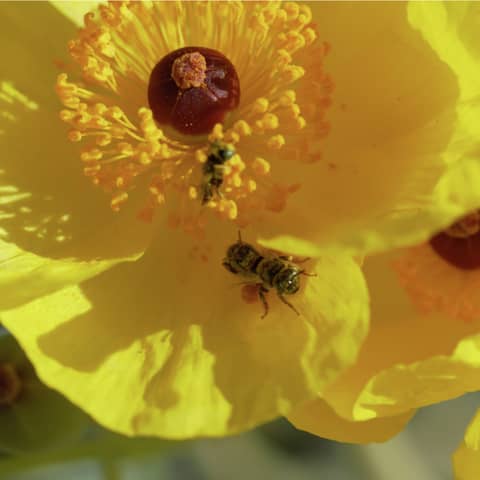
Podcast episode artwork: Mojave poppy bee (Perdita meconis). Photo courtesy Zach Portman / University of Minnesota Department of Entomology via the Nevada Independent.
Become a desert defender!: https://90milesfromneedles.com/donate
See omnystudio.com/listener for privacy information.
Like this episode? Leave a review!
Check out our desert bookstore, buy some podcast merch, or check out our nonprofit mothership, the Desert Advocacy Media Network!
UNCORRECTED TRANSCRIPT
0:00:00 - (Chris Clarke): 90 miles from the Desert Protection Podcast is made possible by listeners just like you. If you want to help us out, you can go to 90 miles from needles.com donate or text needles to 53555.
0:00:25 - (Joe Geoffrey): Think the deserts are barren wastelands. Think again. It's time for 90 miles from Needles, the Desert Protection Podcast.
0:00:45 - (Chris Clarke): Thank you, Joe, and welcome to this episode of 90 Miles from Needles, the Desert Protection Podcast. I'm your host, Chris Clarke, and today we're talking about bees. Had a wonderful conversation with Mary O’Brien of Project 1100, a small nonprofit based in Utah that works to educate land managers and the general public about the deleterious impacts of siting honeybee apiaries on public lands. Turns out honeybees compete really aggressively with native bees, some of which are crucial to the survival of flowering plants that they have evolved to work with.
0:01:25 - (Chris Clarke): And it's a little bit counterintuitive because you hear a lot about the plight that bees are facing in this world from pesticides and other issues. And almost always that conversation centers on honeybees, as Mary O'Brien will elaborate. And honeybees are, they're pretty fascinating, but just by sheer force of numbers, they can displace or out compete or starve out native species that do a much better job of pollinating the plants that they evolved with. Which means that those plants can suffer very, very badly when introduced honeybees are brought into an area, especially on public lands, which are essentially the wildflower repositories for the Western U.S.
0:02:09 - (Chris Clarke): especially in the desert. Now, introduced honeybees are not new to the desert. It was a good 16 years ago that I had my first encounter with an increasingly common, let's just call it a honeybee related phenomenon. This was a second date. And I took my date to Big Bear for a couple of days, rented a cabin, and we were gonna head to take her home to Los Angeles. And we decided to go from Big Bear to Los Angeles by way of Joshua Tree, which is not a shortcut.
0:02:42 - (Chris Clarke): It is the long way around. But we both wanted to see Joshua Tree and we didn't really want the weekend to end. So we went there and we parked my wonderful, late, lamented, used Jeep Cherokee given to me by my friend Sherwood and Diane. We went to the Cholla Cactus garden in the Pinto Basin, and it was a really hot day. It was the middle of the summer, so we left the windows in the Jeep rolled down so that it wouldn't be able to bake bread inside it by the time we got back, walked around the Cholla cacti.
0:03:15 - (Chris Clarke): Took some photos. It was a lovely time. Walked back to the Jeep, which was full of angry honeybees. I'm not talking a dozen or 25 or even 50. There were hundreds and hundreds of honeybees that were in this Jeep, batting up against the windows, not sure how to get out, missing the windows that had been rolled down several inches. And if they managed to get out, then the call of their distressed comrades would call them right back in.
0:03:47 - (Chris Clarke): We stood there staring at each other for a second, and then we just decided that we were going to drive away. So rolled all the windows down, opened the hatch in the back, left that up. I was thinking, if we get up to about 20, 25 miles an hour, we'll blow most of the bees out of the back hatch more or less unharmed. That was the goal. And it worked. And neither of us got stung. I remember very clearly my date speaking sweetly to an individual honeybee that had landed on her thigh and coaxing it onto her fingertip and putting her fingertip out the window. And maybe the bee just flew in the back window again, but it was a sweet moment.
0:04:32 - (Chris Clarke): There were bees on the steering column. They were on the shift lever. They were on the accelerator and the brake pedal. It was, I'd say, the most potentially catastrophic second date I have had in my entire life. And now it's a hilarious memory. Anyway, talking about bees, especially honeybees, but also native bees, it's interesting to note that this episode would not exist if I had not gone last year to Salt Lake City and a conference on livestock on public lands that was put on by Western watersheds at the University of Utah's law school.
0:05:07 - (Chris Clarke): It was a really interesting three days. And part of the benefit is that I heard Mary's presentation said, I gotta get her on the podcast. And only almost a year later that happened. Which of course means it would not have happened if I hadn't gone to Salt Lake City. And for that ability to travel, I need to thank you, our donors and contributors who make it possible for the Desert Advocacy Media Network to do things like get me an Airbnb walking distance from the University of Utah's law school.
0:05:40 - (Chris Clarke): And along those lines, we have some folks to thank. We have a very generous anonymous donation to our general support fund. You know who you are, and thank you for that. We also have some donors to our Amargosa documentary project, which I've mentioned once or twice before on the air. We will have an actual entire episode talking about that documentary before too many more Weeks go by, but the people who have donated this month to that project include Raghu Manavalan, Joyce Wagner, Andrea Ridley, Raphael Sbarge, Taylor Roth, and Erin Crotty. Thank you all so much for helping us get a really beautiful piece of the North American deserts on camera so that more and more people can understand what's at stakeholders.
0:06:31 - (Chris Clarke): And speaking of upcoming episodes, there won't be one next week. I have to spend the week finishing up and putting out our 2025 annual report. I will let you know where you can find that in our next episode in two weeks. It's kind of nice to look back on what we've accomplished. Inspiring, even. Anyway, let's get to our interview with Mary O'Brien of Project 1100 on the downside of putting honeybee apiaries on public land in the desert Southwest.
0:07:16 - (Chris Clarke): Mary O'Brien, from Project 1100, thank you so much for joining us on 90 Miles from Needles.
0:07:22 - (Mary O'Brien): Oh, my gosh. It's learning about all of the conservation episodes you have, all the desert episodes. I'm honored to be here.
0:07:32 - (Chris Clarke): Well, we're honored to have you. And I am quite curious about Project 1100, especially with regard to your work to educate folks about honeybee apiaries on public lands.
0:07:42 - (Mary O'Brien): Well, that's its focus.
0:07:44 - (Chris Clarke): So when you hear about threats to invertebrates, a lot of times what you hear in the media is threats to European honeybees. And a lot of people really love honeybees, you know, possibly accepting people that have allergic reactions to getting stung. But even those folks in my orbit tend to like them and just admire them from a distance. So what's wrong with honeybees?
0:08:07 - (Mary O'Brien): Well, it's really not wrong with honeybees so much as maybe some of the places they are are the best places, like public lands. They're a social bee. They are really treated as livestock. A queen is placed in a box, a hive with workers. And we've all seen stacks of boxes and rows of boxes. Any one of those boxes at the height of the summer season or the flowering season will hold about 6,60,000 honeybees.
0:08:46 - (Mary O'Brien): They will almost all be female workers and one queen and some drones, the males. And these bees will work very hard. The workers will pretty much work themselves to death individually in about four weeks, but be replaced by more worker bees. The queen can live generally one to two years, but can live as long as five years, although beekeepers will replace the queen generally after one or maybe two years so that more eggs will be laid faster.
0:09:30 - (Mary O'Brien): She'll lay between 1200 and 2000 eggs a day.
0:09:36 - (Chris Clarke): Wow.
0:09:37 - (Mary O'Brien): And so you have this factory of honeybees who are flying quite a distance. It's often been said, oh, a buffer of four miles around a hive is sufficient. Beyond that, there will be pressure on the native bees. They can fly farther than four miles, and they will spread out very far, in part to avoid each other, you know, have flower to themselves. But this is just a real problem for your native bees.
0:10:16 - (Mary O'Brien): The honey bee is going to flowers, gathering pollen and nectar to raise their young, because that's what bees do. They are vegetarians. They raise their young on pollen and some nectar. And so you've got a solitary bee. And California has the greatest diversity of bees in the entire United states, with about 1500 species of native bees, of which a few dozen at most are bumblebees, I think 25, maybe.
0:10:53 - (Mary O'Brien): So this single solitary bee will be out on the flower. Her whole species lives only about four to six weeks of the season. She has emerged from an egg and larva that had been laid the previous year. And in those four weeks, she needs to mate, find a location for a nest, dig a nest, if it's in the ground, as most of them are, go out, gather pollen and nectar, make it into a ball, put it in the nest, lay an egg on it, seal it off, go out, get the pollen and the nectar and make it into a ball and lay an egg.
0:11:38 - (Mary O'Brien): And she'll maybe lay 12 eggs in her lifetime as a flying bee. So this is what you're up against. A queen bee in many hives gathered together, each of them laying 1200 to 2000 eggs a day, and these little solitary bees laying 10 to 12 in their lifetime. Native bees will emerge at different times in the season, different species, but any one species is out there four to six weeks. Now. Bumblebees are social, but they're a different order of magnitude than the European honey bee. Because one queen will have survived from her colony the season before.
0:12:32 - (Mary O'Brien): She will have been underground for the winter. She will have mated the previous fall. She will emerge, go out by herself, and gather the pollen and nectar to make some workers bring it back to the nest. Finally, about two weeks after her doing this, the first workers will emerge, and then she'll retire to be laying eggs. And she lays nowhere near 1200 a day. Somewhere 50 to 100. Those workers then will start bringing in the pollen and nectar and taking care of the developing larvae.
0:13:22 - (Mary O'Brien): Eventually, some queens will be produced by being fed extra nutritional food. Toward the end of the season, the queen, the one that has been there, will leave and Take maybe about half the workers and set up a new colony. But all of the bumblebee colonies will be gone at the end of the season, except for some queen, all separate on by themselves. So the problem with, you know, the advantage of European honeybee for industrial agriculture like the almond orchards is in California, is they produce very rapidly.
0:14:10 - (Mary O'Brien): You can have thousands of hives and they can just blanket these large groves of almonds or later apples. And that's the advantage of them. They're not necessarily the best pollinators of almond trees, but they were the most numerous. But then comes the end of the, maybe fruit season, the almond season, the apple season. Where are the bees going to go? Because that colony lives year after year after year and the beekeeper wants to find the least expensive crop or plants that they can put out their hives on, move the hives to.
0:14:57 - (Mary O'Brien): And unfortunately, as we all know by you know, what is charged to cattle on public lands, it's a real bargain on public lands, almost nothing that you pay.
0:15:10 - (Chris Clarke): How many bees make up an animal unit month?
0:15:14 - (Mary O'Brien): Yeah, that's right. So they are livestock. And then as far as people being concerned about honeybees, it is a sense of concern in reality for individuals because pesticides, neonicotinoid group of pesticides in particular, are deadly for bees. So your honeybee keeper can lose 30% of the hive in a year, 40%, even 60%. But they just build them up again because being so prolific, they can breed them right back.
0:15:58 - (Mary O'Brien): They're not in trouble. They're more numerous now worldwide than they've ever been. They're being used agriculturally on almost all continents, in almost all countries. And the nativees are being out competed for pollen. And perhaps even more consequentially, ultimately the honeybee is transmitting their diseases to native bees. And the native bees have no immunity against these particular viruses, pathogens, parasites and so on.
0:16:37 - (Chris Clarke): So I was thinking about the livestock label and thinking about a metaphor and it seems like sheep might be the most telling one. If you have a piece of public land and you fill it with domestic sheep, then not only are they going to eat all the food that the desert bighorn sheep would have liked to eat, but they're also going to be serving as disease vectors for pneumonia and ailments like that that the desert bighorns will catch. It sounds like it's essentially the same situation with European honeybees.
0:17:05 - (Mary O'Brien): Exactly.
0:17:07 - (Chris Clarke): And I should mention to our listeners that when you talk about the dangers of pesticides for insects or any other kind of organism, you're not just remembering something that you read in a pamphlet once, but you have a history working on pesticide issues with what was the group again?
0:17:23 - (Mary O'Brien): It was Northwest Coalition for Alternatives to Pesticides, which was headquartered in Oregon, but worked with Oregon, Washington and Northern California and Idaho primarily. Yeah, for about eight years and learned the ubiquity of pesticides. The need to understand that alternatives existed for pesticide use in almost all cases, as we know from the growing industry of organic food, where pesticides have been considered essential for growing food and they are not.
0:18:02 - (Mary O'Brien): So there's alternatives. And of course, the alternatives for public land use by the European honeybee is private lands, agricultural lands, alfalfa, other farm crops.
0:18:18 - (Chris Clarke): So what are the long term impacts of having honeybees outcompete our native bees? Obviously, for those of us who cherish biological diversity and individuals of interesting species, wild pollinators, et cetera, we value them just because they exist. But what are the likely impacts if we continue swamping the public lands with these imported and extremely successful competitors to the native insects?
0:18:43 - (Mary O'Brien): Bees evolved in tandem with flowers. And honeybees are not very good pollinators, and not pollinators at all of a number of many species of plants. And you can then stress your rare plants, your plants that are in trouble, that happen to be really dependent on a particular solitary native bee or a group of native bee species. So it's both the native bees themselves, the species and the plants that they pollinate or pollinate better than honeybees. For instance, honeybees, they're looking for a mass of flowers.
0:19:35 - (Mary O'Brien): They want as many flowers as they can. That's often invasive species. And they'll go to those they really are not going to bother or notice the rare small plant, because that's just to utilize a flower, a bee has to use the method that flower is requiring of a bee. And some of the say in the Asteraceae, those are open flowers. They're easy. You can just go poke around at each of the individual flowers in a sunflower head and quickly gather pollen, get pollen all over your body and so on.
0:20:25 - (Mary O'Brien): But when you think of some of your more specialized flowers that have tubes or triggers or put nectar in certain places, then that takes a bee that knows that particular flower. When honeybees are trying to be as productive as possible, it's not worth their effort to learn how to get the nectar and pollen from particular flowers. So your rare plants are at real risk. And then as far as the native bee species themselves, it's just astonishing to read the life history of different species of bees. They are not all alike at all.
0:21:10 - (Mary O'Brien): Each one is a species that evolved and is a species because it does something differently than another species. So we're simplifying the world. When we have the honeybee as your main pollinator, we are putting certain flowers at risk of having no pollinator. They too in the desert bloom very briefly and they either get visited by a bee that can carry their pollen over to another flower of their species to make reproduction possible or not.
0:21:57 - (Mary O'Brien): There is a flower and blanking on the name right now in southwestern Utah they think has lost its native pollinators and is now serviced only to some degree by honeybees.
0:22:16 - (Chris Clarke): Now I'm not certain what southwestern Utah and Plant Mary speaking of, and I won't venture a guess, but I do note that There was a September 2019 article in the Journal of Apicultural Science that was entitled Timing of invasion by Africanized bees coincides with local extinction of a Specialized pollinator of a bear poppy in Utah, USA about sometime between 1994 and 2011. So called Africanized honeybees, which is not a name I'm really thrilled about. You could probably guess why.
0:22:47 - (Chris Clarke): But at any rate they're more aggressive honeybees, more robust, and they arrived in southern Utah at some point in the last 30 years. And it's thought that they're a big reason for the local extinction of Perdita mechonis, which is a native specialist pollinator of Arctomicon humilis, which is also known as bear poppy. Now Arctomeikan is one of my favorite desert wildflowers. It's not uncommon to see it just blooming its head off at a roadside depending on how much rain the area has gotten.
0:23:17 - (Chris Clarke): And it is worth noting that one of the lead authors of this study was Vincent Tepadino of Utah State University. That name will become relevant later in this interview. There is a subsequent paper put out by the US Forest Service which says those introduced honeybees are pollinating Arctomycon humilis just fine. And of course they would say that because they are in the business of providing rights of way for apiaries on their public lands.
0:23:46 - (Chris Clarke): Anyway, back to Mary.
0:23:51 - (Mary O'Brien): There's one threatened species in my valley in Castle Valley in southeastern Utah. They basically almost never see it reproduce. It is a threatened species. They believe it has just lost its pollinator and perhaps a honeybee would not even know how to pollinate it. One of the staff people at Xerces Society, which is your premier national organization on invertebrate conservation, said you Know, trying to save bees by saving the honeybee is like trying to save birds by saving the chicken. It just doesn't work that way. And public lands are a refuge for native bees because when they are healthy and they aren't raided by cattle or sheep, then they have a diversity of species.
0:24:48 - (Mary O'Brien): And that's where your native bees belong. They evolved 120 million years ago. They evolved from wasps. And it appears, and research is always ongoing, it appears they evolved or moths that ate primarily thrips, those little tiny black insects that are often seen all over some flowers. Yep, the thrips are eating pollen. And it appears that these species of wasps that ate thrips basically were bringing back both thrips and pollen to feed, to raise their young, and eventually evolved to just rely on pollen.
0:25:40 - (Chris Clarke): That is kind of mind blowing. That's wonderful. If the word thrips is unfamiliar to you, that's not surprising. Thrips are pretty well known to people in the entomology and landscape, horticulture businesses, and not to too many other people. But here's what they are. They are tiny little insects, mostly less than a millimeter long, not really strong flyers, in the words of Wikipedia. They are a functionally diverse group of around 7,700 species.
0:26:07 - (Chris Clarke): Some of them eat fungi, some of them are crop pests, and a few of those are crop pests because they are vectors for plant disease, viruses. Others just eat too much of the plant for our liking. However, some other thrips are pollinators, and even more feed on other small insects or mites, which can be potentially beneficial for the plants that they live around. And fun fact, the name thrips is both singular and plural.
0:26:39 - (Chris Clarke): So you can have one thrips or five thrips, or as in the case of some greenhouses, I have walked into hundreds of thousands of thrips. In fact, it's probably more likely you have that many than that you have one thrips. The word is a direct transliteration of the ancient Greek word, wait for it, thrips, which means woodworm, but also in ancient Greece, was sometimes used to describe someone who is cheap as hell.
0:27:05 - (Chris Clarke): I'm not sure what the relationship there is between that pejorative and the insect that we'd call thrips. But if you have a sense of what it might be, let us know.
0:27:15 - (Mary O'Brien): Worldwide, deserts are where bee species are, and particularly solitary bee species. So as I mentioned, California has more bee species than any other state in the Union. About 1500. Project 1100 is named after the number of species In Utah, which is where I was working for Grand Canyon Trust when I started working on this project.
0:27:45 - (Chris Clarke): How does Utah stack up to other southwestern states? I mean, we've covered California, but California has all these different crazy biomes jammed into the same political boundaries. We have kelp forests and redwood forests and Joshua tree forests and saline lakes and all these different kinds of biomes.
0:28:02 - (Mary O'Brien): You've got it. You're the best state in the Union that way.
0:28:05 - (Chris Clarke): And Utah's no slouch. I mean, Utah's got sky islands in the south and slot canyons and the Wasatch Range and its own gigantic saline lake and a couple others. And so there's clearly a lot of opportunity for differentiation and evolution for organisms that find themselves in Utah. But how are the other states?
0:28:24 - (Mary O'Brien): Well, like I said, California has about 1500 species of bees. Arizona is second with about 1300. You got the Sonoran Desert there, and then Utah's third, about 1100. Colorado, not so many, because it's more moist state. So really, it's the deserts, and it's counterintuitive, right? Deserts are dry, they're hot. The plant flower, the flowers of some species, you just got to get out at a particular time of year or you've missed it. And that's precisely what has probably juiced the evolution and speciation of native bees. Because if you got these flowers that a particular species with its own configuration of the flower is only going to be there for a few weeks, you've got to have a bee on it right away.
0:29:19 - (Mary O'Brien): You've got to have a bee that's adapted to that flower. And, you know, a bumblebee has to have flowers all season. The colony lives all season. It depends on flowers being there. Solitary bees don't depend on the flowers being there all season. They've got a bee that's pretty well matched to this flower that's only there for a little bit of time. In fact, when I did my dissertation on pollination of some plants in Southern California, in San Bernardino Mountains, there was a particular little onion that was endemic to the site, called a Rostrary Flats.
0:30:02 - (Mary O'Brien): And that onion would emerge in the spring, and so would the little bee that pollinated it. And when I caught those little bees during the season and knocked them out with dry ice long enough to take some pollen off them, they always had just that pollen. Then the plant would finish flowering and the little bee would be around for several more days and be gone. They were that tightly adapted to each other. Same signals for emergence in the spring.
0:30:40 - (Mary O'Brien): Solitary bees are Often very, very hard to identify. It takes a specialist. I found a specialist, that genus. And he said, you know, I think this is a species that hasn't been named before. Do you need me to go through the whole process of distinguishing it from the other species? And so I said no. I kind of regret that I was being careful of his kind, but I kind of regret that I would have learned what species that was and he.
0:31:11 - (Chris Clarke): Could have published it.
0:31:13 - (Mary O'Brien): That's right. But instead I published who was pollinating all 21 species on our ostray flats. And it wasn't always bees.
0:31:23 - (Chris Clarke): So quick question about that. I mean clearly bees are extremely important and they're what people think of a lot of the times when they think of pollinators. But there are lots of other pollinators, everything from birds and bats to moths and butterflies to flies and other kinds of insects. How do they play into this? I assume that there are some species that honeybees are not an issue for. I mean Joshua trees only get pollinated by Joshua tree moths.
0:31:50 - (Chris Clarke): Bees are probably not going to impact that. Similarly for things like saguaros that are bat pollinated, maybe honeybees wouldn't be that big of a deal. But do they interfere with say fly pollinated and other kinds of insect pollinated plants?
0:32:07 - (Mary O'Brien): No, I don't think there's much interference. It's rather some plants, particularly generalist fluoride flowers, can be pollinated by, you know, 20 different species. And it can be some flies, sometimes syrphid flies in particular are being found to be quite key pollinators or plants. Beetles can sometimes pollinate. Beetles are often less so because they don't have hairs on their body to capture pollen, which is why those hairs on bees were evolved specifically to gather pollen.
0:32:46 - (Mary O'Brien): So some species are less effective. But still, if their numbers are great or they are coming out in a particular season and the native bees aren't, the native bees are quite good at sometimes just skipping a season if they can tell this is going to be slint pickings because of drought. So I learned very little of interference, but more additive and hedging bets and so on. That said, a little solitary native bee is not going to be able to pollinate a bat pollinated flower.
0:33:25 - (Mary O'Brien): Social bees, their greatest speciation is in the tropics in human areas. Meadows way up in high alpine area because they have flowers all season long. So it's the deserts that are spectacular for solitary bees. To put this in perspective, there was a four year study in Grand Staircase Esquani National Monument in southern Utah. And they found it had about 600 species of native bees. If you picture the US from the Mississippi east, that is including all the eastern coast from the Appalachians over there in all of those states, there's about 700 species of bees.
0:34:25 - (Mary O'Brien): And yet just in Grand Staircase Esfaloni national monument, there's over 600. So it's just something to be celebrated in the desert. And if the listeners to 90 miles from Needles understand what a treasure they've got with these solitary bees and start looking for them. Some of them are metallic green. Some are, you know, big and heavy like the carpenter bee. Some are very, very tiny. Some look like wasps, but aren't.
0:35:01 - (Mary O'Brien): Some are blue. Once you know, native solitary bees are in your world, in your desert world, you really can delight in like, oh, I don't think I've ever seen a bee like that. I've never seen one of those. And yet it's very, very hard to learn whether they're which ones are declining, which ones are rare. Because think of how you study the population of one species of solitary bee. You've got maybe four weeks in the year that you can do all your research.
0:35:39 - (Mary O'Brien): You've got them very tiny, maybe not emerging in the year that you had free to do the research, and you've got to distinguish that one from other native bees. And they can often look very, very similar. So we basically don't know. We do know they are declining because simply because they aren't there on the flowers as much as they were, or certain flowers, seeds are not being produced, we just know as a group they're in trouble.
0:36:18 - (Mary O'Brien): We know very little about an individual native bee species except again, for the bumblebees. They're big, they're slow, they're obvious. And you have the whole season to study them because the colony is going to be there. And so that's why under California Endangered Species act, there's several bumblebees that are candidates for listing under cisa, California Endangered Species act, for the most part, except for one group of Hawaiian solitary bees. There's solitary bees just don't make it to the Endangered Species Act.
0:37:00 - (Mary O'Brien): They will have evolved over millions of years and they can be lost. And we never knew they were there.
0:37:09 - (Chris Clarke): So we're talking about honeybees as a threat to these other species of bees. And I don't want to lose track of that because obviously it's your primary focus with Project 1100, and we've talked about pesticides. Are there other threats that we need to account for? For the solitary bees and the bumblebees and other critters like that.
0:37:27 - (Mary O'Brien): Yeah, I think the big is a big one is loss of habitat. You know, every time a new housing development goes in, a new data center goes in. Anytime land has lost a diversity of flowering species, then you've lost native bees. So habitat loss is huge. And of course facing not only native bees but us is climate change. It's getting hotter, it's drier, drought, obviously in drought there's going to be less flowers or smaller flowers and it can't support as many bees.
0:38:08 - (Mary O'Brien): So climate change, habitat loss, pesticides probably account in the larger picture for most loss of native bees. So you think, well, why am I spending my time on this issue of permitting of apiaries on public lands? It's simply because that's one other stress. So Project 1100 is about as small of an organization as you can get. I'm the volunteer director, has a board of six people. But my focus is also very small.
0:38:47 - (Mary O'Brien): Try to end the permitting of apiaries on public lands. And to do that, it isn't. It can't be just me. I have to rely on the scientists who have studied these to know that they are in trouble. I rely on center for Biological Diversity for the legal wording we use in communicating with managers who are making decisions about apiaries. I rely on Xerces. They're a partner in providing the latest. Just quite often I get an email in my email box. Mary, here's another research article that will help us. So I work with the California Native Plant Society, which is spectacular for knowing the rare plants, and then combine that with what I can learn from the scientists about whether it's be pollinated or likely be pollinated given its particular configuration.
0:39:51 - (Mary O'Brien): So I'm doing this one little task of trying to end the permitting of apiaries on public lands. But my partners are there with me on the letters we sign on the advice, on the science, on the field science on the academic science. And so they're glad I'm doing that. They have pesticides to be dealing with, they have other CBD has all these other species, but they know I'm just on it with a little laser on this issue of apiary per native. And then I try to track where are the apiaries, how many are there, because Project 1100 started in the last two years of my 40 years of working as staff with public interest organizations. First toxic, like you mentioned, pesticides, and then public lands conservation with Hells Canyon Preservation Council and Grand Canyon Trust. For 17 years, my doctorate had been in pollination, right?
0:40:56 - (Mary O'Brien): I had never dealt with pollination in those 40 years. In year 38, I get an email from Vince Tepidino, whose career has been strong studying native bees. And he's frantic. He had somehow found my name on the web, that I knew pollination biology, which I had not dealt with in 40 years. And he sends me an email. He says, I need help because AD Honey out of South Dakota, the largest honey producer in the country, wants a permit for 8,000 hives on the forest in Utah.
0:41:40 - (Mary O'Brien): He said it'll be devastation for native bees. He says, I know the science, but I don't know how to deal with the Forest Service. That's what you've been doing. Can you help? And you know, I was just two years away from my planned retirement. I thought, oh, man, how interesting. I haven't dealt with this since I was a graduate student and I started working on it. And when I left Grand Canyon Trust, there was no one going to continue it because their plate was full with all kinds of Bears Ears National Monument and so on. They had their own issues.
0:42:18 - (Mary O'Brien): So I thought, well, if I'm going to continue using the Freedom of Information act request to find out where the apiaries are, I'm just going to have to form a 501C3 so I can get the FOIA information free. So I know that in California about five national forests have apiary permits. And I know when their permit is expiring. And at that point that we send a letter. We, I say, California Native plant Society, Xerces, CBB and Project 1100 sends a letter, look, this is why you shouldn't renew this permit or you shouldn't authorize this permit by a request.
0:43:07 - (Mary O'Brien): So I have to find out by foia, because these permits are issued with no public notice. They're done under what's called categorical exclusion from the National Environmental Also Act. Really no analysis is needed, no documentation, Just say yes to the permittee. So we have relied on FOIA to find out where they are and we, we are tracking particular permits, particular permits that supposedly expired December 31st this last year.
0:43:44 - (Mary O'Brien): And I have FOIA requests in to find a. Did you renew them? We had sent a letter. We had sent a letter urging the manager not to renew it. And I rely on foia. And of course, this is one of the myriad casualties of depopulating the federal agencies. There's just no one there to answer the slew of FOIA requests. And probably, I don't know for sure, but I probably foia request numbers are going up because there's so much less transparency.
0:44:17 - (Mary O'Brien): And then you've got almost no one there to answer the FOIA request. So I've got a problem now. I'm going to be starting this month doing phone calls trying to find out if the permit has been renewed. But I still will rely on FOIA to see the permit and to see when it expires. And it's like all public institutions right now that are federal are being hollowed out. And it's, it's simply I will have to deal with as many ways of communicating as possible to try to track where the permits are expiring, where they are being issued or about to be issued so we can try to lean in on the manager.
0:45:11 - (Mary O'Brien): And legal routes are disappearing for all of us who are working on conservation. But this is where we rely more on a sense of responsibility about the world. Native bees are most dependent on our desert areas, BLM and Forest Service arid areas and refuges. And we know that introducing honeybee apiaries is direct impact and threat to the native bees. And you don't need to do this. They don't need to be there on the federal public.
0:45:54 - (Chris Clarke): So, Mary, we've eaten up a lot of your morning and I'm aware that you need to get to a demonstration in Moab, and thank you for doing that. But I wanted to ask basically, what can listeners do, aside from going to the Project 1100 website to learn more, which we always recommend? You and I talked a little bit yesterday about a wonderful book that we will link in the show notes called the Forgotten Pollinators by Stephen Bachman and Gary Nabhan.
0:46:18 - (Mary O'Brien): Yeah, it's wonderful.
0:46:19 - (Chris Clarke): And I'll read a laundry list if Gary Nabhan writes it. But Stephen Bachman is also an amazing writer and the book's a couple decades old at this point, but it's still an important resource. Aside from those things, both of which are really important, what can people do to first off, help you do what you do, and secondly, limit their own contribution to the honey industrial complex Apiaries on public land. Are there ways that people can avoid accidentally buying public land apiary honey?
0:46:50 - (Mary O'Brien): Yeah, there's several things. It's often quite attractive to think that you're buying wildflower honey. You're almost certainly buying honey that was produced on public land where there's the diversity of wildflowers. So just buy your regular old alfalfa honey and tell your local organic food stores that that wildflower honey probably is public land honey. It's kind of like range fed beef, free range. It means that cow was on public lands probably.
0:47:29 - (Mary O'Brien): So what can sound good may be in fact the worst. There's an interesting just little story at Woonflower Market in, in Moab, the organic food store I go to, they had, they have some books for sale and one of them was growing wildflowers for honeybee and honey. I went up to the checkout person and I said, you know, you really shouldn't have this book here. You should have one about growing native plants for native bees in your garden.
0:48:02 - (Mary O'Brien): And he said, honeybees are in real trouble, they're endangered. I said, well actually they aren't. And I started to explain how they can be reconstituted their numbers in the winter. And another customer in the store heard this and said no, I, I read, I read the honeybees is endangered. And I, you know, didn't argue further but I thought, you know, next time I come to the store I'm going to bring a fact sheet from Xerces about honeybees and native east.
0:48:33 - (Mary O'Brien): And I came the next day, next time, not the next day. And he wasn't there and I had the paper all ready to show, showing and but the next time I came to the grocery store, I didn't have the paper with me. He says, oh, by the way I looked it up, you're right, honeybees are not in trouble and it is the native bee. And so I love that. So that's one thing people can do is share this knowledge that honeybee is non native, it's invasive, it's not in trouble.
0:49:10 - (Mary O'Brien): But if they grow native plants in their garden, they will have the joy of seeing native bees. And if they decide to take up honeybee, have a couple honeybee hives. So the joy of raising your own honey, you are just putting the native bees in your neighborhood at risk. And Southern California was, I saw there was a big article in the Los Angeles Times that for parts of Southern California almost all you can find is honeybees.
0:49:45 - (Mary O'Brien): So put up a hotel, a bee hotel with the holes. There's lots of direction on the web how to do that. Now that's for a very small sliver of the native bees because 85% of native bees nest in the ground and they're not interested in your bee hotel, but leafcutter bees and some others are. And that's fun to be providing habitat for the native bees. Also simply knowing about native bees and the honeybee and spreading that information just in conversations or when you're talking in Your conservation work about wildlife. Include bees as wildlife because they are.
0:50:33 - (Mary O'Brien): It isn't just the big animals and the charismatic animals. I just routinely talk about wildlife as mammals and birds and bees and, you know, just include them. There's also this. There's about nine major groups of native bees in. In western US and there's this little, this folder Common bees of Western North America. It's a little laminated folder and it's just great for having in your day pack or just looking at it.
0:51:07 - (Mary O'Brien): And you eventually will start recognizing different types of bees. It just helps you. Suddenly what has seemed faceless all the same little bees, emerges into your vision as really different bees. Then an odd one I've never mentioned before in Project 1100 because I've relied on FOIA. If you see some hives on BLM or Forest Service land, I'd like to know where those are. Now, the chances are they're legal, they have a permit, they've been permitted to be there.
0:51:48 - (Mary O'Brien): But on the other hand, they may not have been. And it also may be an apiary that I had wondered whether they had been permitted or not. So my address is on our website, Project 1100 and you spell out 1100, it's just project1100.org I would love to know when you see nav highs, but you need to tell me exactly where that was. If you could tell by GPS or whatever or as specific as you can and take a photo, that would help me.
0:52:28 - (Mary O'Brien): For the most part, we're trying to work behind the scenes with the Forest Service managers and BLM managers because you know what? They're under the pressure they're under to use public lands for every private purpose possible. We haven't been running media or trying to get huge numbers of people up in arms about it. Actually, that may be counterproductive in the sense that it would bring attention of the honeybee industry and oh, let's add something, a rider on some bill that just mandates that you can never say no to a permit.
0:53:10 - (Mary O'Brien): So I think this is all behind the scenes and quiet. Anyone who knows a particular BLM or Forest Service manager and can just talk with them and say, do you have apiaries? You know, oh, good, I'm glad you don't have any apiaries because they're really hard on the native bees and provide them with a flyer. You can print one out from my website. But again, Xerces has great handouts on this. Xerces Society also has lists of plants you can grow that do attract native bees because some flowers just don't and others are visited by different species of native bees. So those are some of the things, but the most important is just remembering that it is the native bees, the bumblebees and the solitary bees that are really, really put at a disadvantage with the honeybee.
0:54:15 - (Chris Clarke): And if you really need to eat wildflower honey, just buy it from France or Belgium or someplace like that.
0:54:21 - (Mary O'Brien): Right where the honeybee is native.
0:54:25 - (Chris Clarke): Mary o', Brien thank you so much for joining us. This has been a wonderful conversation and we will have an abundant set of links in our show notes to your group and the Xerces Society and a link where people can pick up a copy of Forgotten Pollinators. And this is a topic near and dear to my heart. I'm just very grateful that you took some time out of your morning to join us.
0:54:46 - (Mary O'Brien): Enjoy this spring in California. You're not in drought. First time in 25 years. The whole state is not in drought.
0:54:55 - (Chris Clarke): Something like that.
0:54:57 - (Mary O'Brien): Go see the bees.
0:55:10 - (Chris Clarke): Thanks so much to Mary O’Brien for spending this time with us. It was a really wonderful conversation. I learned a whole lot and I'm appreciative for that. If you go to our show notes on this episode, you will see links to Project 1100 to the Xerces Society, to a link or two from the center for Biological Diversity about protecting pollinators, as well as to a place where you can order that laminated fold out guide to Native Bees of the Western us. Again, thank you to our donors for making episodes like this possible.
0:55:43 - (Chris Clarke): We will be back in two weeks. With any luck we will have a finished annual report to share with you at that point. We're probably not going to print them out this time. We printed out a lot of them a year ago and sent them out to the donors and got most of them back because we didn't have good addresses. That was distressing. But at any rate it's better to have a PDF anyway because you can make as many copies as you want and it doesn't cost us a dime. We will be printing a few out just to put in packets for potential small business sponsors and like that.
0:56:16 - (Chris Clarke): And if you really want one in print, I think we can arrange that. Just hollering really hope you are doing okay. It has been absolute craziness on the national scene. Families getting torn apart, federal agents acting in disgusting ways. But it's important to remember that there is cause for joy. I spent several wonderful hours this past weekend in the company of really impressive environmental activists from deserts and arid lands in Africa and Asia and Baja California. And if making new friends from Kenya and South Africa and Zimbabwe and going to a giraffe enclosure and feeding the giraffes tasty lettuce with your new friends. If that doesn't bring joy. And maybe pharmaceuticals are called for. One thing I took away from last weekend is that joy is a much better motivator than fear or anger. And we need both the fear and anger, though they're both appropriate, especially these days. And sometimes that fear and anger can seem to take over our brains and it's unpleasant. It is often called for. Let's not forget the joy part. I hope you do something that brings you joy in the next few days, and we'll see you in a couple of weeks. Take care of each other and yourselves because the desert needs you. Bye now.
0:57:30 - (Joe Geoffrey): And that brings us to the end of this episode of 90 Miles from Needles, the Desert Protection Podcast. You can find show notes for this episode along with links and background at 90 miles from Needles. We're also on social media. You can find us on Facebook, Instagram, Bluesky and Threads. Just search for 90 miles from Needles. And if you'd like a more direct line, you can reach us on signal at HEY90MFN67.
0:58:05 - (Joe Geoffrey): If you'd like to support the show, you can make a donation of whatever size and frequency feels right to you at 90miles from needles.com donate listener support is what makes this podcast possible. Our voiceover is by Joe Geoffrey. Podcast artwork is by Martin Mancha. Nature sounds are recorded by Fred Bell. Our theme song, Moody Western, is by Brightside Studio, with additional music licensed from Independent Artists.
0:59:34 - (Joe Geoffrey): 90 miles from Needles is a production of the Desert Advocacy Media Network.

Executive Director
Mary O'Brien serves pro bono as the Director of Project Eleven Hundred. For 40 years Mary has worked within environmental organizations on pesticide reform, environmental law, and conservation-based public lands management. Her masters and doctorate in Botany were pollination studies in the San Bernardino National Forest of southern California.