

 RSS Feed
 Amazon Music
 Apple Podcasts
 Audible
 Castbox
 Deezer
 Fountain
 iHeartRadio
 Pandora
 PocketCasts
 Podcast Addict
 Spotify
 YouTube
Join host Chris Clarke as he explores the inspiring vision of establishing a transboundary network of protected areas across the US-Mexico border with guest Rick LoBello, Education and Conservation Director at the El Paso Zoo. Chris and Rick discuss efforts to connect Big Bend National Park with neighboring protected areas in Texas, Chihuahua, and Coahuila, fostering cooperation for conservation amid challenging politics. Discover the fascinating wildlife, conservation challenges, and potential benefits of this ambitious cross-border collaboration, while highlighting the unique community bonds in the Chihuahuan Desert region.


In this episode of the "90 Miles from Needles" podcast, host Chris Clarke engages in a thought-provoking discussion with guest Rick LoBello about ambitious conservation strategies along the U.S.-Mexico border. Rick shares insights into his life-long campaign to establish a transboundary protected area encompassing Big Bend National Park, Big Bend Ranch State Park, and several protected regions in Mexico. Despite the current political climate, Rick’s vision emphasizes the possibility of international cooperation in conservation efforts as a means to foster better cross-border relationships and protect vital ecosystems.
Throughout the episode, the conversation traverses a wide range of fascinating topics such as the historical context of the international park proposal and natural wonders of the Big Bend region. The dialogue also highlights the challenges and opportunities in bridging conservation efforts across borders, particularly considering the complex socio-political dynamics. Rick stresses the importance of collaborative frameworks, engaging with local communities, and leveraging relationships to advance conservation initiatives. He draws on past examples of successful cross-border collaborations and provides a roadmap for future actions.
Key Takeaways:
Transboundary Conservation Vision: Rick LoBello shares his initiative to promote a transboundary protected area involving U.S. and Mexican protected lands, aiming for improved environmental preservation and cultural cooperation.
The Role of Local Communities: Local Mexican communities like those in Boquillas del Carmen play a crucial role in conservation efforts, showcasing the importance of community engagement in international environmental initiatives.
Unique Biodiversity: The Big Bend region boasts a rich diversity of wildlife which includes black bears, desert bighorn sheep, and a wide range of plant life, underscoring its value as a conservation priority.
Successful Cross-Border Collaboration: Historical precedents suggest that meaningful, structured collaboration between countries can address mutual conservation challenges effectively, despite political headwinds.
Educational Outreach: Rick’s efforts to increase awareness of Chihuahuan Desert biodiversity through initiatives like the El Paso Wildlife Conservation Society and educational events highlight the critical need for public knowledge in conservation success.
Notable Quotes:
"I've made it a mission in my life to do all I can to help make [a transboundary protected area] a reality."
"People need to know each other and people need to trust each other if we're going to make progress."
"The black bear told us that the environment can heal, and there's hope for other species too."
"My main concern when it comes to development is that it be done in a way that's ecologically sensitive."
"If they know it and they love it, then they're going to want to protect it."
Resources:
Chihuahuan Desert Conference: Visit Chihuahua Desert Conference for details on upcoming events.
Listeners are encouraged to tune into the full episode to explore more about Rick LoBello's inspiring proposals for cross-border conservation, and to stay updated with upcoming episodes of "90 Miles from Needles" for more engaging cont
Become a desert defender!: https://90milesfromneedles.com/donate
See omnystudio.com/listener for privacy information.
Like this episode? Leave a review!
Check out our desert bookstore, buy some podcast merch, or check out our nonprofit mothership, the Desert Advocacy Media Network!
UNCORRECTED TRANSCRIPT
0:00:00 - (Chris Clarke): 90 miles from the desert Protection Podcast is made possible by listeners just like you. If you want to help us out you can go to 90 miles from needles.com donate or text needles to 53555.
0:00:25 - (Joe Geoffrey): Think the deserts are barren wastelands? Think again.
0:00:34 - (Joe Geoffrey): It's time for 90 Miles from Needles, the Desert Protection Podcast.
0:00:43 - (Chris Clarke): Thank you, Joe, and welcome to 90 Miles from Needles, the Desert Protection Podcast. As always, I'm your host, Chris Clarke, and the last week or two have been pretty damn hard with odious conduct of federal enforcement agents in Minnesota and in other places as well. And things are ramping up more and more on the bad news end of things. So we're going to try and counter.
0:01:09 - (Chris Clarke): That just a little bit.
0:01:10 - (Chris Clarke): We don't want to make the bad news go away because we need to pay attention to it but sometimes hearing some good news that has a little bit longer of a time frame offers a little bit of perspective.
0:01:25 - (Chris Clarke): At least we hope so. And so we're going to have a great conversation in this episode with Rick Lobello, who is Education and Conservation Director of the El Paso Zoo. He's a longtime National Park Service staff person. He's worked at Big Bend and Guadalupe Mountains and Carlsbad Caverns National Parks. And just for the last couple of generations, Rick has been the best ally he can be to the wildlife, the plants, and the people of the Chihuahuan Desert.
0:01:55 - (Chris Clarke): Anyway, he's working on an idea that gives us a little bit of a Reminder that right now is not the end of things. As bad as our body politic has gotten on the idea of cooperating with people from the next country to our south, it's good to remember that there's a different future possible. Rick and I will be talking about his work to form a network of protected sites, including Big Bend National Park and Big Bend Ranch State Park, along with a couple other protected spots in Texas and three formally protected areas on the other side of the river in Mexico. And it's just a really optimistic and wonderful scenario. Makes a lot of sense. And so of course this administration won't do it, but maybe the next one will, if there is a next one, and we need to make sure that there's a next one.
0:02:44 - (Chris Clarke): It's always a treat to talk to Rick LoBello, either for the podcast or in person, which I got to do in El Paso last year. I think you're going to enjoy our conversation, but I want to take time first to thank a couple of folks who've made generous donations to the Desert Advocacy Media Network, which is, after all, the Nonprofit mothership of 90 miles from Needles got a wonderful generous donation from Lynn Buckner, who I really should have thanked in the last episode. In addition to Lynn's donation, we got a wonderful one from Kristen Stipanov.
0:03:14 - (Chris Clarke): Thank you, Kristen. And another quite generous donation from a person who prefers to remain anonymous. But you know who you are, and I'm touched beyond belief. If you want to join Kristen and Lynn and our anonymous friend, go to 90miles from needles.com donate. And with that, let's get to our conversation with Rick Lobello of the El Paso Zoo and many other projects.
0:04:18 - (Chris Clarke): We're really lucky to have Rick Lobello joining us again. He talked to us a couple dozen episodes ago about the Texas Lobo Coalition with some of his colleagues in the Trans Pecos El Paso area. It's really hard to figure out exactly what to focus on in introducing you, Rick, because you've just, you have your fingers in so many different things, you know, Current gig as education and conservation director at the El Paso Zoo, Rick has also worked in almost all of the major landscape level national parks in the Chihuahuan Desert, at least on the north side of the border.
0:04:55 - (Chris Clarke): And we're talking today about an idea that is a little bit counterintuitive given current politics, I think, but it's a beautiful idea of establishing a formal cross border network of protected lands, including Big Bend National Park and Big Bend Ranch State Park, which are neighbors on the Texas side of the Rio Grande, Rio Bravo, as well as protected areas in Mexico and a couple others in Texas, including the wild and scenic river sections of the Rio Grande.
0:05:30 - (Chris Clarke): And basically this would connect pieces of protected land that are about the size of Los Angeles County, a little bit smaller than LA county for a more regionally appropriate comparison, a little bit smaller than Hudspeth County, I think. But that's enough introduction. Rick, just really pleased to have you join us again.
0:05:50 - (Rick LoBello): Thanks for having me. I've been working on this project in Big Bend National Park to help put the conservation of the area internationally on the radar screen in Texas and in the country basically since 1988 when I was invited by the governor of the state of Coahuila, Mexico, to go with him on an expedition into the Maderas del Carmen mountain range, which is right across from the Rio Grande Village Campground in Big Bend. And I went with the superintendent of Big Bend National Park, the Late Jim Carricko and and all the senior staff from the park, along with representatives from different organizations and other agencies like Texas Parks and Wildlife.
0:06:40 - (Rick LoBello): And when I Saw that mountain range, I said to myself, oh my gosh, this is even more beautiful than Big Bend. And then I started to learn more about the international park proposal. And ever since then, I've made it a mission in my life to do all I can to help make that a reality. Now, today on the Mexican side, they have the area. As a result of the governor of Coahuila pushing this forward, they have that area protected in a way, through the Mexican government system of protected areas.
0:07:19 - (Rick LoBello): But it's not the same as a national park. People are still allowed to live there, which I have no problem with, because I believe that today when we try to protect nature, we have to involve people. We just can't say people can't be there.
0:07:33 - (Chris Clarke): Right.
0:07:34 - (Rick LoBello): And they're doing a pretty good job. But because of the politics in Mexico, there's no guarantees that land is going to stay protected the way it is now. So I've always felt that if we had a international treaty with Mexico on protecting the lands on both sides of the border as one big international protected area, that would help to get more attention for funding to address some of the conservation issues on the border where they need help. And I've talked to the managers of the protected areas in Mexico, and they have a lot of things they need help with, but not enough money.
0:08:16 - (Chris Clarke): Right.
0:08:17 - (Rick LoBello): So if it was designated as a high priority area for international protection, I think it would help to draw more resources to both protected areas. Right now, even Big Bend National Park doesn't have enough resources to deal with things like exotic species, feral hogs, aoudad, exotic plants moving in, and the Mexican side is even worse. So I think right now the politics in our country is not very good when it comes to an international designation in Big Bend.
0:08:52 - (Rick LoBello): But I think we need to have a good plan for the future as to how that could happen, because there hasn't been a plan in decades. The last time there was any kind of plan to protect those areas as one big unit with both countries maintaining their sovereignty, was back in the 1930s when the first international commission was formed and they actually met here in El Paso. Most people don't know that Big Bend National Park, for example, was never meant to be a national park on the US Side only, it was originally proposed to be an international park.
0:09:33 - (Rick LoBello): And I believe that a lot of the problems that we have on the border with Mexico might not be as great if we had gone through with the original proposal, because President Roosevelt said that it would be a meeting ground for both cultures to come together where you know we're seeing each other on the trail, getting to know each other and in the campground and so on. So that never happened. But there's still hope for the future. And I'm now working with people from both sides of the border. As a result of my leadership with the Chihuahuan Desert Education Coalition, we now have, for the first time in the history of our organization, which focuses on protection of the entire Chihuahuan Desert.
0:10:19 - (Rick LoBello): Our vice chairperson is from Mexico and we got board members from Mexico. So that's a really good thing and that's going to help us with the current effort that we're trying to undertake.
0:10:32 - (Chris Clarke): I've only been to Big Bend National Park once, which is failing on my part, that I need to rectify as soon as possible, need to get back for a second visit. But I was really surprised to the degree that there's a very subtle, but nonetheless thriving cross border commerce that goes on, especially places like Boquillas and Rio Grande Village, where there is, aside from the border crossing station, basically no infrastructure that would make you think that this was a contested frontier.
0:11:04 - (Chris Clarke): You know, horses wandering back and forth across the river without any regard for immigration laws or livestock importation laws or things like that. You know, I probably had maybe not my life, but certainly my happiness saved by somebody that sold me a. A big bag of empanadas before I went on a hike.
0:11:24 - (Chris Clarke): Clearly made in somebody's oven over in Boquillas. And it's just, it's always seemed to me like what a border ought to be. You know, it's more of a. More of an eco tone than a separation.
0:11:39 - (Rick LoBello): Definitely. Yes. I love going down to the border.
0:11:42 - (Chris Clarke): And so with regard to folks that live in Boquillas or nearby, I recognize we're not talking about a lot of people here, a couple hundred maybe. But what are people's sensibilities as far as you can tell, about how people in Mexican communities along this section of the border feel about conservation?
0:12:04 - (Rick LoBello): For years on the Mexican side, many people from that area and further south, even towards Mexico City, have been very suspicious of efforts to create an international park, thinking that this is just another way for the United States to grab some of Mexico like we did over 100 years ago when we went to war with Mexico and one quarter of the United States, or one third of the United States was taken from Mexico.
0:12:37 - (Rick LoBello): And then many people have thought that if you were to make an international park, that would mean the people who live in that area would have to move. Because at Big Bend National Park, that's what they had to do do so. As a result, I've avoided as much as possible the use of the word international park, even though that was in the original proposal. And now I'm saying trans boundary protected area, which makes more sense. And to be a protected area does not require that the people who are living there move someplace else.
0:13:10 - (Rick LoBello): But, you know, the educational outreach has not been great. There have been people in cities like Monterey and Chihuahua City and even Mexico City who have been supportive of this. But the main thing is, is the people who are down there right now in Boquillas, they see the value of promoting conservation and tourism because it's their livelihood.
0:13:34 - (Chris Clarke): Right?
0:13:34 - (Rick LoBello): That's how they're making their money, selling souvenirs. And they have little restaurants over there. And even though, as far as I know, the Mexican government does not have a formal program in those protected areas for guided hikes and tourism, informally, the people who live down there have been doing it. They've been talking to tourists that come across to the restaurant and they ask them, hey, do you want to go up in the mountains with me? I got a pickup truck.
0:14:07 - (Rick LoBello): And then they charge them for that trip.
0:14:09 - (Chris Clarke): Wow.
0:14:10 - (Rick LoBello): Now, there is an outfitter, Mike Davidson, who right before COVID had some kind of agreement with the Maderas del Carmen protected area through this organizations called Cemex. They are a big cement company that bought a bunch of land and have protected it. And I believe he had an agreement with either them or the government to actually take groups up there. But I haven't heard a whole lot as to whether or not he's going to start that up again. But I do know for a fact that some of the people in Boquillas are taking people into the interior, either legally or illegally. I'm not sure how they're doing it, but what I'm trying to tell you is that the people who live down there, they see the value of conservation, and they would be greatly in favor of probably development.
0:15:02 - (Rick LoBello): My main concern when it comes to development is that it be done in a way that's ecologically sensitive to the entire region. Like, for example, one of the greatest things that people are promoting about Big Bend National Park is the dark skies. If some developer was able to convince the governor of Coahuila to build a big resort right on the Rio Grande, there's no guarantee that it would be fitting into the landscape where you wouldn't have all these lights going off at night.
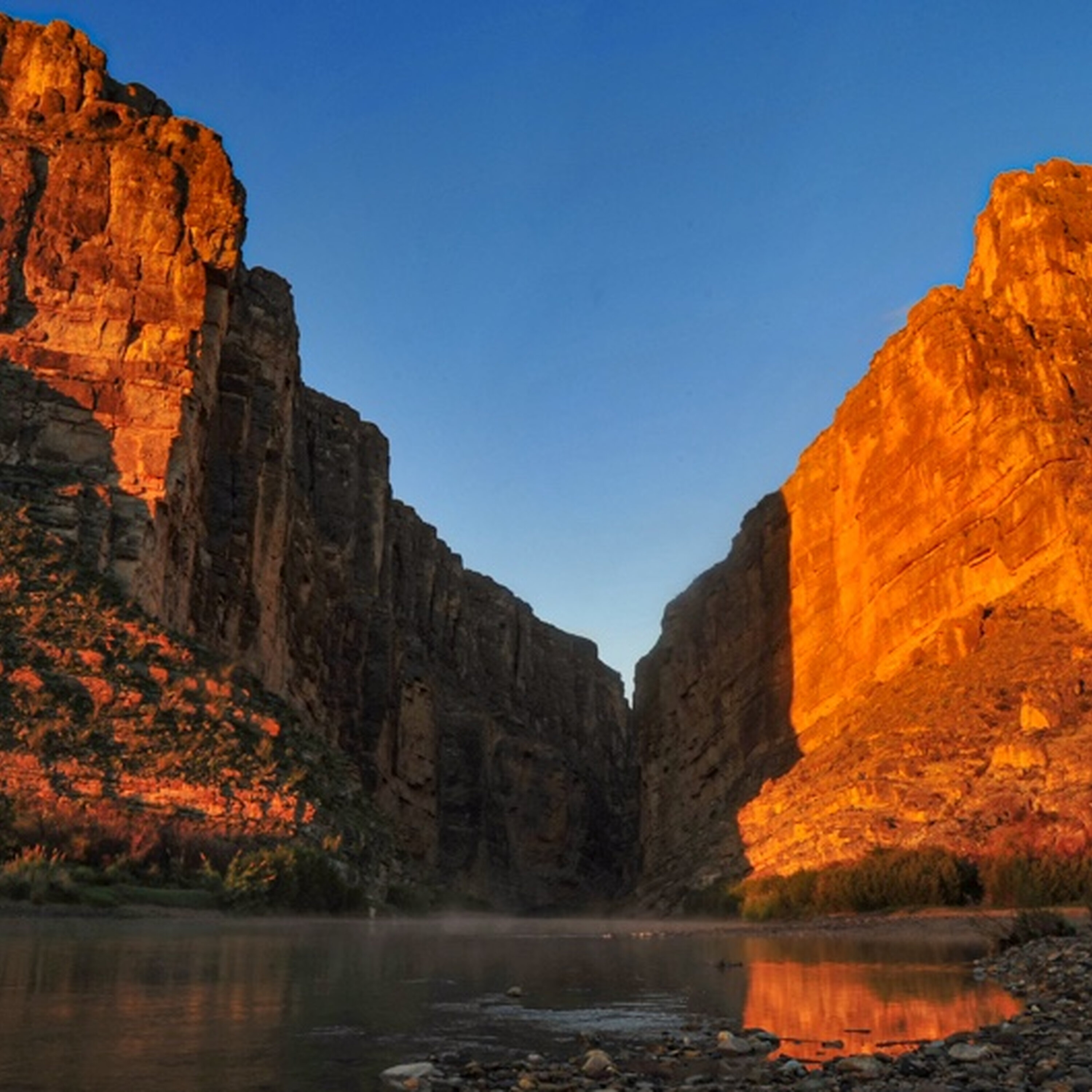
0:15:35 - (Rick LoBello): And when you drive the roads of Big Bend National Park, no matter whether you're going to the east side and Boquillas Canyon and Rio Grande Village, or you're going to the west side to Santa Elena Canyon. A tremendous percentage of what you see when you're driving is Mexico. I mean, it's. You can see it on the map. But when you're driving, unless somebody tells you or you know for a fact those mountains that you're looking at are sometimes in Mexico.
0:16:04 - (Rick LoBello): So it's really important that if we have an international park someday or protected area, transboundary protected area, that there be built into the agreement on how both countries are going to work together. Now, there is some collaboration now, like in fighting fires, but not as much as there needs to be.
0:16:24 - (Chris Clarke): Okay, so we've talked about the Madera del Carmen, which is the one place that I've actually seen from across the river.
0:16:32 - (Rick LoBello): Right.
0:16:32 - (Chris Clarke): But there are a couple other protected areas on the Mexican side as well. What are they like?
0:16:38 - (Rick LoBello): Well, they're pretty much undeveloped. Now, on the Santa Elena Canyon side, I have seen videos on YouTube where people from the interior of Mexico have been driving up to the Santa Lina Canyon on the dirt roads that are there. And. But, you know, the, the tourism on that side is not controlled. Like, for example, they made this beautiful video of Santa Lina Canyon that they filmed with a drone. But the Park Service on the US Side has a policy against drones.
0:17:09 - (Chris Clarke): Right.
0:17:10 - (Rick LoBello): So you could see how if you don't have a controlled system of tourism, people will do whatever they want to the detriment of the experience that people come to Big Bend for. The people who hike into Santa in the canyon don't want to see drones flying overhead. But that's what's happening, right? Not as often as it could be, but, you know, it could happen more often in the future. It could become a serious problem if we don't control it.
0:17:40 - (Rick LoBello): So that's where the cooperation comes in. There’re three protected areas. And so all the areas that were originally proposed, as far as I know, to be part of the international protected area, are there. They're in place. But what's missing is a structure or a framework for increased collaboration. And that's where I'm saying that we need a plan on how we can get there, how we can convince the Mexican government to want to cooperate with the US Government in coming up with a better plan for conservation. Now, when President Obama was in office, he actually had a meeting with the Mexican President in Washington D.C.
0:18:28 - (Rick LoBello): President Calderon, and they actually had a press conference. And during that press conference, they talked about this area of Big Bend on the Mexican side as well. As being an area of high priority for conservation. So when I heard about that, I said, wow, we're almost there. But something stopped it from happening. And I think it had a lot to do with the politics in Congress. You know, a lot of people that are in Washington, D.C. are not very supportive of working with Mexico. They look at Mexico as one big negative because of illegal immigration, the drug trade, you know, these kinds of things. And now we got a border wall separating our countries.
0:19:11 - (Rick LoBello): Just one big negative on the Mexican border. And I think one of the things that we need to do to change that is to have something positive happen and creating an international protected area with Mexico where our president and the president of Mexico shake hands and say, we're committed to this area and making sure that we have good border crossings. I'm not saying open borders, that's for sure. Everything that we have now on the borders in place, and we're protecting the air quality and the water quality and the environment together.
0:19:48 - (Rick LoBello): And I wouldn't it be great if we could have a meeting between the US Congress and the Mexican Congress down there at Big Bend right there on the border with the beautiful nature surrounding us. You know, when people are outside in the natural world, it creates a different attitude about how we look at life. We realize more and more that we share this planet.
0:20:11 - (Chris Clarke): You know, not that President Sheinbaum doesn't have other, more pressing things to worry about in her relationship with the U.S., but do you have a sense of whether there's support from that administration?
0:20:23 - (Rick LoBello): Well, I. I don't know of any support from that administration. Now, I do know of support from past administrations. As a matter of fact, I attended a meeting in chihuahua city about 25 years ago. And Ernesto Anchor Line, he was in charge of all the protected areas in Mexico. And we were talking about this project, and he said, you know what? We're ready. We're ready to do something. It was the US Side that was holding him back.
0:20:50 - (Rick LoBello): And so I've tried to reach out to every Secretary of the Interior. The last Secretary of the Interior that I ever talked to about this was Secretary of Interior Bruce Babbitt. And he told me the last time I talked to him, he said, rick, don't give up. Keep going. And so I've been doing all I can to keep the dream alive by writing about it and encouraging people to learn about it and want to get involved. So right now, the Chihuahuan Desert Education Coalition has information on its website@chihuahuandesert.org
0:21:29 - (Rick LoBello): and people can go there and learn about this project and support it in any way they can in supporting the organization. And what I'm trying to do is find the right people who can form a international committee that can work on a roadmap. We need a map on how we can get to this point of having an international protected area. And right now, there is no roadmap. So we need to get the right people in place who know how to make something like this happen.
0:22:00 - (Rick LoBello): And that's what I've been trying to do. I think the next step, for Texas at least, would be Congressman Anthony Gonzalez, who is in San Antonio. And recently, because of the redistricting in Texas, more of El Paso now is part of his district. So I'm hoping now that he has more interest in El Paso, that's going to help us develop a relationship with him, because Big Bend National Park is in his district, in his congressional district.
0:22:33 - (Rick LoBello): It's key that we get him on board and having a committee, because this can't be just. I mean, we need business leaders and conservation groups, but we need people who understand how to make things happen, you know, with the legislature. So Waterton Glacier was formed. Yeah.
0:22:50 - (Chris Clarke): Are we talking basically like a feasibility study or is that a couple [steps] down the road or something?
0:22:56 - (Rick LoBello): Something that would be. I mean, I know it's very feasible. I mean, the areas are already protected. The question is how to make that relationship more permanent and more structured so that there's laws in both countries that are respected on collaboration. In other words, you just don't build a big resort on the border without consulting the people on the other side of the border. So it all fits into the conservation goals of the of the international protected area.
0:23:29 - (Chris Clarke): Let's talk a little bit about the natural aspect of the landscape we're talking about. I was mostly thrilled, but a little surprised to visit Big Bend and read that black bears had reintroduced themselves to the Chisos Mountains in the middle of the park from across the river, presumably the Madera del Carmen. Sounds like there's really good black bear habitat up there in the higher elevations. But aside from black bears, what kinds of animals are we talking about that would be.
0:23:59 - (Chris Clarke): Or animals or plants? I mean, Hinkley Oaks are fascinating. Ben Ranch State park, but what kind of biotic players are we talking about here?
0:24:09 - (Rick LoBello): The black bear is one. There's also desert bighorn in Mexico. They're trying to bring back the pronghorn antelope, and there's already elk over there. And so there are some cooperative efforts to bring back the desert bighorn. The problem right now is aoudads. Aoudads are exotic species from Africa. They're also called Barbary sheep, and they compete with the native species that both governments have been trying to bring back because they were over hunted.
0:24:42 - (Rick LoBello): And so that would be another species. Of course, mountain lions go back and forth across. Birds like peregrine falcons and golden eagles go back and forth. A lot of people think that it's possible there may be some species up there that we thought were extinct. I'm hoping that maybe that could be the story for the imperial woodpecker, the largest woodpecker in the world that went extinct from Mexico.
0:25:08 - (Rick LoBello): There have been reports over the past few decades of the possibility of an imperial woodpecker over there someplace. So it's really important that we protect that habitat because of that reason as well. But I think overall the species components are pretty much Chihuahuan desert, you know, javelina, mule deer, all kinds of reptiles and small birds are there. And then the plant species on the Mexican side, for the most part are pretty different from what's on the US Side.
0:25:43 - (Rick LoBello): Now here in Texas, you know, we have a little bit of a high elevation forest with ponderosa pine and Arizona cypress. But in Texas there's, it's very small that, that kind of habitat. But right across from Big Bend, you know, where you have elevations of up to 9,000 or more feet, you have a forest of ponderosa pine in Arizona cypress that you don't see on the US side. And that's probably one of the reasons why black bear have come back is because that forest was there.
0:26:15 - (Rick LoBello): But lo and behold, we didn't know. I don't think anybody knew how adaptable the black bear was to the desert. They are now reinhabiting desert areas that we didn't even know they, they would live in. Wow.
0:26:29 - (Chris Clarke): Yeah. I was having a lot of trouble imagining the mindset of a bear that would be up in the Sierra del Carmen and look across 40, 45 miles of, of desert scrub and yucca and some prickly pears and things like that to the distant mountains with hints of trees and just say, I'm going for it.
0:26:53 - (Rick LoBello): Yeah. Well, I think the reason why that happened was the, the population was so well protected that there were just too many bears over there and they were got, they got pushed out. And normally the bears that would get pushed out would be the males because they wander more than the females. But one year, I think it was 1987 or 88, a female actually came across the desert, went up into the Chisos mountains and we didn't even know she was there.
0:27:22 - (Rick LoBello): And, and during the winter months, she had cubs. And one day this hiker from Austin was hiking around Emery Peak, the highest peak in the Chisos Mountains, and he took a picture of this sow with three cubs. And then we knew that something was happening, that they were breeding in the Chisos Mountains and we didn't even know it. The black bear recovery gives me a lot of hope because a lot of people say that Big Bend National Park in that area doesn't have an adequate prey base to bring back the wolf.
0:27:54 - (Rick LoBello): But I believe that the wolf would surprise all of us if we gave it a chance to recover and reinhabit the areas where it used to live. Black Bear told us that Rick's talking.
0:28:06 - (Chris Clarke): About the Mexican wolf, AKA Lobo, which he and some others have been working to pave the way for their reintroduction into West Texas. And that is a long-term strategy. You can hear more about that in our episode 31 of season three. So go to 90 miles from needles.com/s3e31 to hear more about the Texas Lobo Coalition and their attempts to bring Mexican wolves back into West Texas. But back to the black bears.
0:28:35 - (Chris Clarke): Yeah, it's a wonderful story. And because the black bears are not jaguars, it probably didn't get as much press, at least, at least outside of West Texas. But it was just such an uplifting and wonderful story about the planet deciding to heal despite our best efforts.
0:28:52 - (Rick LoBello): Well, the way those black bear are moving across West Texas, I wouldn't be surprised if one made it into the Franklin Mountains here of El Paso someday.
0:29:02 - (Chris Clarke): That'd be fun. Gotta get rid of all that unexploded ordinance in the Castner Range so they don't hurt themselves. But that'd be pretty exciting.
0:29:09 - (Joe Geoffrey): Don't go away. We'll be right back.
0:29:12 - (Chris Clarke): From West Texas, let's go a little ways to the northwest into the Desert National Wildlife Refuge not far from Las Vegas for our offering from our friend Fred Bill, nature recordist extraordinaire. Enjoy.
0:30:40 - (Rick LoBello): Foreign.
0:30:45 - (Joe Geoffrey): You're listening to 90 miles from Needles, the desert protection podcast, Leave the Snakes Alone.
0:30:54 - (Chris Clarke): So I want to shift a little bit because you were involved in the Chihuahuan Desert Fiesta last year, putting that together. And our listeners put up a significant amount of money for me to get hotel rooms and tanks full of gasoline and things like that to get out there.
0:31:13 - (Rick LoBello): Good.
0:31:13 - (Chris Clarke): So they may want an update on how that went.
0:31:16 - (Rick LoBello): It's been a, an annual event that we've had here in El paso for over 20 years and during the past five years we've had it here at the zoo. I think it's, it's helping us get the message out about the Chihuahuan Desert and the value of the Chihuahuan Desert. There's a big focus on reaching the youth through our educational partners and from both sides of the border. So it's really helping us to develop the relationships that we need to have with our community and with people in Mexico right across from El Paso.
0:31:52 - (Rick LoBello): So I think that's one of the, one of the great successes of this event is it's helping our community get to know each other better and share our love for the Chihuahuan Desert. And everybody will tell you, because we've been talking about trans boundary conservation, that the success of any conservation effort, whether it's educational or action related, and protecting land or saving an endangered species, the most important thing we need to keep in mind is the importance of relationships.
0:32:26 - (Rick LoBello): People need to know each other, and people need to trust each other if we're going to make progress. And that's basically one of my major focuses in working on this project and other projects in El Paso is helping to build bridges and bring people together. So we have the Chihuahuan Desert Conference coming up in November. You can learn more about that by going to Chihuahua Desert Conference.org and that's the purpose of that meeting, is to bring people together so they know each other and they'll want to work together more by developing those relationships.
0:33:04 - (Chris Clarke): And I am marking that on the calendar for November for my own participation.
0:33:09 - (Rick LoBello): You can make a presentation, Chris.
0:33:11 - (Chris Clarke): I would be happy to do that.
0:33:13 - (Rick LoBello): Yeah, sign up.
0:33:14 - (Chris Clarke): It's interesting to me just how much I hear a lot of people talking about cross border stuff in places like Nogales or the Imperial Valley. Our last episode. And that is a really robust phenomenon in El Paso, Juarez, Las Cruces. But as I get to know the community a little bit better, and I'm just a tourist in El Paso, I'm not an expert by any stretch, but it's really striking to me the degree to which, more than in any other set of border communities in the desert, there's a sense that El Paso and Juarez and the neighboring communities are all one community, Right. And there are some significant differences depending on where you live, but there are more commonalities than differences, it seems. And it's just such, such an inspiring place to start meeting like I did at the zoo last fall, start meeting people that are working on STEM education for middle schoolers in Juarez. Or it's just again Kind of like what a border should be, even though there's the wall there. And it's not an entirely happy story in El Paso with regard to US politics about the border. But the degree to which people in the community are working together is just really inspiring to me. And I'm hoping that listeners will say, hey, wait a minute, here in Nogales we have this and you should come down here and take a look at it. But I've only seen what I've seen. And in El Paso, Juarez, the unity of the community is enviable and admirable.
0:34:49 - (Rick LoBello): You know, one of the things that helps with that is the fact that a lot of people marry each other from different countries. So you know, if, if you, if you marry someone from Juarez and you live in El Paso and your spouse comes to El Paso, you still have that connection with your family in Juarez. Yeah, and, and a lot of families in El Paso and Juarez have members on both sides of the border. So that helps to bring people together as well.
0:35:19 - (Chris Clarke): Yep.
0:35:20 - (Rick LoBello): It's not just commerce.
0:35:22 - (Chris Clarke): So all of the organizations that you've mentioned will be linked in our show notes. Is there anything else? I mean, I expect that we'll talk to each other a few times this year and you know, we got got a couple of episodes that I want to wring out of you over the course of the next few months. But anything in particular you want to direct people's attention to?
0:35:42 - (Rick LoBello): I'm a, I'm a person who when I see a need, I act on it the best way I can. And one of the things that I've seen in El Paso is a greater need for awareness of what lives here as far as the wild kingdom is concerned. And so I work at the zoo where I'm educating the public. But I feel like we need another organization besides the zoo that reaches out to the community as well. So earlier this year I announced the formation of a new group. This will be my third non-profit that I'm working on now in El Paso and it's called the El Paso Wildlife Conservation Society.
0:36:26 - (Rick LoBello): We have a website so you can go to El Paso wildlifeconservationsociety.com and the purpose is to simply help people become aware of what's living out here because I'm a strong believer in and the fact that if you want to protect anything, people need to know it's there and they need to know it by name so that they can love it. And if they know it and they love it, then they're going to want to protect it.
0:36:52 - (Rick LoBello): And the problem is too many people don't know what's out there, and they can't love things that they don't know. And as a result, they're not involved in protecting it. So this is just one more organization that's going to help make that happen in El Paso.
0:37:08 - (Chris Clarke): Okay, Rick Lobello, thank you so much for joining us again. It's always a pleasure to talk to you.
0:37:14 - (Rick LoBello): Thank you so much for having me.
0:37:33 - (Chris Clarke): Huge thanks to Rick Lobello for talking with us about this really inspiring idea to link up protected areas on both sides of the Rio Grande or Rio Grande or Rio Bravo, depending on your regional pronunciation preferences. We're going to be bringing more ideas like this to you as we get further into 2026. As soon as I pack this episode up and get it ready for publication, Going to be heading to the Living Desert Zoo and Botanic Garden in Palm Desert, not too far away from where I live, for their International Desert Conservation Summit. I'm really looking forward to meeting some folks there. There's going to be a lot of travel this year. I'm very stoked about the Chihuahuan Desert Conference in November, stoked about the Trinational Sonoran Desert Conference in Ajo, Arizona in March.
0:38:26 - (Chris Clarke): Gonna be getting a lot of miles in this year, I think. Stay tuned and thanks again to Kristen Stepanov, to Lynn Buckner, and to our anonymous friend for all three of you lifting my spirits this week. And hopefully, hopefully we can return the favor somehow. And we'll see you this time next week. Thanks for listening.
0:38:49 - (Joe Geoffrey): And that brings us to the end of this episode of 90 Miles from Needles, the Desert Protection Podcast. You can find show notes for this episode along with links and background@90miles from needles.com. we're also on social media. You can find us on Facebook, Instagram, Bluesky and Threads. Just search for 90 miles from Needles and if you'd like a more direct line, you can reach us on signal at HEY90MFN67.
0:39:24 - (Joe Geoffrey): If you'd like to support the show, you can make a donation of whatever size and frequency feels right to you at 90miles from needles.com donate listener support is what makes this podcast possible. Our voiceover is by Joe Jeffrey. Podcast artwork is by Martin Mancham. Nature sounds are recorded by Fred Bell. Our theme song, Moody Western, is by Bright side Studio, with additional music licensed from Independent Artists.
0:39:56 - (Chris Clarke): This week we heard Western Country Blues by Cinematic Alex.
0:40:53 - (Joe Geoffrey): 90 miles from Needles is a production of the Desert Advocacy Media Network.

Rick LoBello is the Education and Conservation Curator at the El Paso Zoo and Botanical Gardens, with previous experience as a park ranger at Big Bend National Park. A founding member of the Texas Lobo Coalition, Rick has decades of experience advocating for the conservation of the Mexican wolf.