

 RSS Feed
 Amazon Music
 Apple Podcasts
 Audible
 Castbox
 Deezer
 Fountain
 iHeartRadio
 Pandora
 PocketCasts
 Podcast Addict
 Spotify
 YouTube
Chris Clarke reflects on his first encounter with the North American deserts, sparked by a 1966 road trip with his father, James Clarke, who recently celebrated his 91st birthday. This episode revisits a previously shared piece by Chris exploring family ties, personal history, and the profound connection to nature through the lens of Joshua trees and their pollinators.


Chris Clarke, the host of "90 Miles from Needles: The Desert Protection Podcast" is a seasoned storyteller, passionate environmentalist, and a desert aficionado. Throughout his career, he has dedicated himself to the protection of desert ecosystems through his writings, activism, and this podcast.
Chris's work often intersects with emotional narratives tied to family, nature, and the unique beauty of desert landscapes.
Episode Summary:
In this heartwarming episode of "90 Miles from Needles," host Chris Clarke relates poignant memories of his first encounter with the North American deserts alongside his father, James Clarke, who recently turned 91. The podcast blends reflections on family ties with the enchanting life cycles of the desert's flora and fauna, particularly focusing on the coastal dynamics of Joshua trees and their pollinators, the Joshua tree moths.
Chris's narrative paints a vivid picture of his desert journeys, interwoven with the deeply personal legacy imparted by his father. Listeners are treated to rich, descriptive storytelling about the Mojave Desert's changing landscape due to 2005's unprecedented rain, revealing a lush tapestry of growth and bloom.
Throughout the episode, Chris explores the intricate dance of mutual dependence between Joshua trees and moths, using this symbiosis as a metaphor for family relations. His reflections span generations, touching on areas like evolution, kinship, and the broader cycles of nature.
The episode closes with details about upcoming events and heartfelt gratitude to contributors who support Chris’s mission of desert conservation.
Key Takeaways:
- Chris recollects his initial desert experience from 60 years ago, imparting a deep-seated love for this landscape gifted by his father.
- The episode highlights the symbiotic relationship between Joshua trees and their exclusive pollinators, the Joshua tree moths.
- Personal narratives are woven with scientific insights into desert ecosystems, emphasizing the interconnectedness of all life forms.
- Chris shares details of the Chihuahuan Desert travel plans for community engagement and draws attention to ongoing activism for desert protection.
- A touching celebration of familial bonds is tied to the broader theme of inheritance and nature's ongoing legacy.
Notable Quotes:
- "It shaped my life. And the guy that was behind the wheel driving me and some others around in the desert that month in 1966…"
- "Building a good fire is a matter of balance… and I think about my father."
- "It's the family I've always longed for, and I cherish my place in it."
- "We are related. We are kin."
Resources:
Visit 90milesfromneedles.com for more details about upcoming events. For contributions to the Chihuahuan Desert Travel Fund, go to 90milesfromneedles.com/elpaso.
Become a desert defender!: https://90milesfromneedles.com/donate
See omnystudio.com/listener for privacy information.
Like this episode? Leave a review!
Check out our desert bookstore, buy some podcast merch, or check out our nonprofit mothership, the Desert Advocacy Media Network!
Uncorrected Transcript
0:00:00 - (Chris Clarke): 90 miles from the Desert Protection Podcast is made possible by listeners just like you. If you want to help us out.
0:00:08 - (Chris Clarke): You can go to 90 miles from Needles.Com/donate or text needles to 53555.
0:00:25 - (Joe Geoffrey): Think the deserts are barren wastelands. Think again. Foreign it's time for 90 miles from Needles the Desert Protection Podcast.
0:00:54 - (Chris Clarke): Thank you, Joe, and welcome to this episode of 90 Miles from Needles, the Desert Protection Podcast. I'm your host, Chris Clark, and this week I am thinking about the guy that showed me the desert for the first time in my life. It was an impossibly long time ago. Next summer It'll be 60 years since I got my first glimpse of the North American deserts with this guy behind the wheel of the Chevy Malibu.
0:01:22 - (Chris Clarke): We went through the West Desert in Utah and the Great Salt Lake Salt Flats into North Central Nevada, around Tonopah, et cetera, into California, spent some time roughly along the corridor now taken up by Interstate 5 between the Central Valley and Orange county, and then headed back east into the Coachella Valley. I have some really clear memories of the Palms to Pines highway between Palm Desert and Idyllwild.
0:01:53 - (Chris Clarke): Remarkably clear given how old those memories are. We camped on the shores of the Colorado river south of Needles, not 90 miles from it, about five or six miles from needles. And as we headed further back east, we did the Route 66 thing. Grand Canyon, the Painted Desert, the Petrified Forest, Albuquerque. It was an important visit in my worldview. It was only a few days, just a few days, but it shaped my life.
0:02:24 - (Chris Clarke): And the guy that was behind the wheel driving me and some others around in the desert that month in 1966, who was about to turn 32 back then, turned 91 years old last week. And so, in honor of that guy, James Clarke, my dad, we're going to celebrate with something we have run before as an episode early last year, a piece that I wrote for what will become eventually the book on Joshua Trees that I'm putting together.
0:02:59 - (Chris Clarke): And some of that's because we have.
0:03:01 - (Chris Clarke): A lot of medical things going on in this family these days. I haven't really had the time to put a new episode together this week, but what better time to celebrate the person that showed me the desert for the first time than in the week in which he has turned 91 years old?
0:03:17 - (Chris Clarke): This podcast has been a little bit.
0:03:19 - (Chris Clarke): Joshua Tree heavy for the last few weeks, between talking about the fire on Cima Dome again and talking to Brendan Cummings about the Western Joshua Tree Protection Act. But somehow I don't think too many people are going to mind, and we'll get to saguaros and sagebrush and all those other wonderful desert plants. I haven't forgotten that there's more to life than the Mojave. But be that as it may, I want to thank a couple of folks who made donations to our Chihuahuan Desert Travel Fund since the episode last week, one of whom is somebody I've known for a few years. And I am incredibly grateful to her for her work and for her donation. And nonetheless, I am mortified to say that despite the fact that I've known her for five or six years, I have no idea how to pronounce Bridget's last name.
0:04:08 - (Chris Clarke): Is it Sandate? Is it Sandate?
0:04:11 - (Chris Clarke): When we get together, we're just Bridget and Chris.
0:04:14 - (Chris Clarke): So I don't know Bridget or anybody that knows Bridget. Give me a buzz and rake me over the coals for not knowing how to pronounce my friend's last name. But my stupidity notwithstanding, I am thoroughly grateful to Bridget for her donation. She does amazing work. She's a cultural influencer and cultural worker with the Chemehuevi people in eastern California and just across the river does amazing work. In addition, and likewise, Laura Camp, who has donated to us in the past, did so again to help us get to El Paso and Tucson at the end of this month to try and welcome new people into the 90 miles from Needles family.
0:04:54 - (Chris Clarke): Bridget and Laura, you both made my week. Thank you so much. If you want to be as cool as Bridget and Laura, you can go to 90 miles from needles.com/elpaso to donate to our Chihuahuan Desert Travel Fund. And if you want to make a general donation that's not earmarked for anything in particular, you can go to 90 miles from needles.com donate either way, you can make a donation of the size that you prefer.
0:05:23 - (Chris Clarke): And at the general donation link you can also choose whether or not to make your donation recurring. And with that, let's get to the meat of this episode. My essay entitled Joshua Trees and Family Trees and I will see you on.
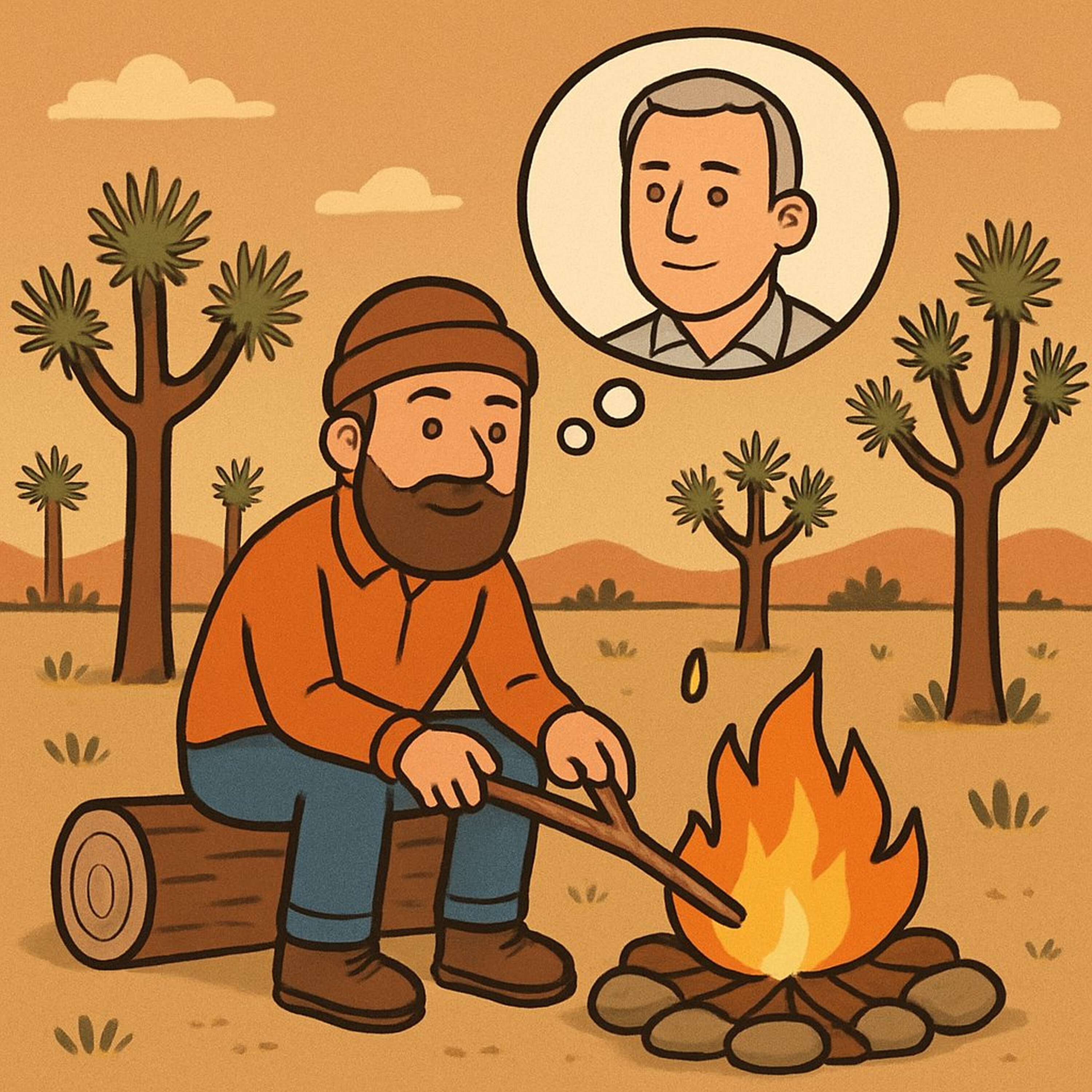
0:05:37 - (Chris Clarke): The other side Building a good fire is a matter of balance. Bright flames are cheery, but they're relatively cold. If your intent is to keep tolerably warm for quite a while, your fire can't be either too efficient or too wasteful. You've got to stack your firewood loosely enough that the air can flow through freely, but not too loosely. Each burning log heats the burning logs nearest it. If you have too much space between them, the fire will cool off.
0:06:17 - (Chris Clarke): Too little space between the logs and the oxygen starved fuel will keep its heat to itself. On a desert night like this, a cold1 in March 2005, I want to coax the fire to share every bit of warmth it can for as long as possible. For the tenth time this evening, I poke at my little campfire and think about my father. The cold drop of water hits the back of my neck, runs down inside my jacket. I turn, I scan the sky.
0:06:57 - (Chris Clarke): It takes a moment of looking away from the fire for my eyes to adjust to the night, for the sky to resolve into starry view behind the ghostly fire lit blooms of the Joshua trees that are all around me. The moon hangs low above the western horizon. It's a thin crescent, not quite bright enough to wash out the stars. And above me there's a small dark hole in the sky moving eastward. It's a rain cloud, a tiny one, and it has thrown a droplet with uncanny accuracy at the spot on me most guaranteed to raise shivers.
0:07:39 - (Chris Clarke): Another minute and the cloud passes out of sight behind Kessler Peak. I turn back to my little fire. I nudge a blazing log sort of distractedly with my hatchet. I remember watching my father do the same thing. It rained a little last night.
0:08:03 - (Chris Clarke): I slept out. And though it never rained hard enough to wake me up, I did get up before dawn and found half a dozen plugs of ice in my hair where rain had hit and then frozen. Tonight the sky is clearer and without its blanket of clouds, the desert is colder. By sunset, little after 6pm I'd already put on a thermal shirt and jacket and now I sit really close to the fire. My knees are too warm, the nape of my neck is too cold.
0:08:36 - (Chris Clarke): According to the law of averages, I tell myself I am therefore completely comfortable. Sadly, I don't find my argument persuasive. Maybe a little moving around will warm me up, stoke my inner fires a little bit and get the oxygen flowing through them. I hoist myself out of my folding camp chair and I trudge over to look at a Joshua tree covered in bloom. Its flowers seem to shimmer against the wind.
0:09:06 - (Chris Clarke): I'm glad it's not raining. The desert's been drenched the last few months. The experts are already calling the rainy season of 04 and 05 the wettest in Southern California history. In August, a flash flood roared down Furnace Creek in Death Valley, killing two people and ripping out the road, which as of this March has not yet been reopened. And at Zabriskie Point, the flood picked up two 24-ton concrete outbuildings and moved them 200ft downhill.
0:09:41 - (Chris Clarke): That was merely a dramatic summer prequel to the season just now ended. The Mojave got five times its usual ration of winter rain. Underground rivers came to the surface. Washes burbled with water. Dry lakes filled. In January, I stood at Badwater in Death Valley, 282ft below sea level, lowest spot in North America, and a gigantic sheet of water lay before me. It was a ghost of Pleistocene Lake, manly two feet deep across miles of valley floor.
0:10:20 - (Chris Clarke): I stood at the bottom of Death Valley, one of the driest, hottest places in the world, and I cursed myself for not having had the forethought to bring my kayak. The lakes have shrunk in the two months since. The land around them now is mantled in pale green. And here on Cima Dome in the Mojave National Preserve, the soil, which is usually barren between clumps of black brush and menadora, grows a garden of flowers in the making.
0:11:04 - (Chris Clarke): Little green leaves gather sunlight to make new generations of green leaves. The desert here already looks improbably lush. A month before the usual beginning of desert bloom season, and soon this place will blaze with color. Rain and freezing temperatures in January and February spur Joshua trees to bloom. In March, stalks emerge from the clusters of sharp leaves at the ends of the tree's branches.
0:11:32 - (Chris Clarke): These stalks look vaguely like fat asparagus spears about a foot and a half long, and from the sides of these stalks emerge subsidiary stems, at the end of each of which is a fat flower bud that will open into a pale white blossom about 2 inches wide. At first glance, each blossom resembles an orchid with three petals and three sepals. The flesh of these flowers is thick and waxy. It has a mild, soapy flavor that's only a slight hindrance to edibility.
0:12:05 - (Chris Clarke): I have battered and fried the blooms and eaten them happily. Joshua trees are monoecious, which means that an individual tree will produce both male and female blossoms. On occasion, one Joshua tree flower will possess both male and female parts. This is a condition botanists call perfect, which personally, I find rather enlightened. I watch tiny moths flit back and forth between the open flowers on this Joshua tree, and it's far too dark to see them clearly, and if I went to fetch the flashlight out of the truck to see them better, the white light would spook them.
0:12:46 - (Chris Clarke): They don't mind red light, and serious moth watchers cover their moth viewing torches with red cellophane. That's a basic camping essential that I have once again neglected to pack. It doesn't really matter. I know what the moths look like, and my mind fills in a few of the murky details for me. They are Joshua tree moths. Here on CimaDome, they'd be the eastern species Tegeticula antithetica, as opposed to the Tegeticula synthetica I found closer to LA.
0:13:18 - (Chris Clarke): They're whitish, sort of. Their wings kind of resemble those of dragonflies. Two pairs of elongated ovals. The longer ones in front of wingspan under an inch. The rearward margins of those wings have a fringe of tiny hairs. The moths crawl into and out of the flowers with purposeful determination. Sometimes they leave one flower and crawl into the next one. Sometimes they come to the lip of a flower and fly out of range of my night vision.
0:13:58 - (Chris Clarke): The top log on my fire collapses, its strength burned away. Yellow flames flare up briefly, then die down. My little fire turns red. It deepens 20ft away. I flip my collar up against the cold breeze and shiver, wonder if I should just let my fire go out. I'm ambivalent about night fires. They warm one, and on a night like this that's no small favor. But they keep my eyes and hands busy and distracted.
0:14:30 - (Chris Clarke): They blind me to the stars. They make a circle of not night in the desert, and they imprison my mind in that circle. The fact that we use fire distinguishes us from all the rest of nature. And at times it separates us from all the rest of nature as well. Over here, with my fire dying down, I feel the night seeping into me. The stars grow in brilliance as the moon arcs toward Teutonia Peak. Out in the open desert, somewhere between me and that moon, a coyote yodels its traditional folk song at the stars.
0:15:13 - (Chris Clarke): Another one a half mile behind me or so responds in kind. And then a third. For a long moment, my desert night is filled with song. And then the moment is over. I wait a long time for an encore. When it becomes clear after the moon sets that no encore is coming, I walk back to my dying fire and almost automatically, almost out of duty, place more wood on it. In 10 seconds it's ablaze. I wasn't born a desert rat.
0:16:41 - (Chris Clarke): I grew up in the wet country east of the Great Lakes, where summers brought rain that actually hit the ground and then rose back up into the air as humidity and mosquitoes. I spent my first two decades living among pin oaks and silver maples, every untended plot of land a green wall, the forest soil spongy, sodden mass shot through with moss and fungal threads and salamanders, the view in every direction blocked by a profusion of leaf and branch.
0:17:14 - (Chris Clarke): Now and then someone would cut down one of those trees and saw it into cordwood and then sell the wood to my father, who would set it on fire. Tonight my fire is made of pinyon and juniper and they're clean. Scented smoke smudges my mind like burning sage. Back then, as I studied my father, placing each new log on the half-burnt remnants of its companions. The smoke that followed me around the fire was deeper, its secrets better hidden.
0:17:49 - (Chris Clarke): Even then, the upstate New York landscape seemed claustrophobic to me. Second and third growth forest turned inward and brooding, as if suffering from generational trauma. My father's campfires put out a moist smoke tanged with fungal woodland notes that hinted at old unremembered pain. Quiet questions I soon knew better than to ask. I left New York at age 22 and hitchhiked west and woke one morning in northern Nevada.
0:18:22 - (Chris Clarke): The emptiness of the desert landscape completely unnerved me. The landscape seemed unadorned and ugly, and yet I couldn't tear my eyes off the far hills. Everything was out in the open there. Any secrets the sagebrush might have held seemed small and subtle. In time, the northeastern forests of my youth seemed stultifying, overgrown and choked. My allegiance had shifted. I had adapted to the West's open terrain.
0:18:56 - (Chris Clarke): Still, put me in front of a western campfire and I'm transported back into a cloud of that older smoke, sitting once again by older fires back east. My father would poke at the fire in resolute wordlessness, adjusting his precise fuel placement by increment. For the first 15 years of my life, I started fireside conversations that went nowhere. My father met each question, each statement either with a dismissive sounding sentence or with complete silence, leaving me feeling that I just said something stupid.
0:19:37 - (Chris Clarke): Eventually I began to feel as though my saying anything was a disappointment of his expectations of silence. These days I know that was wrong. These days I know his silence masked old hurt that it really had nothing to do with me. I realize now how well he meant, how adrift he felt in a talkative world. His eldest son and campfire apprentice growing out of his paternal worship, his marriage to my mother slowly crumbling.
0:20:11 - (Chris Clarke): I'm much older now than he was then, and now I get it. Back then I blamed myself for the awkward silences. They made my heart shrivel. I never doubted his love for me, just his respect. One afternoon on a bluff above the St. Lawrence river, my father gathered kindling for that night's fire and I was 9 or 10 years old. I found a path leading beguilingly into the woods. And not looking forward to the next hours of silence, I announced I was going for a walk.
0:20:46 - (Chris Clarke): My father brought me up short with some anger. I wasn't going anywhere, he said. The woods are dangerous for unchaperoned children. He told me a story, vague and seemingly half remembered, about two boys who'd gone out for a walk in the woods near his father's farm. And they got lost, he told me, and when they were found, they were dead. The story, no more than five sentences long, had an immediate and permanent effect on me, and predictably, that effect was the exact opposite of the one my father had intended.
0:21:22 - (Chris Clarke): I was persuaded that the forest was a thrilling place. I gave my father 20 minutes to lose interest in what I was doing and walked nonchalantly up the path into the woods. I spent subsequent decades doing the same thing, hoping that my old life would end and a new one begin among the trees. After a moth pollinates the Joshua tree flower, that flower slowly develops into fruit. At the same time, the one or sometimes two eggs the moth lays in each flower develop into moth larvae.
0:22:03 - (Chris Clarke): They'll eat a few of the seeds before they emerge and drop to the ground, then bury themselves in the soil awaiting a future bloom of Joshua trees to emerge as adults and continue the cycle. The process is a matter of balance. A Joshua tree will shed a flower if the moth has laid too many eggs in it, or if the moth hasn't packed enough pollen into the flower, or if too much of that pollen came from the same tree, which increases the risk of inbred seedlings.
0:22:36 - (Chris Clarke): If not for developing Joshua tree fruit, the new generation of moths would have nothing to eat. If not for moths to pollinate the flowers, no new Joshua trees would be born. One by one, each generation makes its way into the forest. Each generation fades in turn in favor of the one that follows, a link in a braided chain stretching back to the dawn of life. And each generation bears the mark of those generations that came before.
0:23:13 - (Chris Clarke): More talkative than my father by an order of magnitude, I still inherit from him his tolerance of days long silences, his ability to let important things go unsaid. I fight it in myself. I conscientiously tell people I love them. I try to return friends phone calls. Within a few weeks I deliberately strike up conversations with complete strangers. And still I find I'm not fully at ease until I need not talk to anyone, until I'm sitting alone for long dark hours among the Joshua trees.
0:23:52 - (Chris Clarke): The forest calls me and I'm unsettled until I answer it until I head toward yet another little fire like tonight's driven to it like a moth to. Well, you know. Dawn will break in a few hours, and I look forward to another day of walking in the Joshua Tree forest. The desert floor here fills more each day with green. I'm already looking past the end of this visit and planning the next one. Two weeks from now, a month with all the winter rain, 2005 will certainly be a killer year for desert blooms.
0:24:38 - (Chris Clarke): Call it unfinished business if you like. Call it wish fulfillment. It's the basic lesson of modern biology, all of evolutionary theory summarized Trace the lines of ancestry of any two living things back far enough and you find a common ancestor. The eastern and western Joshua tree moth species share an ancestor perhaps 15,000 years ago. Their mutual ancestry line diverged from mine 590 million years ago.
0:25:13 - (Chris Clarke): If you go back another 400 million years before that, the Joshua Trees line of ancestry converges with ours. And thus, when I speak of the kinship of all life, I do not intend metaphor. The moths. The coyotes. The pack rat now watching me from across the fire. The owl swifting past on silent wings. The trees presiding quietly above us all. We are related. We are kin. It's the family I've always longed for and I cherish my place in it.
0:25:59 - (Chris Clarke): Sitting among my kin in quiet contentment now and then, posing the Joshua trees questions they never answer.
0:26:11 - (Chris Clarke): And that about wraps up this episode of 90 Miles from Needles the Desert Protection Podcast. Again, I want to thank Bridget and Laura for donating to our Chihuahuan Desert Travel Fund at 90 miles from needles.com elpaso I also want to thank Jim Clarke for being the best dad I've ever had. That may seem like a sidelong slam, but it's the kind of humor he appreciates. Guess there's a reason they call it dad jokes.
0:26:49 - (Chris Clarke): Thanks as well to Joe Geoffrey, our voiceover person, and Martin Mancha, who created our podcast logo. Thanks to our Nature Sounds recordist Fred Bell, who doesn't appear in this episode but will in the next one. Our theme song, Moody Western, is by Brightside Studio. Other music in this episode is via premiumbeat.com look for more information on our Tucson and El Paso trip in the next episode. We've been having a frustrating time trying to put together a Tucson event.
0:27:25 - (Chris Clarke): Had a really promising location that turned out to be just a gigantic runaround. It's a shame because it's a restaurant I really like, but we'll work something out and in El Paso we know for sure that I will be at the El Paso Zoo along with a bunch of other admirers of the Chihuahuan desert on September 27, Saturday starting at 10:30am for the Chihuahuan Desert Fiesta. Hope to see you there. These are troubling times.
0:27:56 - (Chris Clarke): They just keep getting more troubling. And while we work to protect the vulnerable in our society, human and otherwise, let's just remember to breathe and to be thankful for the good friends that we have and the relations that we have. Family is complicated. My family is no exception. But for the last 65 years and a few months, I've been privileged to be in the orbit of Jim Clarke.
0:28:24 - (Chris Clarke): And I'm just honestly overcome with emotion at saying that. So let's let me get to that. And y' all be good to the desert. Be good to each other. Remember to hydrate. We'll talk soon. Bye now.
0:28:47 - (Joe Geoffrey): 90 miles from Needles is a production of the Desert Advocacy Media Network.